
April 2026 has become one of the most volatile periods for crypto security since 2025. The ecosystem has been battered by over a dozen significant attacks and exploits, primarily targeting the DeFi sector. Notable victims include KelpDAO, Drift Protocol, and several others suffering from critical bugs. This wave of incidents has highlighted systemic vulnerabilities, making it one of the worst months on record for total value lost (TVL) due to malicious activities.
Last week, Litecoin (LTC) faced a major operational challenge. An attack exploited operational vulnerabilities rather than the core protocol, causing transaction anomalies and a concrete risk of double-spending. To mitigate the damage, the network underwent a 13-block reorganization (reorg), effectively rewriting the most recent part of the blockchain. Despite this significant intervention, the market reaction has been surprisingly calm.
Resilient Performance: LTC Remains Green
Currently trading at $55 USDT, Litecoin is showing remarkable resilience, maintaining a +2.69% gain for the month of April. While other protocols have seen their tokens collapse following security breaches, LTC's price stability suggests that investors view the reorg as a successful defensive maneuver rather than a failure of the network's integrity.
Litecoin Monthly Overview: Responding to Crisis with Resilience
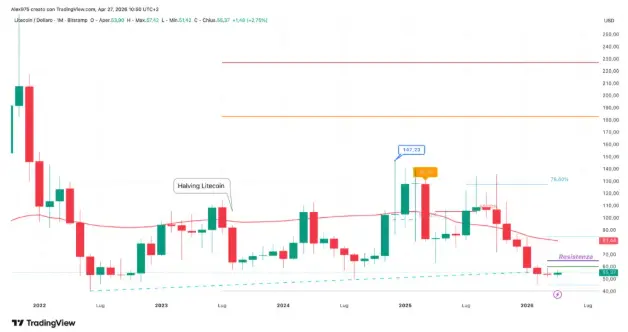
Litecoin remains a pillar of the Top 20, with a market capitalization of $4.27 billion. Looking at the monthly chart, LTC has undergone a protracted bearish phase since its ATH of $412 USDT in November 2021, eventually bottoming out at $40.33 in June 2022. From those lows, a recovery phase emerged, characterized by several swings that propelled the price to a relative peak of $147 in December 2024.
However, since September 2025, LTC entered a significant bearish leg, recording seven consecutive red months ending in March 2026. Despite this pressure, the February 2026 low of $45 USDT successfully held above the critical 2022 bottom, establishing a potential long-term double-bottom structure.
Weekly Analysis: Post-Flash Crash Recovery
Switching to the weekly timeframe, the focus shifts to the aftermath of the October 2025 flash crash. Before the crash, LTC was trading at a relative high of $130.6 USDT. The event saw an extraordinary 24-hour volatility range of nearly 50%, which tilted the primary trend and initiated a price contraction phase, leading LTC to close 2025 with a -25% loss. The current consolidation in the $55 zone represents the first real attempt to stabilize the trend after months of downward pressure.
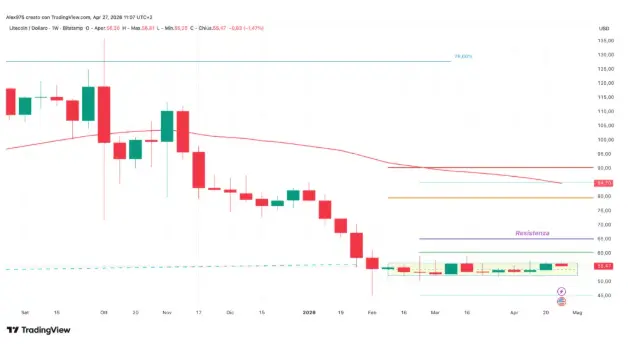
The beginning of 2026 was marked by a sharp bearish trend, with five consecutive red weeks leading to a yearly low of $45 USDT in February. Since hitting that floor, Litecoin (LTC) has entered a recovery phase followed by a prolonged sideways consolidation. As shown on the charts, the price is currently locked within a well-defined congestion zone, signaling a period of market indecision and potential accumulation.
Key Resistance Levels & Short-Term Outlook
For a definitive trend reversal, LTC must break out of its current congestion range. The primary technical hurdles are:
-
Vector Resistance: The first major obstacle sits at $60 USDT (representing the key retracement level of the annual high-to-low move).
-
Critical Resistance: The most significant supply zone is located at $65.30 USDT. On the daily timeframe, price action since March confirms that LTC remains bound within this consolidation bracket, awaiting a catalyst to trigger a breakout toward the upper resistance tiers.
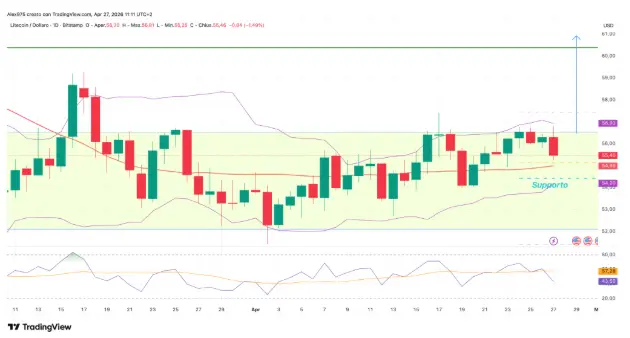
Litecoin is recording a -1.50% contraction today, drifting toward the first critical vector support at $55 USDT. This level is technically significant as it coincides with the 50-day Simple Moving Average (SMA 50), acting as a major dynamic floor. Below this, the primary structural support sits at $54.40 USDT. A failure to hold these levels could see LTC retreating toward the lower boundary of its current congestion zone.






