
The media spotlight firmly affixed on the NFT space of late has been unrelenting and incredibly exciting. It's fascinating to see television technology reporters, who know a bit about Bitcoin and less about Ethereum, attempt to explain the difference between an ERC721 & ERC1155 to the other reporters at the news desk who ask, live on the air, why can't people just print out the image they like on their printer instead of paying $69 million for it.
The discussions that are occurring on Twitter surrounding NFTs have been the most entertaining. This is the social media platform of choice for most crypto influencers and technologists. The reason is text-based discussions abound from influential users who are already on Twitter crafting tweets for their technology projects. While one would think Instagram would be perfectly suited for NFTs, and it is being utilized aggressively by many NFT artists, Twitter is still the platform of choice.
Computer science folks, blockchain engineers, entrepreneurs, we all love Elon Musk. For those who have not done a deep dive into the hours of hilarious and fascinating interviews that Elon Musk has done on Joe Rogan's podcast, one must understand Elon's sharp sense of humor that makes him an endlessly entertaining character.
Yes, he is the world's richest person, a real life "Tony Stark" from Iron Man, and his characteristic intellectual curiosity feeds his seemingly insatiable appetite to find macro solutions to problems: SpaceX, Tesla, The Boring Company, OpenAI, Zip2, X.com, and Neurolink. All while raising kids. Impressive.
He will also tweet often about Bitcoin, Ethereum, Dogecoin, and now, NFTs.
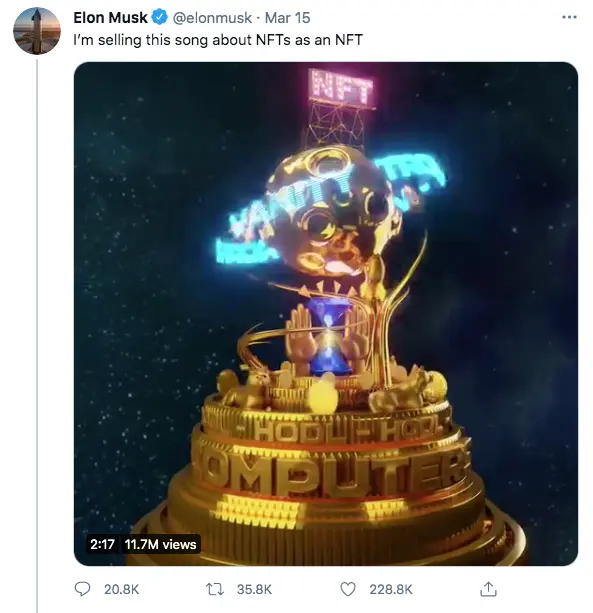
So this NFT speaks to, through the prism of Elon's humor, the perceived frivolity of the NFT marketplace. The NFT's song has an electronic dance music feel with the lyrics of "NFT, for your vanity" on repeat and "It's verified. It's guaranteed."
The visible display of such a trophy would unquestionably radiate vanity vibes. It's gaudy beyond belief, covered almost entirely in gold, precious stones, physical Bitcoins, and golden calfs. While I'm not an art critic, this is clearly religious iconography. The golden calf speaks to the Judeo-Christian story of Moses and the worship of idols. While Moses was on the mountaintop, his followers smelted gold to create a golden calf, evocative of the Egyptian deities from the land they had just left. Literature has made a golden calf synonymous with the unhealthy obsession with material things that come from a misguided focus away from the important aspects of a meaningful life.
The verified/guaranteed language just speaks to the underlying technology. An ERC721 is a cryptographic token that is non-fungible, not mutually interchangeable, and with metadata processed through a cryptographic hash function, a 40-character sequence that allows it to be verifiable. That's what's under the blockchain hood, but the "guaranteed" speaks to it as an investment, which is anything but guaranteed.
Unlike almost any industry, unfortunately, charlatans abound in crypto. Scams can be carried out often without a trace, with VPNs and Tor browsers leaving nary a breadcrumb for investigators to work with, creating increasingly emboldened cybercriminals.
This combining of the two terms speaks to how so many pseudo-technologists will enter the space and wrap absolute garbage behind the veil of some easily replicable technical construct or simply a fork, a literal copy of an existing project, and jump onto a Clubhouse app VC room and demand an 8-figure valuation without work history, an executive team, employees, or a willingness to even provide the type of verification necessary to borrow a book at the library.
While so many serious artists bristle at the hint that they may have an inflated sense of self or are the leader in their own self-congratulatory parade, Beeple, characteristically, embraces the good fun. This is the same type of self-effacing humor that he heaps upon himself when interviewed about his brilliance and lofty standing among the broader artistic community.

Elon has long been poking fun at the cryptocurrency ecosystem with Dogecoin memes. The project was founded by a meme of a Shiba Inu dog and was done more as a joke, but, irregardless, the crypto community has rallied around this project for its lack of pretension, inexpensive gas fees, and ubiquity across exchanges.
Often it can cost upwards of $100 to pay an exchange withdrawal fee in Bitcoin or Ethereum. With Doge, it's typically 1 to 5 doge, which--until Elon began tweeting his Doge memes, was $0.001. Paying 1/10 of a penny is far more palatable of a bite than $100.
In the ClubHouse app interview Elon did with Vladimir Tenev of Robinhood a few week, however, he reiterated that his perceived pumping of Doge was all tongue-and-cheek and that Musk-ites that believe that everything he touches turns to gold need to pump the breaks on their FOMO or "Fear of Missing Out" on Dogecoin that was pushing the coin into the stratosphere. Up to 125x and 101x leverage on platforms like Binance and FTX also did much to rocket the coin up to the $0.05 price it stands at today, despite its lofty valuation and supply.
News outlets have published that this humorous back-and-forth was actually a sale. The reports I'm getting are that this was all in good fun and this follow-up image by Beeple keeps the humor rolling.
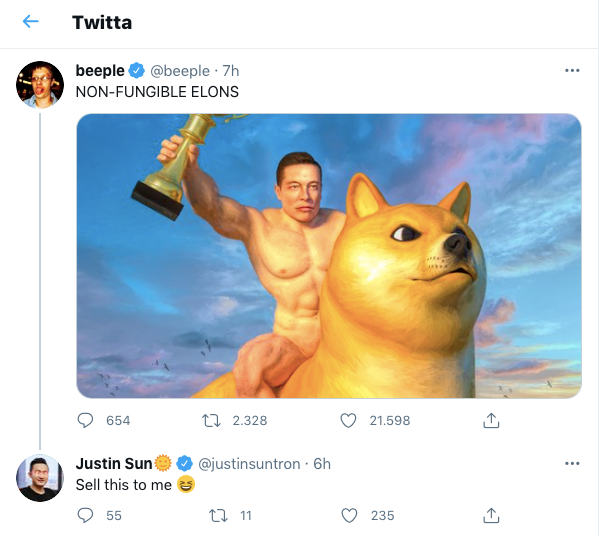
While Beeple and Elon don't take themselves too seriously, for artists who are striving to be self-sufficient, this NFT movement is of the utmost seriousness and tantalizing. We're now beginning to see hugely important artists, long the darlings of Sotheby's and Christie's, entering the NFT space. The most recent heavyweight: Damien Hirst.
Hirst is notable for his shark under glass piece entitled the The Kingdom, fetching £9,561,250 and, appropriately, The Golden Calf, fetching £10,345,250.

The overlap between the contemporary art and NFT market is clearly evident, and, as such, it's no surprise that contemporary artists such as Hirst are scrambling to make a timely and opportune splash and leverage their impressive auction sales history into some sizzle and sales for their NFTs.
While it's fun to marvel at brand-name artists making a mint and the eye-popping numbers at the top of the market, it's far more exciting, for me, to see artists who were relegated to churning out exceptional ebook covers for $25 a pop now seeing some of their NFTs going for $2500, finally more appropriately rewarding the digital art skills they've been honing and perfecting for years.
The inelasticity of art has always been the outlier for economics when compartmentalizing asset classes, and it continues to be difficult to assign a cold, hard asset value on a work of art, across any of the movements. It's that rarity and societal appreciation that acts as the fundamental value indicator, as well as recent auction records for a work of similar size, medium, and subject-matter.
As society begins to see the shift in favor of NFTs as a legitimized member of the art community, as opposed to a novelty, so too will NFT-specific digital art take its place as an art movement unto itself.






