
How does the FOMO effect affect Bitcoin?
In times of stimulus satiation, we have long since become accustomed to the massive input that the media influence us on a daily basis. Nevertheless, or precisely because of this, we often feel that we are missing something important. We are constantly trying to keep up to date with the most important events in politics and business. At the same time, we do not want to lose touch with any of our social contacts and want to be informed about their events.
The urge to always be at the top of the information chain is usually stronger than reason. The FOMO effect often manifests itself in that we focus almost exclusively on one particular thing. Even if we know that this thing is not really going to change in the near future.
What is FOMO?
The term FOMO has become increasingly popular due to the rapid growth of social media. The term is also often used in connection with financial markets. FOMO (Fear of missing out) means something like "the fear of missing something" and is therefore self-explanatory. Especially the networking through the internet fires the FOMO effect enormously. But we can also perceive this effect in our daily social interaction with our fellow human beings. Driven by the addiction to updates, many people lose sight of their surroundings and lose themselves in their smartphones and social media apps. Behavioral researchers have therefore long since called the FOMO effect a serious risk with a high addiction potential.
How does the fear of missing something arise?
Information acquisition is a rudimentary process in humans and immediately essential for survival. The better you can filter and utilize information from your environment, the higher is your chance of survival. Therefore this process has been anchored in our brain since time immemorial.
Even if nowadays survival itself no longer depends on it, it can still have a decisive influence on the quality of life. Because it can often pay off to know about events before anyone else. Conversely, not knowing about certain events can have a significant disadvantage. This is the case in many financial markets, for example.
Signs and symptoms of FOMO
Anyone trading Bitcoin or similar financial instruments is automatically at risk of being affected by the FOMO effect. Because you always want to make a good trade and close the position with a profit. This increases the desire to be constantly informed about the current price. However, the risk of making the wrong decision by an ill-considered or hasty reaction also increases. If you go looking for opinions and price predictions on the Internet, you will always come across different forecasts. This quickly creates a negative feeling if you have the impression that everyone is profiting from the current price and you yourself are left empty-handed. Anyone who then also quickly becomes impatient, uncertain and nervous is probably already affected by the FOMO effect. Another sign is that you want to tell your friends and colleagues about your successes and failures. In addition, it is difficult for those affected to concentrate on the essentials and even while eating and driving, the focus is on gathering information.
What influence does the FOMO effect have on the Bitcoin price?
Bitcoin is basically a product that is regulated by price and demand. The higher the demand increases, the higher the price will adjust and vice versa. Now we can assume that the market is monitored by the participants around the clock. Every change in the price is immediately picked up and interpreted by them, followed by a positioning. Every trader on the market tries to find an optimal entry point for himself. The more people find an entry at the same time, the higher the demand and the higher the price. And the higher the price rises, the more people want to find an entry to profit from the price increase. They are guided by the fear of missing the price increase and try to place themselves quickly on the market. This creates a direct interaction between the FOMO effect and the price trend.
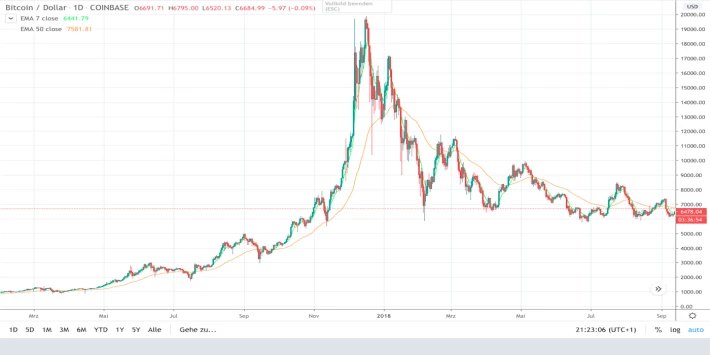
Bitcoin had its highest level so far in 2017 and in the period between October and December the value of the digital currency quintupled from 4000 US dollars to 20,000 US dollars. Due to the rapid rise and the associated FOMO effect, more and more market participants wanted to profit from the strong growth and quickly joined in. However, within a month the price corrected back to 7,000 US dollars and many investors were annoyed by the high level of entry.
How can you use the FOMO effect for yourself?
The best way to benefit from the FOMO Effect is to avoid being influenced by it yourself. In the best case, you have already positioned yourself before the hype about a price increase sets in. That's why investors should keep an eye on the market to be able to react quickly. If an unusually strong rise has already become apparent in the price trend, it's usually too late and the entry point has already been missed. The better you can estimate how much a project could trigger the FOMO effect in other participants, the better your chances of an early placement. Good indicators of the FOMO effect are positive news and statements, as well as announcements and events.
However, you should always try to assess the current situation as rationally as possible. Because even if you may not notice it right away, you may already have fallen victim to the FOMO effect. Moreover, the emotions of market participants are only a limited indicator of rising or falling prices.
CFDs are best suited for short-term trading, as they do not require a wallet and a trade can be concluded immediately. CFDs can also be used to bet on falling prices and therefore offer more opportunities. One of the best known providers in this area is the broker eToro . There, trading with leverage is also possible in order to profit from small price fluctuations.
John McAfee: The FOMO guarantor
One of the most famous personalities in the field of cryptocurrencies is the entrepreneur John McAfee. Especially his achievements in the areas of anti-virus software and computer security have earned him worldwide renown and an enormous following. As a result, McAfee sometimes used his influence on his fans. He presented several projects and crypto-currencies via the platform Twitter, which often led to immediate price increases. Some traders recognized the potential and therefore followed the tweets around the clock. As soon as McAfee introduced a new project, they speculated on the subsequent FOMO effect and covered their bets before the other followers and latecomers.
The opposite of FOMO?
Especially when it comes to your own finances, you should never be guided by hasty decisions. Even if a project is experiencing hype, no one knows how long it will last. Often the rates fall faster than they have risen and you regret the short-term entry. For this reason one should adopt the characteristics of JOMO (Joy of missing out). Because just as it can be a fear not to be there, it can also be a relief to miss out on certain things. This saves nerves, time and often money.
The FOMO effect can also occur when prices fall. One could describe this behaviour as the fear of not getting out in time (Fear of not getting out). It is precisely this behaviour of market participants that often triggers drastic price slumps. If prices fall slightly, this can lead to a chain reaction and thus drag other investors down with it. Often a slight drop in the current price is enough to trigger the FONGO effect and the price plummets to the bottom. Thus, similar to the self-fulfilling prophecy, it is a psychological phenomenon that strongly influences the price due to the emotions in the market. Even if no other factors would speak for a decline in the price. However, the mere indication that there could be a loss is enough for investors to want to take their deposits out of the market as quickly as possible and thus cause the price to collapse in the first place.

Long-term consequences of permanent stress
The urge to constantly enrich oneself with new information represents an enormous burden for the body. Because the brain has to continuously select between useful and nonuseful information. Always with the thought in the back of my mind of missing something important. Thus the body produces stress hormones, such as adrenaline and cortisol, which are supposed to spur on to stronger performances. The consequences are imbalance, severe restlessness, irritability and insomnia. If the body is now continuously exposed to such conditions, at some point it can no longer meet the high demands and capitulates. The diagnosis is then often burnout and depression. Too much workload and high pressure are often cited as the primary causes of such illnesses, but inconspicuous things are often behind them. For example, treatment would rarely be based on the fear of missing something. For this reason, one should act early for the sake of health, if corresponding symptoms occur.
Conclusion: emotions are not good indicators
Even though the FOMO effect can lead to success in exceptional cases, the risk is usually higher and the strain on the body is not worth the effort. In most cases it is pure luck or coincidence if one attributes the success for a successful trade to one's own emotions. The gut feeling is just a feeling and is not based on any fundamental data that can be used for price analysis. Likewise, it often turns out to be the wrong decision to chase after hype when it is already at its peak.
Please feel free to tell us about your experiences with the FOMO effect in the comments. What tricks and tips do you give the readers of Blockchainwelt to limit their actions according to emotions?






