It is thought that the most important thing for everyone to pay attention to today is that at 22:00 p.m. US Federal Reserve Chairman Jerome Powell spoke at the annual meeting of the Jackson Hole Global Central Bank. The content of his speech mainly focused on the statement of US monetary policy, especially the data on the September interest rate hike and the statement of the federal funds rate before the end of the year. So far, the Fed's September rate hike is focused on the possibility of 50 basis points and 75 basis points, while the Fed funds rate is from 3.5% to 4%. Most commentators are predicting Powell's likely statement will be somewhat more hawkish. After all, at a time when there is no evidence that inflation in the US will abate to less than 4% by the end of the year, and when the Fed still wants to achieve lower inflation mainly by suppressing the economy, markets, and US stocks in particular, seem to be fighting the Fed, so keeping markets low may well be a priority for the Fed. Recent speeches by Fed officials suggest this. So the personal view of Powell's speech this evening is that he will still make anti-inflation his top priority, and will certainly "insist" that the Fed does not move before inflation falls to 2%, while warning markets against being too optimistic about Fed action. Second, Powell will not give a direct answer to the September rate hike data. The Fed, which has abandoned forward guidance, now needs the data more. Relatively speaking, it is the Fed funds rate that is the most important point until the end of the year. If the neutral rate of 3.4% is maintained, September must be the Fed's last big rate hike of the year (provided inflation does not reverse the trend). As was introduced yesterday, market speculation has now shifted from anticipating a September rate hike to anticipating the Fed's last high rate hike, which will moderate after September. If the Fed were to raise the year-end federal funds rate, even a 4% increase would be a turning point in September. The November and December rate hikes would be expected to be 50 basis points and 25 basis points, but September and October would be relatively difficult. But, either way, as long as inflation does not continue to rise, the most difficult year of 2022 will surely pass as interest-rate hikes abate, and risk markets should not be far off the mark, if not bottom. Judging from the risk market's mood, there will always be some risk-averse early shift of chips to the stock exchanges before the macro mood may change. In particular, judging from the current rate-hike forecast, the 50 basis-point hike forecast for September is already below 40%, and the market is forecasting more Powell hawks, so the mood may be a little more nervous before today's conclusion.
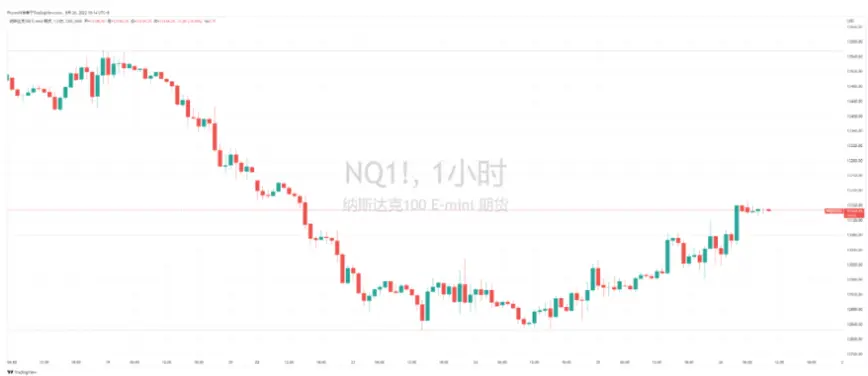
The Nasdaq futures are also in a narrow downward trend after hours, and would have been more likely to open lower if they had been falling when US stocks opened. And if the index can turn positive, the chances of a high opening increase when it opens naturally. In particular, in the absence of any clear information, the correlation between the currency market and the NASDAQ has remained close.
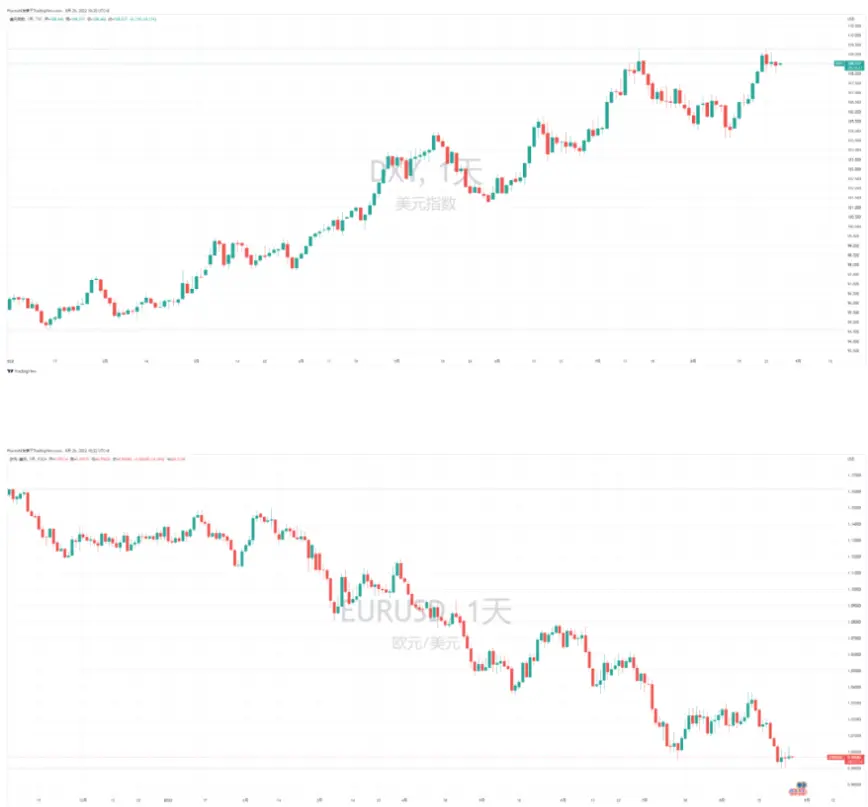
And, financially, the dollar index is stuck at around 108. But talk of a peak in the dollar index continues, even though momentum has been lost, especially since interest-rate hikes in the eurozone will at least provide an expected short-term pick-up in euro-zone prices. The peak in the dollar index, and the expectation of a bottom in the risk markets, gives money alternatives to Treasuries.
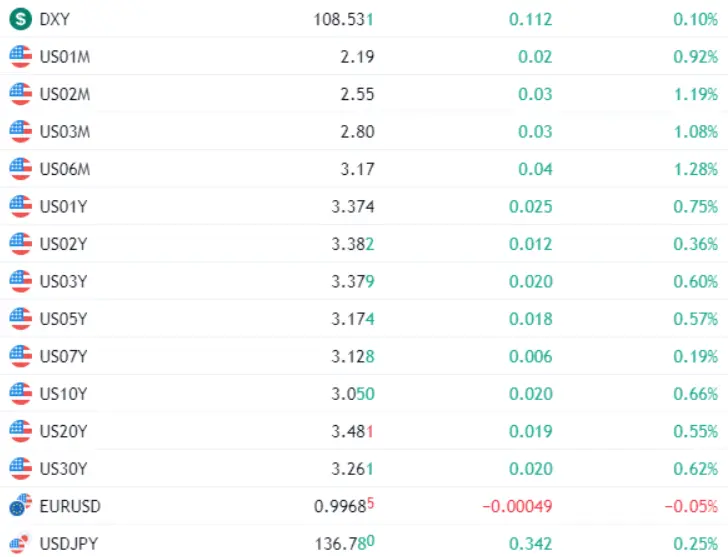
And judging from the current data of U.S. Treasury bonds, with the exception of one month's continuous buying of U.S. Treasury bonds, there are signs of capital outflow in other periods. And one month's U.S. Treasury bonds haven't even outperformed the current federal funds rate. Moreover, one-year short-term U.S. Treasury bonds are now nearly two to three years or longer all the time high, but the market is not buying at all. On the contrary, more capital is leaving the U.S. Treasury market.
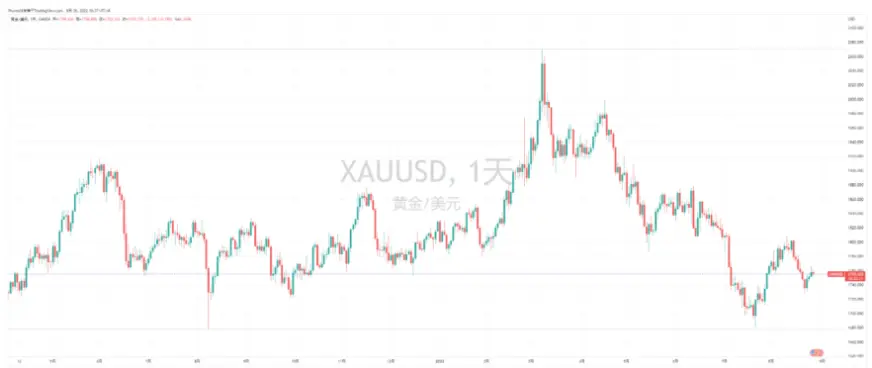
There is no clear conclusion as to where and where the investors' money will go, and whether they will enter the risk market. But there is no sign of a large amount of money entering gold. The current price of gold is only around USD 1,750. But if September turns out to be the month the economists expect, the risk markets will surely see more outside money, and the currency market will be a relative gain.
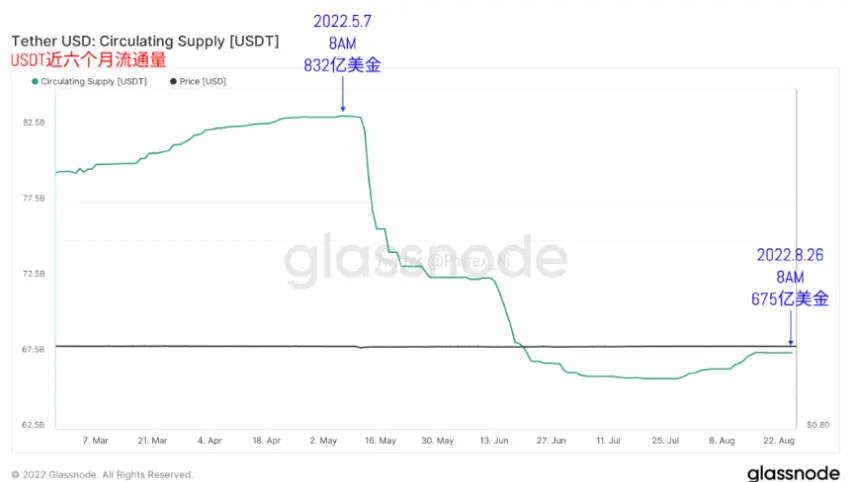
But as things stand, there is no sign that the Treasury overflow is flooding into the currency market. USDT, the main deal maker, did see a rebound in market value after it was shorted. But by Aug. 16, USDT's market value had ground to a halt, and USDT's predominantly European and Asian use means that outside money in both markets is holding its breath. And USDC's market value is gradually regressing from its increased share of shorting USDT. Receiver BUSD's market value is growing at a rapid clip, so it would be a mistake for some analysts to suggest that USDC's decline represents a major U.S. funding shortfall that is not only an indicator of U.S. funding, but also a sign of weakness. Because this Tornado incident was not nice enough to be decentralized. But it is a safeguard for U.S. institutions and investors who expect more compliance. No one wants their money to be easily laundered away from the market if stolen, so more money is leaving because of emotional discontent and a resistance to censorship. That's why it moved from USDC to BUSD, which is also U.S.-compliant, even though some of its investors may not be Americans, let alone U.S. institutions. DAI's continued performance is representative of a gradual shift away from the circular arbitrage of spot ETH, which is part of investors' non-long-term bullishness on ETH prices. The comparison of the four main stablecoins shows that there is no sign of external capital entering the market, and the exchange rate changes in the USDC and USDT have made arbitrage much more difficult, so the increase in the stablecoin's market value depends on the positive effects of macro sentiment. However, on the other hand, while there has been no significant increase in the market value of the stablecoin, there has also been no significant decrease, meaning that the stock of money in the current market remains bullish about the next move in the currency market, as has been shown previously, and even now the market value of USDT and USDC is enough to support the BTC and ETH to reach their highs in 2021. So outside money is just attitude. Looking back at the amount of capital transferred in, we can see that as of 8:00 this morning, USDT's purchasing power had increased in a relatively large scale. However, based on a detailed analysis, the amount of capital in stock on the Exchange has directly increased by more than $500 million, which means that most of the capital transferred into the Exchange does not necessarily translate into purchasing power, but is stored on the Exchange. The actual purchasing power is only more than $400 million, which is higher than it was a few days ago, but it is also limited.
Meanwhile, the USDT fluctuations in the chain were checked, and there was no additional increase, so the initial assessment cannot rule out the possibility of a change in the base call money after Powell's speech tonight. And in terms of time, it happened at 23:20 last night, probably European money. The last time this happened was at 23:20 p.m. on July 13, 2021, Beijing time, after the release of the June CPI. And, unlike USDT, USDC transfers have continued to fall, again hitting the lowest USDC weekday purchasing power in nearly half the year, which was more than half the money spent on weekends in the first half. This is a measure of the continuing weakness of domestic money in the United States, and of how far domestic interest in digital currencies has declined. From the details, it can be found that in the main holding time of US investors, the holding of BTC money holders is continuing to decline. Especially as of 8 am this morning, it can be seen that the holding of US trading time zone is already the lowest in nearly half a year, down nearly 7% compared with the same period last year. Moreover, from the perspective of price trends, the main US trading time zone prices in the last week were also mainly down. The same data for Europe's dominant trading time zone shows that although open interest also declined, it increased significantly relative to the same period of the year. And from price trends, although BTC prices in the most recent week were also down, this trend moderated, and it was more due to the crossover between the dominant time zones in the United States and Europe. In fact, the European timezone is fine independently of purchasing power and price trends. The dominant trading time zone in Asia is largely driven by Europe, but less by the United States, as it overlaps with Europe, and thus shows both positioning and BTC price movements are positive in the dominant trading time zone in Asia. But in fact, it's still more because of the European data, and more because of the money and purchasing power flows, it's still concentrated around 15 p.m. every day. Because tonight's annual meeting of the Jackson Hole Global Central Bank is an important event that may change the current macro sentiment, the early transfer of more chips to exchanges before major events happened again. Judging from the selling pressure data of BTC and ETH as of 8:00 a.m. this morning, it is indeed the largest amount of selling pressure during the week that has been transferred to the exchanges. This is more of a risk aversion event, but it does not rule out some chips leaving early. And from the same period of exchange cash withdrawal data, although selling pressure or say that the risk aversion into the exchange is stronger, but the exchange cash out of the data is stronger, not only BTC has maintained a consistent strong purchasing power, even ETH shows strong purchasing sentiment, which is bound to the upcoming merger of ETH, after all, in 2022 the only visible benefit is the ETH merger event. So, based on the current macro sentiment, the trend of capital flow and the flow of BTC and ETH, before this evening's meeting, there will still not be much change, and prices will still be volatile. But it would still be better to reduce leverage, given that there is still data such as the core PCE at 20:30 ahead of the meeting, and expectations including the core PCE are good, so be more careful of passive divestments in both directions. On the emotional side, there has been a shift. The BTC, which has been shifting between the long and the short, is now more emotionally bullish, if not more so. On the other hand, although the ETH is still widely bearish, there is also a tendency to alleviate. It should be a little bullish game, and from the perspective of the expected leverage ratio, it is still high leverage, and it is better to reduce leverage, otherwise the risk is very large.





