Although three Federal Reserve officials came out to speak last night, it's clear that the tone was still somewhat hawkish, especially since Mr. Williams of FOMC has two points to note. First, he thinks the terminal rate is above 3.5%, which is itself not a problem. But it reveals that even the aggressive Fed isn't planning to raise the federal funds rate above 4%, which means the pressure on 4% will be intense. Although three Federal Reserve officials came out to speak last night, it's clear that the tone was still somewhat hawkish, especially since Mr. Williams of FOMC has two points to note. First, he thinks the terminal rate is above 3.5%, which is itself not a problem. But it reveals that even the aggressive Fed isn't planning to raise the federal funds rate above 4%, which means the pressure on 4% will be intense.
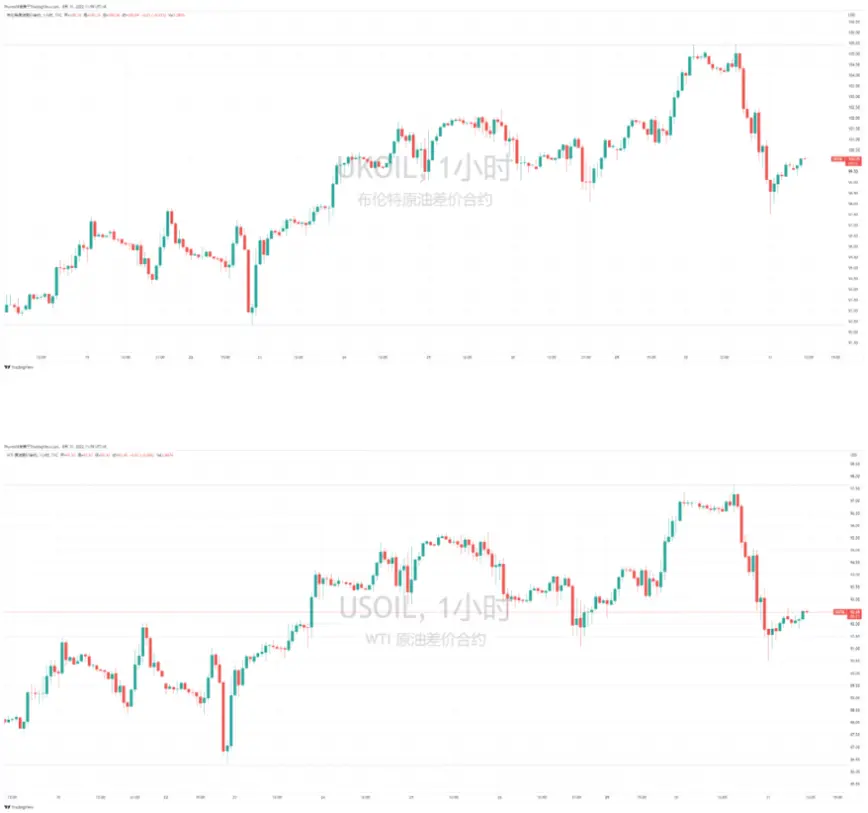
Of course, the key point is still on the CPI. Today is the last day of August. Although oil prices began to rise after the middle of the month, and yesterday afternoon US Oil almost exceeded USD 100, with the release of one piece of news, the prices of both oil started to fall at the same time, and until now. This is because SOMO, Iraq's national oil marketing agency, is prepared to increase its oil exports to Europe. This behavior brought significant relief to European and US oil prices, which fell. Therefore, looking at the oil price throughout August, the average price has still dropped by about 10 US dollars, the contribution to CPI should be able to reduce by about 0.3% to 0.4%, and the price of used cars has also dropped, which is also helpful to the August CPI data. Of course, not all inflation is falling; housing costs, for example, are now rising, not falling, which would be a drag on the CPI data. And the service sector is not pretty. But overall, the August CPI is more likely to fall than it was in July. And another non-farm number from the White House may not be ideal, and the non-farm numbers are not expected to be average. A fall in non-farm numbers is not necessarily bad for risk markets. Because the Fed is holding out for a high rate hike in anticipation that there is no recession in US stocks, and because the non-farm data for July were very strong. But when August's non-farm data, if it is truly disappointing, is a sign that the US economy is going to be in trouble, whether the Fed likes to admit it or not, the Fed's options are even more limited. So it is clear that non-farm households provide a ceiling on the Fed's rate increases, while CPI provides a floor on the Fed's rate increases.
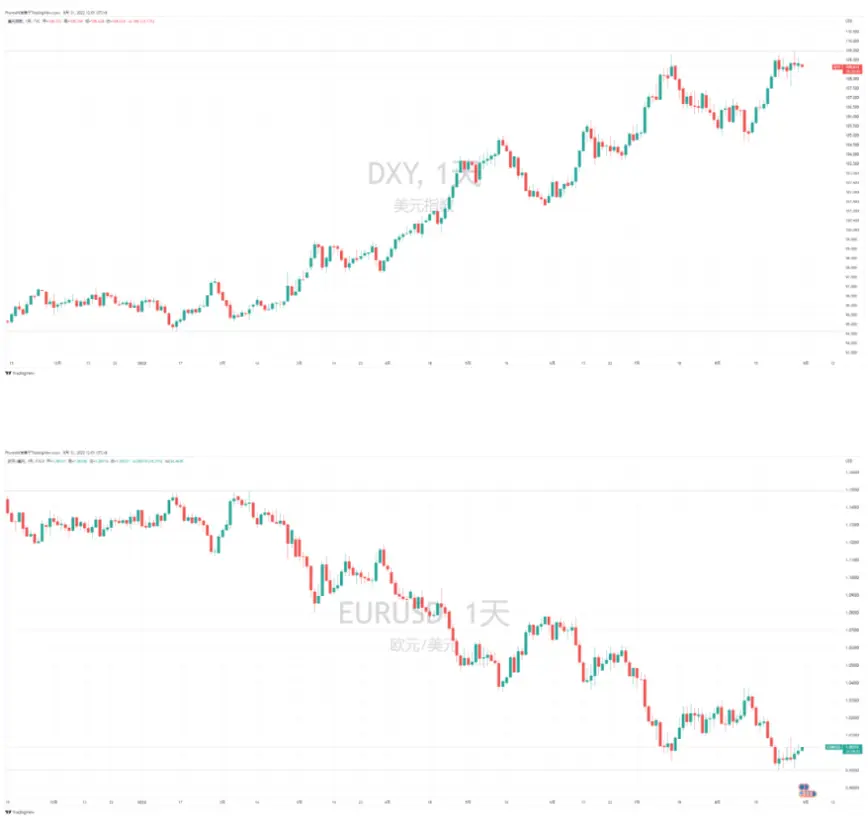
Another is the data of the dollar index. In anticipation of the euro raising interest rates, the euro exchange rate is once again back above 1. After all, the peak of the US rate hike is relatively over, and the rate hike in the euro area is just beginning. Therefore, from the perspective of the dollar index peaking in September or October at most, and then the DXY will gradually decline as the euro area raises interest rates, which is also a favorable factor for risk markets.
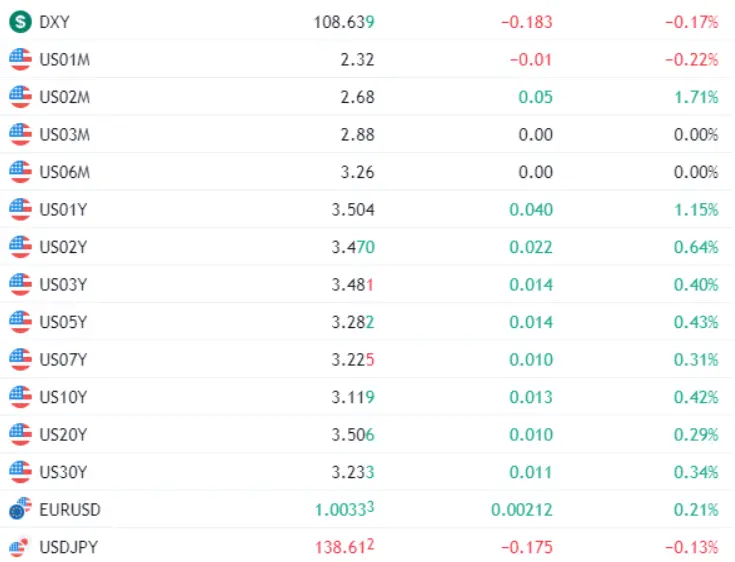
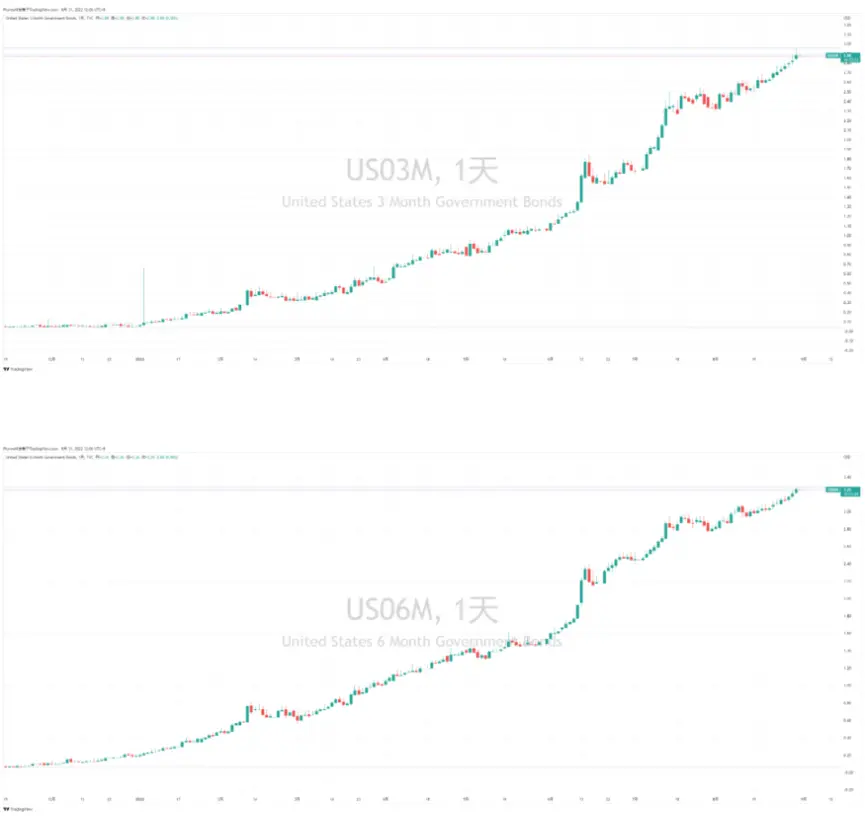
The only big headache is Treasuries. As things stand, U.S. Treasury bonds remain a major source of capital outflows; even three-month and six-month U.S. Treasuries, which first started trading on Monday, are priced in the secondary market as well as the primary market. Short, medium, and long-term U.S. Treasury yields are trending upward, in addition to the January issue and any slight willingness to buy, in a significant indication of Americans' expectations of a U.S. recession.
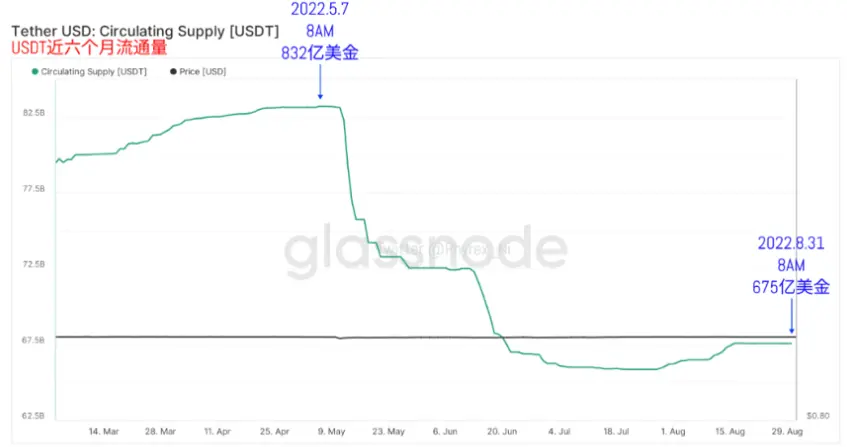
Where the money is leaving Treasuries has also been a concern, although there is no clear indication from the current signs, including that neither the risk markets nor the precious metals have been large buyers recently. According to USDT's market value, the Europeans and Asians as the major users have not changed in market value, either increased or decreased, especially after the Tether audit, indicating that the market is more wait-and-see. USDC, which was affected by the TornDao incident in the recent past, looks to be at an end to the impact, with no further signs of market sell-offs, and as of this morning the overall market value may even have increased by around $50 million, while the BUSD, which gained in the USDC incident, still has an infusion of around $100 million. ETH's spot leverage was increasing in terms of the size of the DAI market, and although it only increased by about $8 million, it could be seen that some of the holders thought that the current price was a relative bottom, opening up the arbitrage mode of the spot leverage. In terms of the overall market value of stable currencies, although the price and sentiment of the whole industry are not very high, there is no sign that funds have left the market by a large margin. On the contrary, they are increasing. But from a purchasing power point of view, there is another problem. As of 8:00 a.m. this morning, the data that USDT transferred to the Exchange shows that the purchasing power is still at a low level. This shows that under the current macro sentiment, the market is relatively pessimistic and capital is mainly wait-and-see. On the other hand, it also shows that the circulation volume of the entire currency market is decreasing. The circulation volume represents both selling pressure and withdrawal from the Exchange. When the data switch to the BTC transfer into the exchange of selling pressure and transfer out of the withdrawal of data can be seen, not only did not reduce selling pressure but also a larger increase, and the corresponding transfer from the exchange has also been a significant increase, and even the exchange of BTC turnover has not small upward, so relatively, the limited funds should be more concentrated in the BTC and ETH. Other ALTs are more likely to experience a shortage of funds. And from the ETH exchange selling pressure and cash data, although price changes lead to more chips in the market for the exit, the relative amount of withdrawals is also very alarming, after all for the entire current currency market, the merger of ETH is the only epic event in 2022, for the money circle and even traditional financial markets are bound to bring new changes. Even from the exchange's ETH stock, the lowest stock in nearly four years was refreshed, even without further signs of significant chips being moved off the exchange. Therefore, judging from the current situation, the outbreak of ETH is not impossible. However, there is still a need to wait and see cautiously. After all, the recent impact of the Nasdaq on the currency market has been verified by the facts. And the Nasdaq is inextricably linked to macro sentiment. From the current situation of the Nasdaq futures, since 1 a.m., the Nasdaq period, which has been in a downward position, has once again shown signs of rebound. In the pre-market, it has already been in a rising state. And the reactions of ETH and BTC are also in a timely manner. We can directly see the upward channel which started from 1 a.m. Therefore, neither the BTC nor the ETH is divorced from the influence of the Nasdaq, nor is it out of a separate market, still following the Nasdaq. PS: My line is simply to see the picture more convenient, there is no price guide meaning. And I can't draw just to be clearer. From the current BTC and ETH position sentiment, we have to admit that the BTC investors turn to be faster, when the BTC has an upward trend, it has been gradually converted from a large area of bearish, and even has been relatively ahead of the bullish, while the ETH investors are more iron, prices are also empty, price increases are still empty, and from the perspective of expected leverage ratio, high-rate leverage should not be the hedging of the spot. So, looking at the overall situation right now, the Fed's expectations for the economy have weakened considerably as a result of lower non-farm data released by the White House, so recent Fed official statements have not stressed that there will be no recession. This, too, is dampening for the Fed's subsequent interest-rate hike, so the market's interpretation is favorable, and the Nasdaq is responding gradually, but with caution and reduced leverage





