Current Summary:
Weekends are ordinary weekends, and until the macro situation changes, it's not just the weekends, it's even the weekdays that are the same, and the implication is that this will change next Wednesday, and while it's not a direct macro change, the emotional change when the CPI data comes out is likely to be the catalyst. The fear chips are either on the exchange or on their way there. So the closer to Wednesday, the more likely it is that selling pressure will increase but trading volumes will weaken. Leaving before Wednesday isn't such a bad idea. It's been nearly two months since prices have been fluctuating at that level, but more investors are hoping to bet against a fall in CPI, given that the August rate hike was only due in September.
Then there must be articles to guide it, and if the CPI continues to rise, as I have read on Space, it may not be bad for medium-term market movements, but there must be panic selling in the short term. After all, the US president is likely to be hit hardest by the rise in CPI. After all, the CPI showed a 75-percent increase in June, and the market was able to rebound, thanks to the president's "June data are not referential, and July data have dropped."
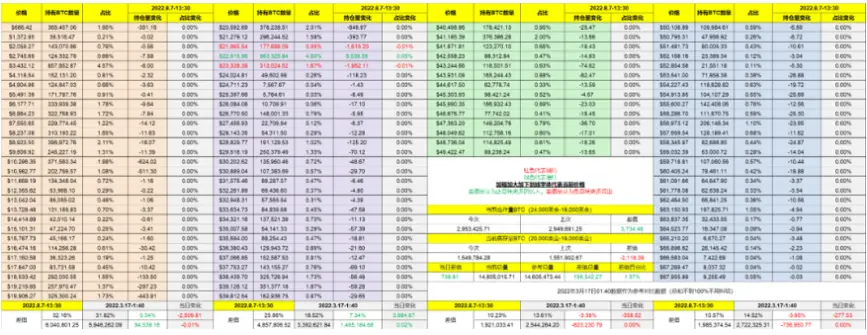
As of 13:30 p.m. today, BTC position price distribution, from 22:00 p.m. yesterday to the present BTC chain data can be clearly seen, although the data obtained a lot of time, but the BTC chain address changes have not increased significantly, the volatility of the unit time is almost the same, this also represents the true response of retail BTC holders over the weekend, there is no purchasing power and no desire to sell. Based on the extreme prices on both sides, the B.T.C. for Younggo holdings is slightly more volatile, and it's out of the range for usual suspects. It's still a low base, so it's hard to tell whether that's exchange interaction or the user's behavior, but neither is going to have an impact on the way things are going. The emptiest interpretation is that the early money-making chips are turning away, fearing that the coming CPI data will be too bad. The major reduction was from a $10,000 range.
The high-backed BTCs have been much calmer than the profit-taking chips, especially in the last two weeks, both on weekdays and holidays, when the high-backed BTCs have shown a lukewarm reaction. Even the overall loss-making chips down the $24,000 mark have been the same, with just less than 1,500 BTC changes in address, not even as much as the long-held chips. Interesting, yes, even around the time of the rate hike announcement, or around the time of the core PCE announcement.
Or perhaps around the time the core PCE was announced, the $24,000 loss-making BTC was cooling down. That was lying flat, the swings were too long, the volatility was too narrow, the leverage was too high, and there was a game of chance, and it was fashionable for physical holders to sit back and watch the Fed perform. Even the price of the current dispute has been accumulating gradually, breaking through historical highs. Yesterday's forecast was for a new high on Monday. As a result, the amount of BTCs piled up by 22,000 US dollars in today's midday data already exceeded the amount of USD 3,000 piled up, realizing the largest single-price stock, 863,325 BTCs, exceeding the USD 3,000 stock of more than 5,000. Of course, this is not to say that it will fall any time soon, or that it will not fall if the stakes are so high. In fact, from the historical data, we can see that too much accumulation is a boost to the upward trend, is to build the bottom. But the downside is selling pressure, it's panicking. The $3,000 can accumulate this amount of chips and remain at the top for more than a half-cycle because the $3,000 is at the bottom, and the bottom's profit chips are always at the bottom, which makes the BTC holders nervous and in no hurry to leave, but that accumulation of $40,000 has occurred, and $30,000 has occurred. Over the weekend, the fluctuation of the overall BTC chain is already at extremely low level. It is not significant to look at the transfer in and out of exchanges and the change of funds. Then let's take a look at the changes in the overall holding time of BTC and ETH during the week. As in the past, a short-term stake is a stake held for less than half a year, while a long-term stake is a stake held for more than half a year.
From the data can be seen more obvious, in addition to the exchange's hot wallet will have chips in, although short-term chips may also show signs of selling, but more positions within a month of BTC has chosen to hold on, or even positions increased by a ladder. And BTC sales, which had been pushing large positions for three to six months, have fallen sharply, suggesting that macro expectations have given these holders considerable confidence. For long-term holders, as in our previous analysis, not only do price changes leave them unaffected, but even macro changes have little impact on them. Even if the actual position with the most moves is one to two years, it can also be seen as BTC risk aversion with a position cost of around $10,000, consistent with the changes in the long-term position data that we have above. And finally after a week of comparison, as of 8:00 a.m. this morning's data can be seen, long-term BTC holdings accounted for 75.478% of the total circulation, up from 75.447% at the beginning of the month, and long-term holdings of chips increased by 0.033%. More BTCs are moving in the direction of long-term holders.
Compared with BTC, ETH data can be circled. Although the price of ETH is hyped because of merger and bifurcation factors, we can see through the actual data comparison that the short-term chips of "buying the bottom" within a month can really take hold. After all, the price has a lot of increase. Not only the chips are not obviously sold but they are still piling up. However, the position of ETH in one month to six months has been greatly reduced. But this reduction is associated with a rise in ETH from six months to two years. It is difficult to tell, however, whether or not a large reduction is occurring as the ETH from one month to three months accumulates. For long-term holdings, ETH from two to seven years is also a major component of the decline, and although some of these holdings are on exchanges, this does not preclude the inclusion of long-term holders' leaving.
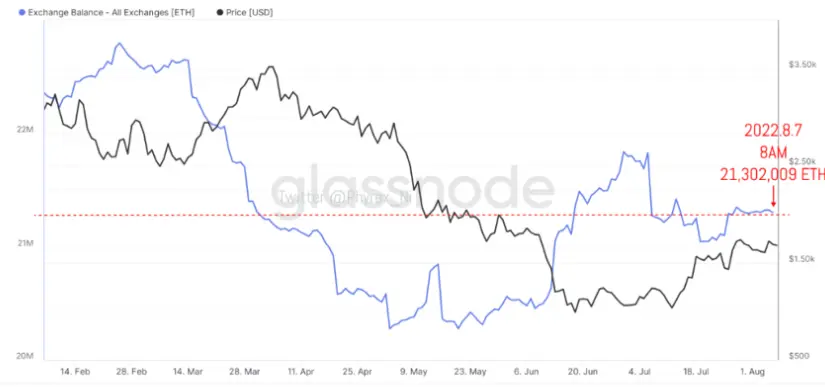
Combined with the last week's ETH stock exchange, because the stock is almost at the level, almost half of this reduction in holdings is from the exchange's withdrawals, and the other half should come from the selling pressure of long-term holders. However, the final figures show that as of 8:00 this morning, ETH held by holders accounted for 70.008% of the total circulation, up from 69.113% at the beginning of the month, an increase of 0.895%, and more ETH is moving towards long-term holding.





