
Hello friends once again here.
Today we will talk a bit about the subject of Elliott and its theory of WAVES.
First of all, it should be noted that Elliott's Wave Theory is not a simple concept, and it takes time to understand it and even more to apply it, but we will walk with its simplest and most basic part to understand what it is about and how it works.
Without further ado, let's begin.
Ralph Nelson Elliott discovered in 1934 that the price action shown on the charts, rather than behaving in a somewhat chaotic manner, was actually presenting an intrinsic narrative.
That is to say, that the markets do not move randomly, but have a certain logic, moving with certain rules and that is what he determined, he basically said that the markets have two phases: a bullish phase and a bearish phase, and that will form a cycle.
Each cycle has two movements that will be made up of eight waves of which 5 are waves that are in favor of the main trend, (1, 3, 5 impulse waves / 2.4 corrective waves)
and three other waves A, B, C (A, C impulse waves / B corrective wave) that are against the main trend, corrective waves.
In the following chart it is clear to us how this cycle is composed.
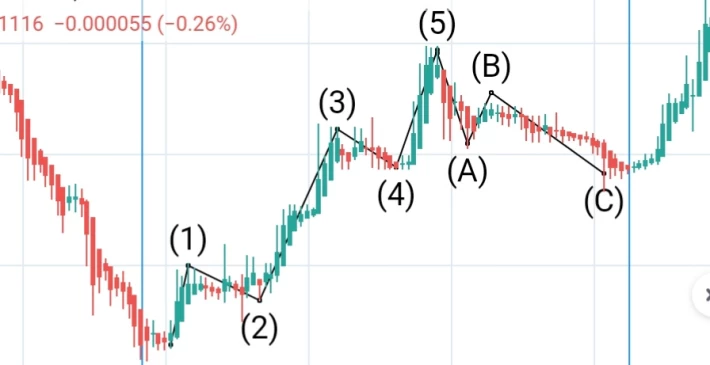
So far, the theory has become clear, now we are going to get into each of the waves and try to describe them.
Wave 1: "reversal"
It is not considered as an important wave, because it happens that we come from a bearish phase, in this case investors do not feel totally confident that the trend is changing, investors are cautious and measured by that, this wave is not so extensive , then comes wave 2, which is the first corrective wave.
Wave 2: "unbelieve"
In this phase a movement is going to take place, the investors who took this asset at the beginning see that it is time to take profit and exit, that is why this correction movement is going to take place.
But it happens that in the markets there is always supply and demand that compete with each other, and since we have an upward trend, in this case the demand will win, those who are seeing that the trend is really changing will win, here comes the wave 3.
Wave 3: "public participation"
The characteristic of wave 3, is that it is the most important, it is the one with the largest extension, here prices will grow and also the volume of operations, and most investors will begin to confirm that the trend is really changing, and that we are already in the presence of an upward trend, confidence, optimism will increase, then wave 4 occurs.
Wave 4: "sudden surprise"
This corrective wave is a confusing wave, it is difficult to identify, prices are going to be quite volatile.
Finally we have wave 5.
Wave 5: "market boil"
It is the last impulse wave, and the characteristic of this wave 5, is that it will not be much greater, but this is where all the investors or all the people who are just starting, the newbies, who are guided by the emotions, those who get carried away by the social media and all those old news.
So those investors will start buying here, and who are they going to sell in this movement? precisely, investors who follow a reality, who have an investment strategy and who entered the beginning of this upward trend.
Here we will have a large volume of operations but prices will not rise as much, there will come a time when prices will be ironed, that is what is called the distribution phase, a market bath.
Here begins The downtrend which is made up of three ABC waves.
Wave A: "panic phase"
It is difficult to detect this wave because we continue with the optimism of the upward trend, and here where we should be most cautious, we have to identify this movement as accurately as possible using our analysis tools.
Wave B: "large recovery"
It is the corrective wave in this case, because we are in the downtrend, here we will notice that our trading indicators will give us overbought signals, that is to say that the prices are well above what they are really worth, then we will begin to realize that the trend is already beginning to come to an end and this is definitely a trend reversal.
Wave C: "discourage and distress selling"
It is destructive, it is the wave where prices drop a lot, and why this happens, because at this moment not only the investors who bought at the beginning of this bullish movement sell, but also those who entered wave five, who were optimistic that prices were growing and that now they are realizing that prices are not going to grow anymore, so that's where the panic occurs, where the supply is practically massive and the demand is almost neutralized, here the prices fall so abruptly.
Look at the chart as the uptrend went step by step, forming longer, and in longer time frames, and notice how fast a decline occurs, a downtrend almost giving us no time to do anything.
Prices go up by stairs and down by elevator, so it is very important to know all the tools to be able to enter at the right time and leave with the greatest possible benefit.
That is the journey in which we live Elliott's Theory, now we conclude with these rules that we must consider when we undertake this theory.
*Wave 2 cannot correct more than 100% of Wave 1.
* Wave 3 can never be the shortest of the impulsive waves (1,3 and 5)
* Wave 4 can never fall below the maximum of Wave 2.
Well, I hope this article has been useful, greetings to all.






