
In the deep ocean of the crypto markets, the biggest players are starting to change course. Why, Whom, What and When!
Big Whales. Big wallets. Big moves. And when they move, it is rarely random. Think of a huge ship turning. It looks slow, but once it points somewhere, the rest of the boats notice.
Lately the turn is clear: whales are taking some chips off Bitcoin and rotating into two altcoins. Not to cash out to dollars. To chase more upside while the cycle expands. That is normal in a bull market. It is not bearish for BTC. It is how smart money climbs the risk ladder.
First, the whale mindset in one minute
Let’s keep it simple, amigo. Whales are not guessing. They build a plan and then add risk step by step.
-
Start with BTC as the macro anchor.
-
Add ETH when liquidity spreads and the market wakes up. It is the easy way to ride more activity while earning a little yield.
-
Pick a fast execution chain for real users and payments, usually SOL when things get busy. That is where everyday swipes and new apps live.
-
Take profits on the way up. Send part back to BTC and stables when charts go vertical and your group chats get noisy.
Right now we are living between steps 2 and 3. That is why the big wallets are rotating.
Altcoin 1: Ethereum for yield and infrastructure
Why ETH? Think of Ethereum as the kitchen where most of crypto gets cooked. The base chain is the main kitchen in a good cevichería, clean, reliable, focused on quality. The rollups are the extra food stations that the chef opens on the sidewalk to serve faster when the line gets crazy. You still pay at the same restaurant, the flavors are the same, but the service flies.
That is Ethereum today. Most serious apps settle here, and the network now lets you earn a native staking yield while you wait for your order. It is like owning a small piece of the restaurant and getting a cut every busy lunch.
Another way to see it if you ride: BTC is the solid bike frame you trust on every route. ETH is the drivetrain that turns your energy into speed, and the L2s are the protected bike lanes that let you pass traffic without crashing into anything. Same ride, same destination, just smoother and faster.
This is why whales like ETH in this phase of the cycle. They want scale without juggling ten risky tokens. ETH gives you exposure to a lot of real activity, from DeFi and rollups to stablecoins and RWAs, and it pays you a steady yield that does not depend on hype.
When institutions need a second line after BTC, ETH is the clean, simple allocation.
What I watch
-
Usage that sticks on L2s, not just weekend spikes. Daily transactions, fees trending manageable, and TVL that moves but stays inside the same Ethereum umbrella.
-
Staking yield that remains sustainable. Fewer inflation tricks, more real fees shared with validators and stakers when the network is busy.
-
Institutional rails that keep opening the door. Better custody, clearer products, and compliance that lets big money buy ETH without headaches.
-
Developer shipping speed. If the chef keeps improving the kitchen and the side stations, the restaurant stays full.
ETH is not a bet on one trendy app. It is a bet on the whole food court, with a tip jar that pays you while people eat. If liquidity keeps expanding, Ethereum behaves like a market index that also earns yield, which is exactly the kind of position big wallets like to hold during the middle of a bull run.
Altcoin 2: Solana for speed and consumers
Why SOL? Because it feels instant. Think of Ethereum as the financial backbone in the back office, and Solana as the cashier where people actually pay. You open your phone, tap, and it goes through before the cashier blinks. That matters for stablecoin payments, tipping a creator, buying game items, or splitting a bill with friends.
If you like food analogies, SOL is the ceviche bar that serves in seconds. Fresh fish, quick squeeze of lime, plate on the table. No one wants to wait fifteen minutes for a small purchase. If you cycle, SOL is the protected bike lane on a busy avenue. Same city, same destination, but you flow past traffic while everyone else is stuck.
This is why whales pay attention. When real users arrive, the chain that handles thousands of tiny swipes with low fees usually heats up first.
What I watch
-
Daily active users that behave like a real consumer app, not a weekend spike. People paying, posting, and playing every day.
-
Stablecoin velocity on chain. More money moving at small ticket sizes means real life use, not just charts.
-
Ongoing performance work and client diversity that keep the network steady as it scales. Less downtime, more confidence for builders and merchants.
SOL is where everyday crypto feels like normal internet. If the cycle keeps expanding and stablecoin payments keep growing, this is the place where volume shows up first.
Is this bad for Bitcoin?
Short answer: no. BTC is still the cleanest collateral in crypto. When risk appetite grows, money explores ETH and SOL to chase more growth. Later, a chunk of those profits often comes back to BTC. Think of it like a fútbol season. BTC is the captain. ETH and SOL son los extremos rápidos que buscan el gol. Si el equipo marca, el crédito vuelve al capitán.
What would flip this view?
-
A big macro shock that dries up liquidity.
-
A serious security or stability incident on a major chain.
-
Rules that slow down staking or stablecoin rails.
If none of those hit, rotation is just the mid-cycle rhythm.
How I would play it, Copybiker style
Not financial advice, just a simple framework you can copy and adapt.
-
Keep a BTC core. That is your long-term conviction.
-
Size ETH as the yield plus infra bet.
-
Size SOL as the consumer execution bet.
-
Add only a few ecosystem plays around those two, time-boxed and with stop losses.
-
Pre-define take profits. Recycle into BTC and stables when narratives go vertical.
-
Write your rules before the pump. Stick to them during the pump.
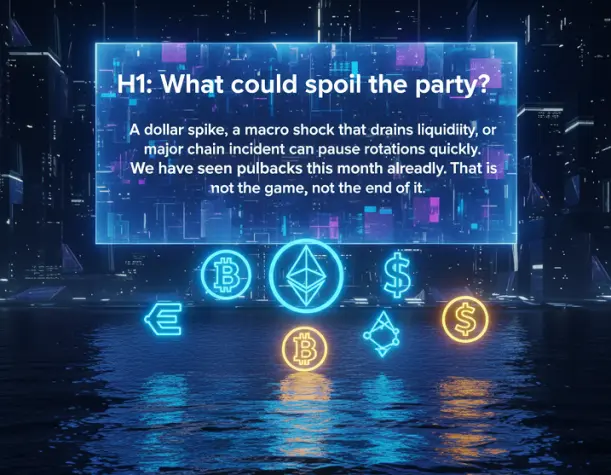
Risks that can break the thesis
-
Macro shock that drains liquidity across all risk assets.
-
A security or stability incident on a major chain.
-
Regulation that slows institutional access to staking or stablecoin rails.
The next 6 to 12 months, in plain words
Here is the simple read, crypto folk.
If liquidity keeps flowing and users keep transacting, money does not sit still. It rotates to where it can work harder.
Bitcoin
BTC stays the reserve everyone respects. Several desks still see upside over the next legs of the cycle. Bernstein, for example, kept a high-conviction path that could take BTC toward 200k by 2027 if the macro and policy tailwinds hold. That does not mean a straight line, just that the big picture remains constructive.
Ethereum
ETH looks like the market’s “dividend tech index.” As rollups cheapen and institutional access improves, Coinbase’s institutional team has been highlighting stronger demand signals like positive ETF flows and expanding stablecoin supply on Ethereum. That combination usually means more activity plus a tighter float for sellers. Some technicians even map a late-2025 range that pushes higher if momentum returns. Take price targets with a grain of salt, but the direction of travel is what matters.
Solana
SOL is where consumer speed shows. Research shops and asset managers keep publishing on Solana’s adoption story, from payments and stablecoins to RWA pilots. Franklin Templeton has written openly about the Solana rails, and independent ecosystem reviews show steady growth in users and throughput. If an ETF path shortens as some analysts suggest, that could add a new buyer base on rallies. None of this removes volatility, but it explains why whales like to have SOL exposure when retail activity heats up.
While the 'whales' conspire in the dark depths, don't let their orchestrated fear shake your resolve.
Hold strong. Don't panic sell.





