
000000000019d6689c085ae165831e934ff763ae46a2a6c172b3f1b60a8ce26f It is the hash of the first block of the Bitcoin chain, which had a secret message. Well, yesterday block 629999 was completed, which also had a hidden message.
��EThe Times 03/Jan/2009 Chancellor on brink of second bailout for banks
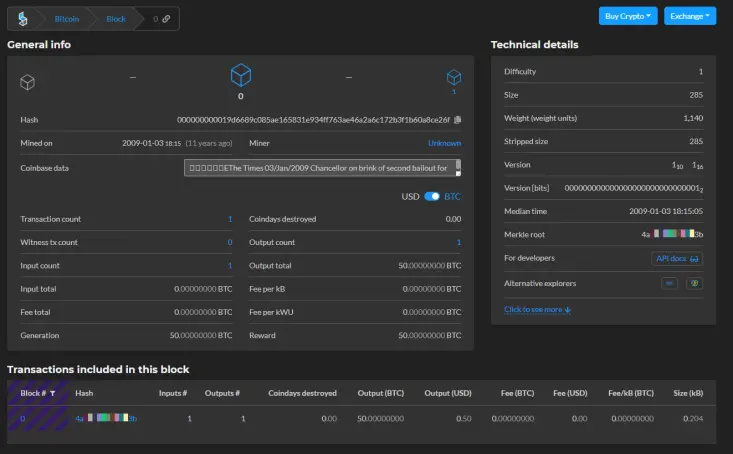
At this address you can enter and check it, apart if you did not know this website, because I already show it to you.
---Block 0---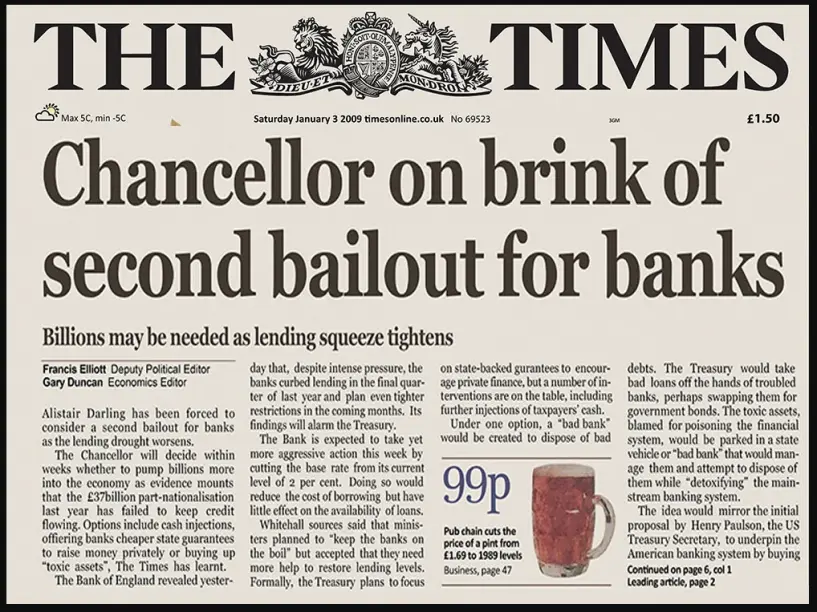
there you can see the hidden message of the mined block in block 629999, recalling that first mined block for which 50BTC was obtained
This message contain � R🐟NYTimes 09/Apr/2020 With $2.3T Injection, Fed's Plan Far Exceeds 2008 Rescue Mined �^H
 0000000000000000000d656be18bb095db1b23bd797266b0ac3ba720b1962b1e this is the hash of the penultimate block mined before halving, This is the hash of the penultimate block mined before halving. Today Halving was not news for traditional media.
---Block629999---
I think that this injection of dollars will be interesting for the crypto world, I think that the generations from the year 2000 onwards, will not want to work with traditional banks, seeing how they play with humanity, seeing how their parents had problems with them, their close relatives too, their neighbors too. I think they are a generation more linked to technology, more sensitive to the environment, more used to working digitally and streamlining bureaucratic procedures via the internet.
Now I am going to share the cryptoanarchist manifesto, by cypherpunks, which is always good to read from time to time.
by Eric HughesPrivacy is necessary for an open society in the electronic age. Privacy is not secrecy. A private matter is something one doesn't want the whole world to know, but a secret matter is something one doesn't want anybody to know. Privacy is the power to selectively reveal oneself to the world.
If two parties have some sort of dealings, then each has a memory of their interaction. Each party can speak about their own memory of this; how could anyone prevent it? One could pass laws against it, but the freedom of speech, even more than privacy, is fundamental to an open society; we seek not to restrict any speech at all. If many parties speak together in the same forum, each can speak to all the others and aggregate together knowledge about individuals and other parties. The power of electronic communications has enabled such group speech, and it will not go away merely because we might want it to.
Since we desire privacy, we must ensure that each party to a transaction have knowledge only of that which is directly necessary for that transaction. Since any information can be spoken of, we must ensure that we reveal as little as possible. In most cases personal identity is not salient. When I purchase a magazine at a store and hand cash to the clerk, there is no need to know who I am. When I ask my electronic mail provider to send and receive messages, my provider need not know to whom I am speaking or what I am saying or what others are saying to me; my provider only need know how to get the message there and how much I owe them in fees. When my identity is revealed by the underlying mechanism of the transaction, I have no privacy. I cannot here selectively reveal myself; I must always reveal myself.
Therefore, privacy in an open society requires anonymous transaction systems. Until now, cash has been the primary such system. An anonymous transaction system is not a secret transaction system. An anonymous system empowers individuals to reveal their identity when desired and only when desired; this is the essence of privacy.
Privacy in an open society also requires cryptography. If I say something, I want it heard only by those for whom I intend it. If the content of my speech is available to the world, I have no privacy. To encrypt is to indicate the desire for privacy, and to encrypt with weak cryptography is to indicate not too much desire for privacy. Furthermore, to reveal one's identity with assurance when the default is anonymity requires the cryptographic signature.
We cannot expect governments, corporations, or other large, faceless organizations to grant us privacy out of their beneficence. It is to their advantage to speak of us, and we should expect that they will speak. To try to prevent their speech is to fight against the realities of information. Information does not just want to be free, it longs to be free. Information expands to fill the available storage space. Information is Rumor's younger, stronger cousin; Information is fleeter of foot, has more eyes, knows more, and understands less than Rumor.
We must defend our own privacy if we expect to have any. We must come together and create systems which allow anonymous transactions to take place. People have been defending their own privacy for centuries with whispers, darkness, envelopes, closed doors, secret handshakes, and couriers. The technologies of the past did not allow for strong privacy, but electronic technologies do.
We the Cypherpunks are dedicated to building anonymous systems. We are defending our privacy with cryptography, with anonymous mail forwarding systems, with digital signatures, and with electronic money.
Cypherpunks write code. We know that someone has to write software to defend privacy, and since we can't get privacy unless we all do, we're going to write it. We publish our code so that our fellow Cypherpunks may practice and play with it. Our code is free for all to use, worldwide. We don't much care if you don't approve of the software we write. We know that software can't be destroyed and that a widely dispersed system can't be shut down.
Cypherpunks deplore regulations on cryptography, for encryption is fundamentally a private act. The act of encryption, in fact, removes information from the public realm. Even laws against cryptography reach only so far as a nation's border and the arm of its violence. Cryptography will ineluctably spread over the whole globe, and with it the anonymous transactions systems that it makes possible.
For privacy to be widespread it must be part of a social contract. People must come and together deploy these systems for the common good. Privacy only extends so far as the cooperation of one's fellows in society. We the Cypherpunks seek your questions and your concerns and hope we may engage you so that we do not deceive ourselves. We will not, however, be moved out of our course because some may disagree with our goals.
The Cypherpunks are actively engaged in making the networks safer for privacy. Let us proceed together apace.
Onward.
Eric Hughes <[email protected]>
9 March 1993
Bitcoin as a solution to the problems of monetary inflation in a globalized country with enormous world debt.
Sometimes I think that yes, this will work and other times I think that the 3 richest people in the world could buy the entire capitalization of cryptocurrencies, and it depresses me a little.
The cryptocurrency market is little larger than the silver commodity. Something bigger. I want us to have a democratic internet, that we can use it freely without being spied on by governments or by malicious people with unorthodox ends, nor by companies that sell our tastes and interests and build societies at their whim.
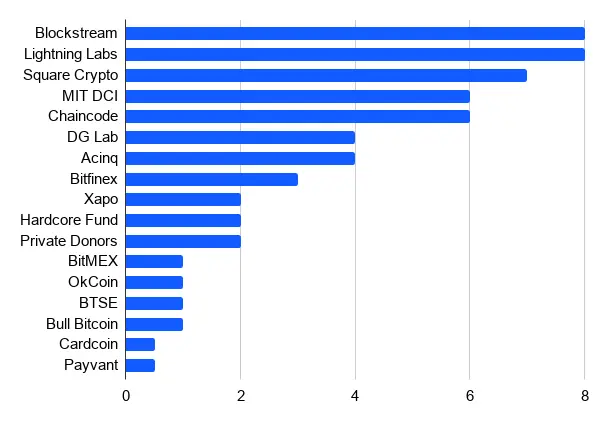
(Source: BitMEX Research)
Bitcoin Foundation Founding Members
- Gavin Andresen, Bitcoin Developer
- Peter Vessenes, CEO of CoinLab
- Charles Shrem, CEO of BitInstant
- Roger Ver, CEO of MemoryDealers
- Patrick Murck, Principal at Engage Legal
- Mark Karpeles, CEO of MtGox.com
- Satoshi Nakamoto, author of the white paper “Bitcoin: A Peer-to-Peer Electronic Cash System”
(Source: GitHub)
I only hope that at least all those companies that finance the development of bitcoin are decentralized as well, and if we are not lucky enough to do so, then unless there are many companies that finance the development so that it is not in the hands of one person. / company / corporation and at least their fate is discussed by various groups.
If you liked the article I invite you to subscribe and start following me so as not to miss any of my analyzes, ways to earn some tokens and learning, nor any of my traditional Spanish recipes, that I have a cooking blog !!! hehe
If you have reached this point I thank you for reading the article, if you have not read this far at least I hope you have left a tip to continue encouraging me to publish articles.
Cheers!!
--- klo ---






