
What are FIAT currencies?
FIAT currencies are currencies that are printed and backed by central banks.
The name FIAT comes from the Latin 'Fiat Lux et Lux Fuit', that is 'let there be light and there was light', to indicate the fact that if central banks decide to print money they simply print it.
But what is the basis of such a monetary system?
Before the 1970s each dollar corresponded to a certain amount of gold-the so-called gold system-but following the 1971 Nixon reform, the dollar was completely untied from what are the gold reserves. So the dollar - as well as the euro - are supported and guaranteed by the trust of central banks.
Regarding this banking system, there have been many criticisms about its effectiveness. First, the focus falls on the concept of "trust": why should we trust it? Secondly, while the honesty of the institutions is unquestionable, the inflationary model is really sustainable.
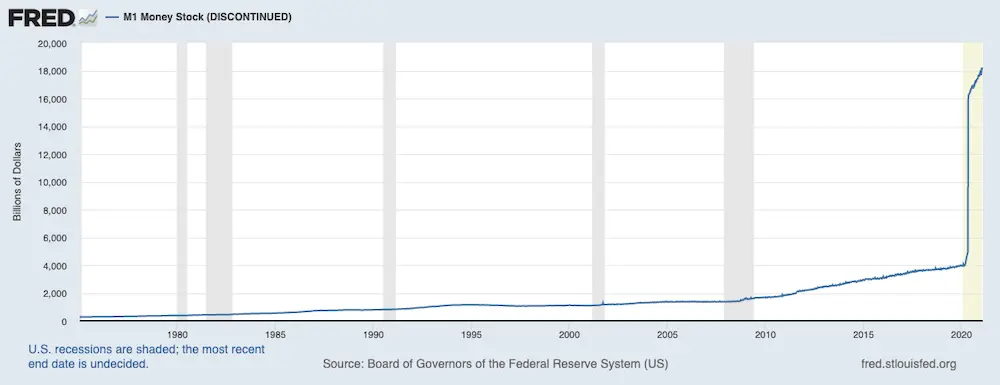
The onerous effect of inflation has been further accentuated during the pandemic crisis, which pushed the American central bank - the FED - to print more money in one year than it has ever printed in American history (and Europe is no different), thus increasing the money supply by about 5 trillion dollars.
Below we can see a graph showing the circulating dollar.
Bitcoin, on the other hand, is a completely different monetary system, based on 'Trustless' principles - as they say "trust is good, not trust is better".
Bitcoin solves the issue of trust issues by eliminating the middleman within a transaction through the use of a cryptography-based payment model.
Bitcoin is a first-of-its-kind, entirely peer-to-peer, i.e., user-to-user, version of electronic cash, which would allow online payments to be made without going through a banking intermediary, but the money would pass from the hands of user A to those of user B directly. Bitcoin accomplishes such a system through the use of digital signatures.
Basically, a user who wants to make a transaction will digitally sign the hash of that transaction, so that the user who receives the payment will be protected from any reconsideration by the sender.
Put another way, a user A claims to send an amount of 2 BTC to a user B and to confirm that transaction, he digitally signs it.
However a question may arise: how can B be sure that A really owns those BTC? How can he be sure that A has not already spent them?
Suppose A requests a service from B, and B requests as payment for that service 2 BTC; how can you be sure that the 2 BTC that A had has not already been spent?
This is known as a double-spending attack. In this attack, A uses a service without paying for it, and B offers a service without receiving any compensation.
An intuitive solution might be to introduce a central authority, a regulator, who knows all transactions that have taken place in the past and can decide whether a transaction is legitimate or not. But again in this case, the fate of the payment system will depend on one central entity, like a bank, without having a real advantage over the traditional system.
Satoshi Nakamoto, proposed a completely decentralized solution to the double spending attack: to use a consensus algorithm (i.e. to validate transactions, i.e. to decide if a transaction is legitimate or not) denoted as PoW (Proof of Work), used by a peer-to-peer network, where the nodes of the network that commit to perform the "proof of work" are called Miners.
References
- Bitcoin: A Peer-to-Peer Electronic Cash System, Satoshi Nakamoto.
- W. Dai, “b-money”, http://www.weidai.com/bmoney.txt , 1998.
- Fred Economic Research, https://fred.stlouisfed.org/graph/?g=eOpL&utm_campaign=myfred_referrer&utm_medium=exported-chart&utm_source=direct





