
Arbitrage trading, even if there is no guaranteed profit, is the closest thing you can get. It is a substantially low risk strategy, which attempts to take advantage of price differences between the various exchanges. A concrete example of arbitrage opportunities is the one that can be had with the slippage effect that liquidity pools suffer from.
In most occasions, arbitrage trading involves buying and selling the same asset (such as BTC or ETH) in different exchanges.
Precisely because it consists of a trade with relatively low risks, traders compete fiercely for the possibility to make similar trades.
Also here we find the universal law of the world of finance: "each operation is associated with a risk proportional to the profit". In fact, profits are generally small and depend heavily on the speed and volume of each trade. Therefore, arbitrage trading is often done by high frequency algorithms (HFT algorithms).
So the challenge for an arbitrator is not only to find price differences, but also to be able to trade them quickly. Moreover, since arbitrage operations are generally low risk, returns are generally low. This means that traders, besides acting quickly, need a lot of capital to make it worthwhile.
Types of arbitrage
In the crypto world we can distinguish some types of commonly used arbitrage. Here, we will talk about the two most common types.
1. Exchange Arbitrage
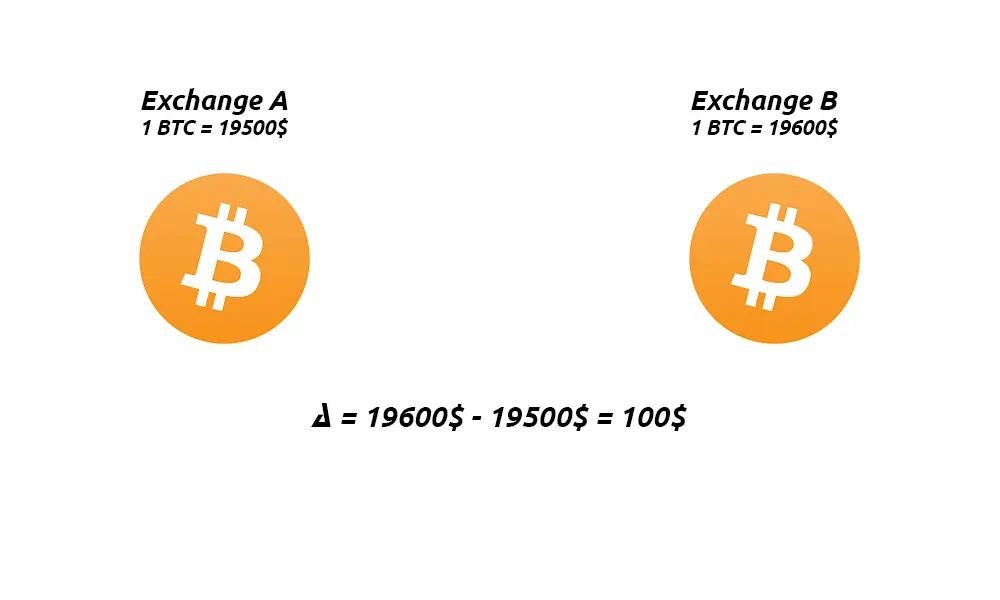
It is the most common type of arbitrage, it simply consists of buying a crypto in one exchange and selling it in another.
The price of currencies changes quickly. If you look at order books for the same asset in different exchanges, you may find that prices are almost never the same at the same time. This is where arbitrage traders intervene, who try to exploit the small differences for profit.
This process makes the underlying market more efficient as the price remains in a small range on different exchanges.
In other words, it is precisely from inefficiencies that opportunities arise.
2. Triangular Arbitrage
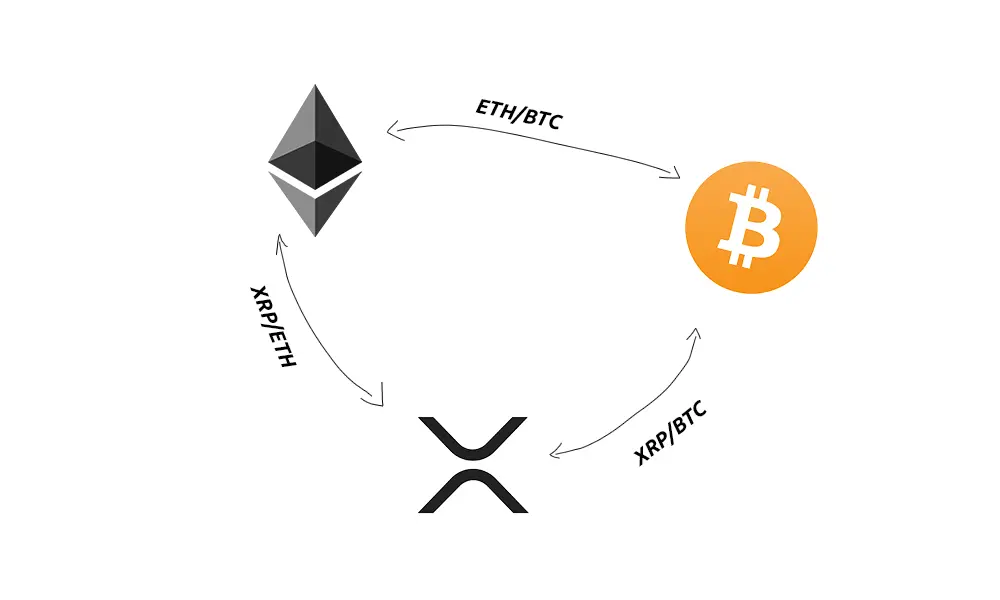
It is another very common type of arbitrage. It is done when a trader notices a price discrepancy between three different cryptos and exchanges them with each other in a kind of loop.
Let's take an example: suppose you buy BTCs by trading them with XRP, then buy ETHs with the newly bought BTCs, and finally buy XRPs with ETHs; if the relative value between ETHs and BTCs does not match the value that each of these currencies has with XRP, then there is an arbitrage opportunity.
Risks
Although the risk associated with arbitrage trading is relatively low, it does not mean that it is zero.
The first risk is the execution risk: it happens when the spread between prices closes before the trader is able to conclude the trade, thus obtaining zero or even negative returns.
The second main risk is the liquidity risk: it happens when in the markets where it is hoped to make a trade there is not enough liquidity to enter and exit the trade.
And what do you think about arbitrage trading?
Let me know in the comments!
If you like my content, leave me one thumbs up ;)





