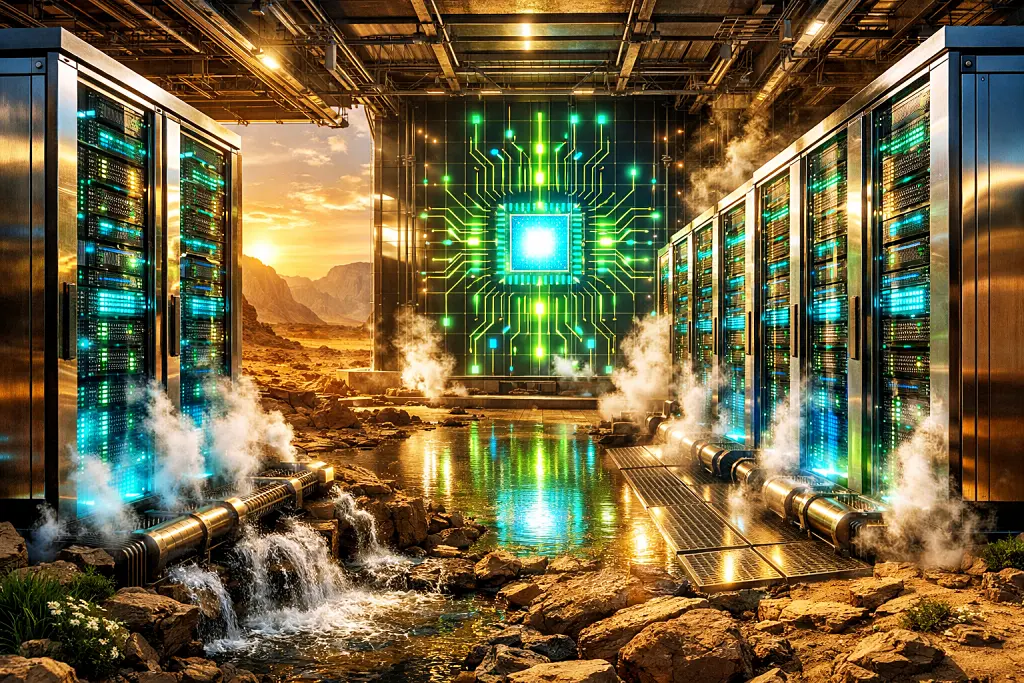
Our digital world is quietly draining our water.
Every time you ask your virtual assistant a question or let an AI suggest a playlist, somewhere a server room hums, cools itself and silently consumes millions of liters of water.
Imagine a small city’s worth of water evaporating just to keep machines running smoothly.
That is what happens in large AI data centers.
In the United States alone, they use up to 60 billion liters of water every year.
Most of us never see it and that is exactly why it feels invisible, yet so real.
The water problem doesn’t stop at cooling.
Advanced microchips, the backbone of AI are produced using ultrapure water.
The more AI grows, the more these chips are needed and the higher the water consumption climbs.
Picture a region already struggling with drought like the Middle East or the southwestern United States.
AI servers and local communities are quietly competing for the same precious water.
Farmers watering their crops, children filling a glass and servers running complex algorithms all share one limited resource.
It may sound exaggerated but the stakes are real.
AI alone won’t create global water shortages, yet it amplifies existing ones.
Some solutions are already emerging: closed-loop cooling systems,
water-efficient algorithms and data centers powered by renewable energy.
Still, until these solutions are widespread, the silent threat of a “digital drought” is here to stay.
The bigger lesson is not about technology, it’s about how we manage our resources.
AI can speed up work, solve problems and connect the world but the cost of this convenience is not just electricity, it is the sustainability of our planet’s water.
If we don’t act, the relationship between AI and water scarcity will increasingly define our future.
AI is exciting, but advancing it responsibly without draining our planet is a responsibility we all share!