
For years, crypto wallets were mostly places where assets sat idle between transactions. People bought coins, stored them, and occasionally moved them elsewhere. That distinction is becoming less clear. More services are starting to assume that swapping, paying, receiving, and managing assets should happen without leaving the wallet environment at all.
One reason for that shift is that payment functionality is increasingly appearing inside products people already understand. The Toss Bank stablecoin integration on Solana is less interesting as a blockchain story than as a product story.
Instead of asking users to enter a separate crypto environment, stablecoin-based transfers are being tested inside familiar banking workflows. The goal is not to make users learn new tools. The goal is to make crypto payments feel like ordinary payments.
If the system adds an on-ramp into Solana and an off-ramp out of Solana, new questions appear: where conversion happens, who provides liquidity, who carries FX and operational risks.
— Xena Kash, Editorial Advisor and former CEO of NOWPayments and NOWNodes
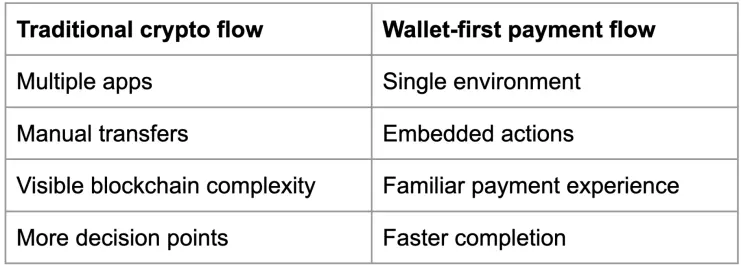
What changes when payments stay inside the interface?
Buying Crypto Is Easy. Spending It Isn't.
Buying crypto stopped being the hard part years ago.
Spending it is still surprisingly awkward.
That idea surfaced again in our conversation with eCash, where Joey King pointed to two separate layers of the same problem: how the system is built, and how it feels to use it.
On the infrastructure side, he notes that sustainability is built directly into the protocol model:
Rather than relying on venture capital, pre-mines, or recurring fundraising campaigns, a portion of the block reward is allocated to infrastructure and protocol development.
But at the user level, the friction is still very visible. Even as the underlying technology improves, payment flows continue to expose steps that traditional apps tend to abstract away.
Users are asked to think about confirmations, settlement risk, network congestion, fee management, and other complexities that don't exist when paying with traditional payment apps.
— Joey King, Senior eCash Developer
Self-Custody Is Expected to Do More Than Sit Still
Once payments move closer to the wallet itself, self-custody tools start changing too.
The D’CENT integration case study reflects a broader expectation shift. Hardware wallets are no longer viewed only as vaults.
Users increasingly expect them to support actions.
A few years ago, the primary question was whether assets were secure. Today, users also want to know whether they can swap, manage, or move those assets without leaving the same environment.
Storage is becoming the starting point rather than the destination..
The same trend appears in exchange infrastructure.
Execution Is Becoming Part of the Interface
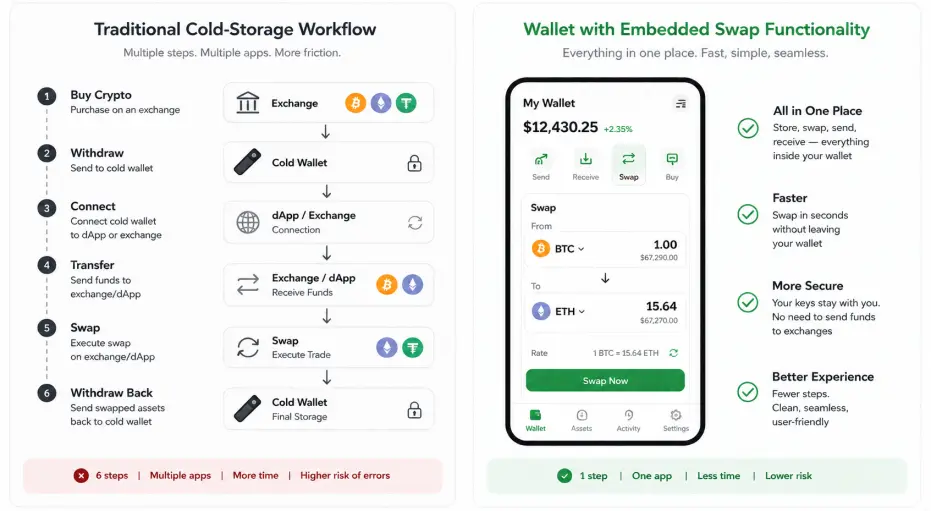
The same trend appears in exchange infrastructure. This ChangeNOW exchange review repeatedly returns to the idea that users increasingly expect execution to happen where they already are.
A redirect may only add a few seconds. Another confirmation screen may seem insignificant on its own. Yet most payment flows lose users through exactly these small interruptions. Convenience is rarely determined by a single feature; more often it comes from removing enough friction that the action feels uninterrupted from start to finish.
Tokenization Still Runs Into Real-World Friction
Not every part of the ecosystem is moving at the same speed.
Tokenized assets continue raising a question that remains surprisingly difficult to answer: what happens after issuance?
Issuing an asset is becoming easier. Making it reliably redeemable outside blockchain environments is still considerably harder.
The discussion around tokenization increasingly focuses on redemption mechanics, liquidity design, and enforceability rather than creation itself.
In one of the short-form breakdowns, Harshil Agarwal points to redemption as the real stress point for tokenized assets. His argument is simple: issuing tokens is no longer the hard part — the difficulty starts when these assets need to maintain credible backing and usable redemption paths in real-world conditions.
A related angle in the second clip builds on the same idea from a slightly different perspective. Harshil Agarwal highlights that once tokenized assets are actually used — not just held — liquidity design becomes more important than issuance itself. Assets that cannot smoothly move between contexts tend to stall, even if they are technically sound.
These questions become harder to ignore once wallets evolve into environments where payments and transactions happen directly, not just storage layers sitting beneath them.
Stress Reveals What Users Actually Care About
Periods of market stress tend to reduce behavior to what actually happens inside the wallet, not what is said about the market.
Insights from crypto winter user behavior analysis show a steady shift in attention toward execution reliability. Price commentary fades into the background. What remains are checks tied to whether something actually worked inside the interface.
In practice, this shows up in very simple questions.
- Did the transfer go through?
- Did the payment arrive as expected?
- Is access still intact?
- Did the swap execute without interruption?
These concerns come directly from how wallets are used when conditions become less forgiving, and small failures start to matter more than interpretation or context.
Where This Leaves Wallets
Taken together, a banking app testing stablecoin transfers, a digital cash project returning to UX friction, hardware wallets expanding interaction options, and exchanges reducing execution steps all point to the same direction. They sit in different parts of the stack but converge in how wallets are being used.
The role of wallets is shifting toward execution. Storage remains, but it no longer defines the structure. The change appears gradually, through small product decisions rather than a single visible upgrade.
Thanks for staying with us! More product signals, ecosystem developments, and wallet-focused updates in the next edition.






