
Portfolio diversification was made popular by Warren Buffet...And, in turned, properly mocked in Remy's Dogecoin Rap. He is a rational investor, right?
The truth is though, the way you handle your asset portfolio is highly individual. In this regard, investing and hodling are just like active trading - some traders can take the swift changes of scalping but many can't. The ones who can't will find that over time they will get better results with trading for longer time-frames, or even just hedging to manage their risks.
That's why I wouldn't discount the idea of diversification completely.
Can you diversify in crypto though?
Everyone who's been around the block a few times knows that when crypto moves, all the boats sort of rise and sink together.
On the screenshot below you see the correlation matrix for several cryptocurrencies. The correlation coefficients are calculated with detrended data, which in plain English means that the assets here tend to move this much and this little together on top of the trend that moves the whole crypto industry together.
The snapshot is for 1 year, made on Nov 9 2021. The correlation matrix is a free tool available at https://cryptowat.ch/correlations.
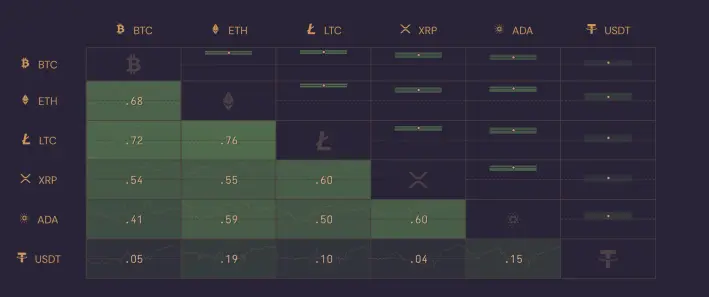
So, yeah: It's all green, cryptocurrencies are correlated. For a good diversification you would want negative correlation numbers.
What you see though is that BTC, LTC and ETH - the biggies - trade very much together. The alt currencies that were developed for a business purpose, such as XRP and ADA, are less correlated.
It might mean that we have a correlation difference based on fundamental difference on crypto markets, but this interpretation is quite speculative.
If it is an accurate interpretation though, we should likely see the break in correlation deepen as the crypto markets get more mature. Different cryptos will differentiate more - those that will manage to survive.
Indie cryptos vs Biz cryptos
This thinking seems to be behind the idea of this article about diversification:
- Choose the strong performers among "indie cryptos". Those are the cryptocurrencies that were created by an individual from the community and are still not affiliated with any business purpose. You want to think BTC, LTC and XMR here. ETH belongs in too, because the ETH blockchain is meant as a platform for all sorts of businesses.
- Then choose promising projects from the "biz cryptos". Those are coins and tokens made for a business purpose, or affiliated with one. Note that Dogecoin belongs here when you read it in the spirit. It is too affiliated with Elon Musk to be considered indie.
Vetting of the biz cryptos is another interesting topic, and here you can adopt some old-school startup thinking:
- First off, check if the idea solves a problem for someone. If it's just cool, it won't last.
- Next, see if the project has all the licenses it needs. Many projects fail at this one.
- Where does the project operate at all? If it is a US-based operation, the potential audience is far greater than for a project based in Thailand, unless the targeted audience is perfectly global.
- The larger the engaged audience, the higher the value expectation.
Combining the indie cryptos with the biz cryptos gives you a solid exposure in the most diversified way we have yet, if you want to keep it purely crypto.
For a true mixed bag of uncorrelated assets you would still have to go to precious metals, stocks and fiat. If you believe the crypto industry as a whole makes more or less sense, even with occasional hiccups, then you may be ok with "mock-diversification" done purely in crypto though.
Remember that diversification is not about profit maximisation, but about keeping the value of your assets somewhat stable and about not missing opportunities. And, btw, you don't have to do it.
Here's a perfectly rational and non-degenerate case against asset diversification:
- You believe ETH has a great future and is the best asset to invest.
- You set up a dollar cost averaging system to buy some ETH with every pay check.
- Every year you take a look at your investment and reconsider. Do you have a better idea to use that money for?
- In the first year you just left everything as it was. In the second year you maybe decided to buy a car, so you sold off a bit. In the third year it might have made for paying off the mortgage.
You see that it is nothing complicated - if you choose the right asset. If you don't know which asset to choose but you still want to invest, diversification is the way for you.






