
I just came back from watching the third episode of Loki, and I have additional questions. (Needless to say, spoiler alert for anyone who hasn't seen the series.)
Loki and Sylvie's chemistry seemed off from the very start.
After they fall through into Lamentis-1, Sylvie is pretty cut up about her "years-in-the-making" plan being ruined. For a plan that long, I thought she would be a bit more prepared than simply storming the TVA; did she expect it to be completely unguarded?
Episode 2 ended on such a great cliffhanger with her big reveal, and I was raring to see how she would turn the tables on Loki in episode 3... only to have Loki turn the tables on her instead by stealing the time device.
I'm also surprised that Loki managed to go toe-to-toe with her for long enough for Renslayer to catch up to her. Didn't she kick his ass in the Roxxmart just an episode earlier? From the beginning where he successfully delays her at the TVA elevators, to how he's able to essentially hold her hostage the entire episode while he hides that episode's Macguffin from her, it felt like he had the upper hand, which made her character feel weak by comparison.
One would expect Lady Loki to be a trickster like Loki himself — suave, lying, boastful, arrogant and always with a trick up her sleeve. I was hoping for a Hela-like character: A badass in all aspects of combat, magic, and charisma. One to truly challenge Loki's lofty ambition of being the superior variant. The fact that she's completely different, instead a driven, scheming, humorless type, yet who still makes rookie mistakes, threw me off-guard. It honestly reminded me of other characters who played similar 'mysterious-stranger-with-a-broken-past' archetypes. For some reason, she was giving me Gamora from Guardians of the Galaxy vibes. Is it really that hard to create a female counterpart to Loki without resorting to tired old tropes?

My criticism of Sylvie's characterisation aside, the hardest part to swallow about episode 3's plot is when the characters do anything that makes them look foolish. Both Sylvie and Loki were made to look foolish in episode 3, first when they both failed to fight/trick an old lady in a shack, and second when they got thrown out of the train. It's tough to understand why they're look so incompetent when they're both supposed to be masterminds at planning and executing schemes.
What I thought was going to be a battle of wits and sneak in episode 3, was more like a buddy road trip, but instead of two down-on-their-luck losers, our main character is stranded in the middle of nowhere with his twin sister. Weird set up for an MCU movie, even by Ragnarok standards. Don't get me started on the oddly intimate dialogue that made me ask the uncomfortable question: "Is Loki trying to flirt with himself?" Why's he waxing lyrical about love to a female version of himself? Isn't it like trying to flirt with your sister?
Should they have gone with more Loki and Mobius?
Why do Loki and Mobius play off each other so well, yet Loki and Sylvie fall flat? Are we the audience just not as excited when it's a complete nobody playing the villain?
Owen Wilson is a big budget veteran and he's had years of building up his personal brand of charisma; essentially, he plays different versions of himself in each movie he's in. If you already like Owen Wilson, you'll like him in anything he's in (bar the awful Cars by Pixar).
Perhaps the studio cast Sophia Dimartino because they didn't want too many heavyweights chewing the scenery. Plus, it can be exciting to see how a fresh face could shine when put in a large production house such as the MCU. Tessa Thompson was a fan favorite in Ragnarok, and so was Okoye, played by Danai Gurira. (But then again, they were straight-up badasses and they pulled no punches, so their main draw was doing cool shit without much backstory.)
I hope Loki doesn't fall into the same pitfalls as Falcon and the Winter Soldier. For all its great character development about PTSD, trauma, racial history and so on, FatWS suffered from a weakly-written villain who had no personal stake in US race-based history. It would have been much more interesting if Isaiah Bradley was the villain, someone who had a real point to make about America's bloody history. I liked Killmonger's character because he represented all of black people's complicated feelings about the US, and Isaiah would have been the perfect cynical foil to Anthony Mackie's idealism.
Overall, though, this was a weaker episode compared to the first two, which did a great job of setting up the show's expositionary elements while keeping us on our toes with the impeccable comedic timing between Mobius and Loki.
Positives of the direction:
Alright, enough bashing. I'd be doing the show's writers a disservice if I didn't point out what I liked about this episode. One positive I'd take away from this whole thing, is that both characters casually let slip that they are bi. It would make sense considering how it's been teased for a very long time that Loki is bisexual in the comics, and he is in real-life Norse mythology.
Big budget studios are often ham-fisted in telling the audience the sexuality of their characters. Some even write certain characters to fall into the tired old tropes of "gay-best-friend", "trans sex worker" or "gay assault victim". But this was handled rather tastefully because it was a "blink and you'll miss it" line of dialogue that makes sense in the context of their conversation, where they were asking about each others' past romantic histories in an intimate bar setting. I hope it doesn't hint towards a romantic development, because that would be just wrong on all levels.
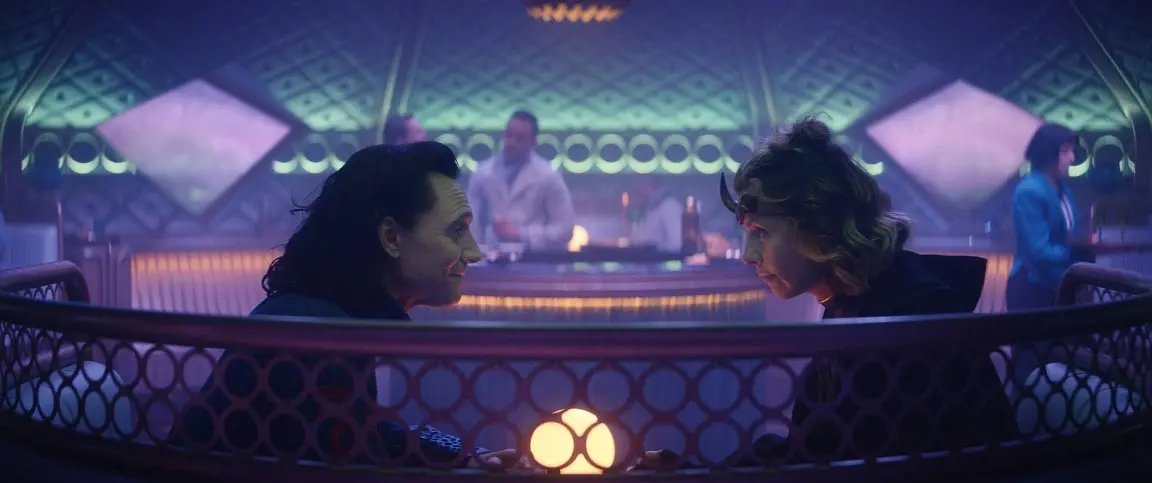
Great lighting throughout the episode by the way. Giving me Blade Runner 2047 vibes.
I also liked how they somehow were able to work together to get onto the train using both their sets of skills. I honestly would love more of that quick-thinking action-oriented chemistry throughout the series, it reminds me of the dynamic duo in Rush Hour or Shanghai Noon (which coincidentally, also starred Owen Wilson).
Reasons why Loki and Sylvie's difference in temperament may be intentional.
A bit of analysis on why Loki and Sylvie might have been intentionally written differently: Loki's illusion magic gives him the edge in deceit and pretending to be someone he's not. His skillset is reliant on how good an actor he (Loki, not Tom Hiddleston) is, which sometimes backfires on him spectacularly throughout the Marvel movies. It's an unreliable skill, because it requires him to act convincing enough to get people to trust him. And when all else fails, he has his daggers.
Sylvie's skillset requires her to just get close enough to touch someone in order for her enchantment magic to work. It's a lot more powerful than Loki's. So it does make sense that she's used to getting her way, by enchanting others to do her bidding. It's actually quite similar to another magic user — Wanda Maximoff. Wanda herself is not known for being charismatic or a trickster, so we shall see how they develop Sylvie's character — will she go down the same path as Wanda? Or will her identity as a Loki variant steer her in a different direction?
Perhaps I am too delusional in trying to predict what a female Loki would act like. So far, movie and TV audiences are only familiar with the style of the male con artist: A sense of bravado, of braggadocio, paired with a wide, disarming smile that belies a hidden deviousness. A confidence trickster, a charlatan, and a quack.
Female con-artists in history have been much more willing to hide in the shadows. They don't want to draw too much attention to themselves, so they use tricks from behind the curtain to deceive or misdirect. If we look at it from that perspective, her character might make a lot more sense.
The way Sylvie fought Loki hand-to-hand using pawns, and only revealing herself at the end, in that sense, could have been an intentional way of revealing her character. Loki called her a "coward" asking her to fight him one on one. Surprising considering he is known for being sneaky as well.
To sum up Sylvie, I think she is a little more nuanced, a little more complicated. It seems we are invited to look into her world and her story a lot more closely than we have done for those two other favorites, so we shall have to see how that unfolds in episodes 4-5-6.
Prediction Time: How I envision the plot of Loki to unfold.

1 - Introduce the time keepers and setting the stage for Loki to go on time-travel hijinks (Complete)
2 - Develop Loki and Mobius' friendship, cliffhanger introduce the villain and her plan (Complete)
3 - Loki escapes with Sylvie and he learns more about her backstory. Some foreshadowing here about the role of the TVA in everything. (Complete)
4 - Loki and Sylvie get captured by the TVA, they get hauled up to trial, a big revelation is revealed (maybe Mobius discovers he is a variant and defects too)
5 - Loki and Sylvie escape, join forces with Mobius, and they make a big plan to expose the TVA. Sylvie / Mobius betrays Loki (subverting expectations)
6 - Finale: Something gets destroyed (TVA HQ) or another big reveal, maybe one of the time keepers appears and is revealed to be a Loki variant, something that sets up Multiverse of Madness happens, Sylvie escapes or dies, Mobius is freed or dies, Loki dies or escapes or pretends to die. Post-credit scene shows Loki rejoining the MCU main timeline.
Perhaps we are meant to say goodbye to the old Loki and follow this new Loki at the end of the series. I sense a big character change in Loki coming, with possibly a grand self-sacrificial gesture, paving the way for Doctor Strange's Multiverse of Madness, and also potentially a Sylvie/Enchantress spin off movie. But I think that would be a misstep for the fans. Everyone's favorite trickster needs to live on in some form or another, that's the whole point of his character.
What do you think? Do you agree with my analysis? How do you think this series will end? Let me know in the comments!






