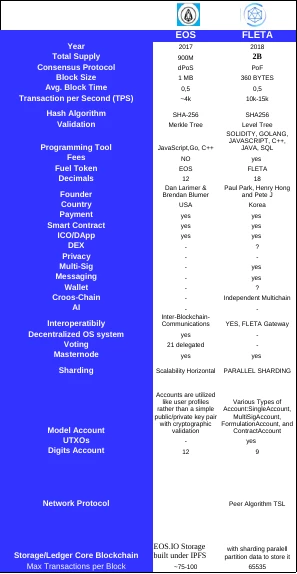
As a final line to our special delivery of the world of decentralized applications, we will make a technical comparison between the most popular platform currently for the hosting of DApps such as EOS and the disruptive FLETA that promises much prominence in the blockchain space, specifically in the accommodation of DApss for gaming.
Recall that the criteria are an approximation of what every developer may want to know in general terms of what they may be able or not to offer their skills these blockchains.
EOS
The core team behind EOS is "Block.one", which is based in the Cayman Islands. Brendon Blumer, the CEO, has been involved in blockchain since 2014.
EOS is designed as the "best of two worlds" that combines the high performance of Graphene and BitShares with Ethereum's smart contract capability. EOS is the logical continuation of Graphene towards the development of programmable intelligent contracts.
-
Scalability
-
The reason why blockchain-based applications can not compute so many transactions per second is because each and every node in the network must reach a consensus for anything to happen.

EOS introduces a different consensus algorithm, called a delegated participation test. The main difference between the delegated participation test and the participation test is that there is a predetermined number of miners, also called delegates.
In the case of EOS, there are 21 delegates that secure the network. Delegates are elected by vote.
Each user who has chips can vote for the delegates. The delegated participation test is still considered a consensus algorithm without permission because anyone can become a delegate simply by getting enough votes from the community.
EOS claims to be scalable to handle millions of transactions per second. It is a great fantasy and the progress of the current project is not very close. Their data currently point to a historical maximum of 4000 TPS, far from what they promise.
-
Transaction rate
-
Normally, when a user wishes to send a transaction through blockchain, he must pay a fee. In the case of EOS, transactions are free. The only requirement to send a transaction is to deposit some tokens in the account.
-
Flexibility
-

Because EOS uses DPOS, if a DAPP is defective, the producers of chosen blocks can freeze it until the system is taken care of. This is simply an extension of the DPOS system, not all nodes have to deal with the maintenance of the chain.
EOS believes that flexibility is a very important concern in the cryptocurrency space. One of the biggest problems that most people with Ethereum had was their inflexibility.
-
Usability
-
EOS allows well-defined permission levels by incorporating features such as the web toolkit for the development of interfaces, self-describing interfaces, self-describing database schemas and a declarative permission scheme.
-
Governance
-
In EOS, the government is maintained by establishing jurisdiction and choosing the law, along with other mutually accepted rules. This is usually done through the legally binding constitution. Each individual transaction in EOS must include the hash of the constitution to the signature. This, in essence, forces users to the constitution.
The constitution and protocol can be modified by the 17/21 approval that must be maintained for 30 days in a row, in addition to other consensus processes.
-
Parallel processing
-
In parallel processing, program instructions are divided among several processors. By doing this, the execution time of that program decreases considerably. EOS provides parallel processing of intelligent contracts through horizontal scalability, asynchronous communication and interoperability.
The EOSIO software is a sophisticated operating system in which applications can be built. The software's brilliance is its ability to scale horizontally and vertically, which means that at some point in the near future, EOS-based block chains will be able to process millions of transactions per second. Another benefit of the software is that it does not charge user fees, making it a desirable platform for developers and users alike. One of the aspects that makes the EOSIO software unique is the way CPU and RAM are used in the EOS blockchain.
-
Self-sufficiency
-
Any blockchain based on the EOS software will have to generate 5% of natural inflation per year. This will be distributed to the producers of blocks of the platform in relation to their confirmation of the transactions in the platform and to the three main contracts or intelligent proposals that receive the highest number of votes from the holders of said tokens.
The reason why this happens is to make sure that a chain of blocks does not depend on a single foundation, organization or individual for its growth, development or maintenance.
-
Decentralized Operating System
-
Probably, the most important feature to really understand what EOS is about is this feature. Think of a MacOs / Windows with a crypto-economic incentive.
Now, Ethereum is a decentralized supercomputer, EOS is positioned as an operating system.
-
Architecture
-
the architecture of the EOS system is not a chain of blocks, according to the traditional definition, but a system of homogeneous non-autonomous distributed databases.
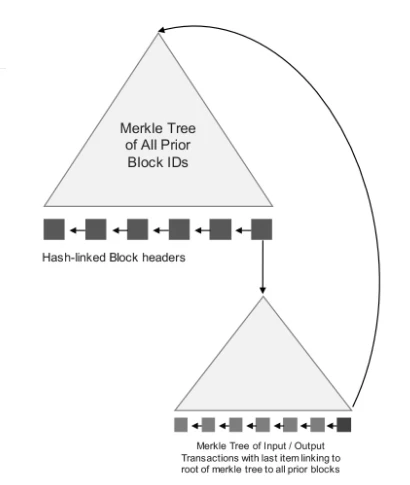
An analysis of accounts in the EOS architecture indicates that the accounts manage the permissions and funds in the EOS network. The accounts in EOS follow a traditional configuration, similar to other distributed systems based on cryptography. However, EOS accounts have another layer of abstraction beyond a pair of public / private keys. Accounts are consistent with user profiles, in which multiple pairs of keys and wallets, with different permissions, can be linked to an account. To manage this, a user interacts with Nodeos and Keosd through the command line tool, Cleos.
Transactions in EOS result primarily in changes to the underlying database, rather than status changes cryptographically verified in an underlying blockchain data structure such as Ethereum, by means of the data structure of the Merkle tree.
-
Storage mechanism
-
in the EOS architecture, state storage represents information that matches the logic of the application. Block producers will publish their available capacity for storage of bandwidth registration, computer debt and state storage. The storage availability of the state depends on the number of tokens that a stake account.
FLETA
FLETA aims to provide a blockchain technology that can be addressed and also support integration with existing development environments. It is a practically new project that is entering the business of the third generation blockchains and aims to conquer the Dapps market through an intelligent and friendly environment for the development of applications.
-
Scalability
-
The advanced blockchain technology of FLETA and the independence of DApp open the doors to infinite scalability.
FLETA proposed a new consensus model. Instead of the existing model, PoW (Work test, verification calculation process) or PoS (Play test, participation verification), FLETA developed a new consensus model to avoid unnecessary bifurcation.
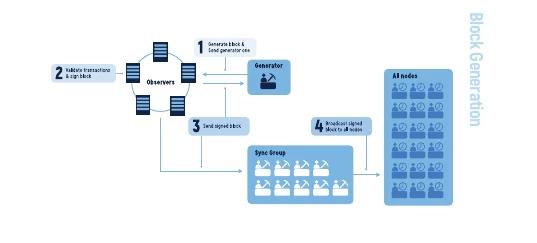
This new model is called PoF (Proof-of-Formulation) in which a consensus is obtained on the block mining procedure and the blocks are generated in a designated order. This allows to reduce the range of dissemination of the block, which results in a faster generation and dissemination of the block. In addition, the observer node allows instant confirmation and avoids bifurcation. In turn, the network becomes stable and the transaction speed increases.
FLETA consists of a main chain and many substrings that operate at the top, creating a multi-chain platform.
Each substring is assigned exclusively to the corresponding DApp application, which means that the administrator of the DApp application has the possibility to perform functions such as updating and data migration. To clarify, a new substring is created when a new DApp is created. Thus, the multichain system of FLETA overcomes the deficiencies of the existing chain systems.
The ECDSA signature algorithm based on secp256k1 can perform a maximum of 23,000 verifications per second in a parallel processing of 8 central CPUs. This requires a network speed of 1.4 MB / s for this transaction to be transmitted. Therefore, FLETA aims to reach 20,000 TPS through the original block design.
As a final result, FLETA has reached a maximum peak of 15,000 transactions per second in its beta phase.
-
Transaction rate
-
FLETA through its multi-channel structure projects very low fees in its transactions to encourage the development of the Dapps.
-
Flexibility
-
FLETA has created a PoF (Proof-of-Formulator), which allows the generation and rapid dissemination of blocks by using the reward sequence of the Formulator to designate the objective of mining and reduce the diffusion range. In addition, the existence of an observer node allows immediate authentication and avoids block bifurcation.
This means that each Formulator is guaranteed with a mining opportunity in each phase and a different formulator sequence is provided in different phrases, in order to avoid possible attacks or collusions of and against Formulators.
In addition to the multi-chain structure, all Dapps are operated as independent blockchains, so the flexibility of the platform is wide to avoid damage to the main chain.
-
Usability
-
FLETA provides intelligent contract services, which can be used with current development formats such as RDBMS, NoSQL and Event Sourcing, to integrate with existing development environments.
FLETA basically provides Solidity, Relational database, Contract type of event supply. The future development of technology and the progress in research could allow new types of contract.
-
Governance
-
In FLETA the Government is maintained through the establishment of block generation by the proposed PoF algorithm.
The mining group consists of A) the generator group of the 1st place, B) a synchronization group consisted of the 2nd to the 10th place, and C) the group on hold consisted of the 11th to the 20th place.
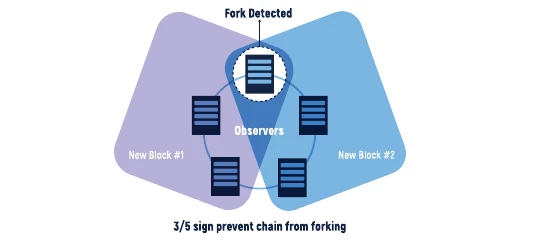
In this way, the block generator can quickly generate a block, and as 3/5 of the observing nodes signed it, a branch is not possible since at least one observer node will detect the branch before it is formed. The integrity of the network is thus maintained by the 3/5 parts of the observing nodes.
To participate in the Formulator group, you must have the FLETA tokens.
The observing nodes will be operated by FLETA first, then operated by delegates later (for example, the dApps themselves).
-
Parallel Sharding
-
The parallel processing of transactions is a fundamental technology that updates the high-speed transaction speed. In FLETA, the transaction is assigned to a certain fragment according to a predetermined rule and the result of the transaction is processed independently in each fragment.
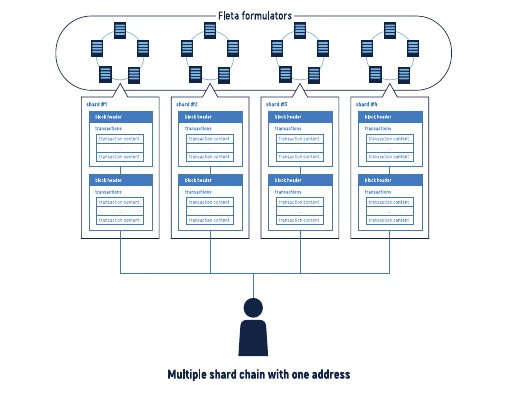
Unlike the structure of a single chain, each fragment of FLETA has an independent chain. Therefore, each fragment does not influence each other and is processed in a parallel structure within an independent block chain. The Shard system basically does not share data and, therefore, it is not possible to duplicate the expense in this design. The independent strings of fragments update the complete parallel structure, increasing the processing speed.
-
Self-sufficiency
-
The dApps with token issued in the FLETA platform are operated in their own independent chain, not in the main chain. That is, the token economy is updated through several consensus modes selected by each and every one of the developers of Dapp.
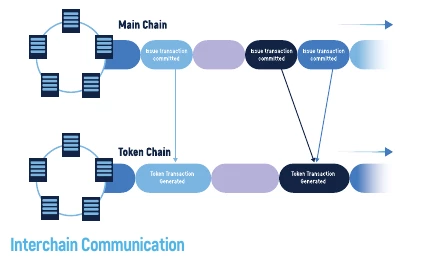
Each DApp token can be rewarded independently through a preferred consensus model (PoW, PoS or voting process is included, but not limited to these). The token economy is a driving force of FLETA and its dApps, which provides the motivation for several utility tokens to join FLETA.
-
Network
-
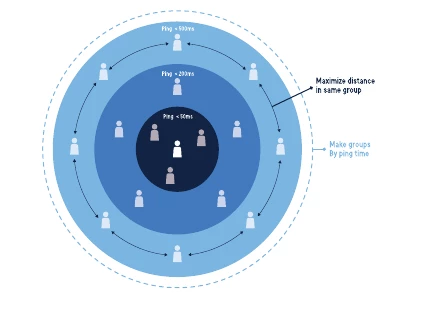
The algorithm of selection of balanced geolocational pairs allows the blocks to be distributed quickly and uniformly. This network algorithm is designed to connect colleagues with geolocated equilibrium. The distance is determined by ping, and the clumsiness of the network can be avoided, receiving nodes per group that is generated through distance. The distance of the network creates the greatest possible distance so that it is as uniform as possible to avoid deviation in a certain direction.
-
Architecture
-
The architecture of the FLETA system has a Microkernal system. Kernel is blockchain as Consensus, Store, Generator and is responsible for its operation, so that each chain supports its own account, transaction and contract.
Microkernal has a summary structure 1) transaction, which is the formula actually modified, 2) account, which stores and manages transactions, 3) contract, which carries out with codes.
FLETA recently designed and improved the block structure, which is the core of blockchain technology. Blocks that had 560 bytes in a transaction have been reduced to less than 360 bytes, leading to faster transaction speeds.
In addition, FLTEA adopted the LEVEL Tree verification method, replacing the existing verification method of the Merkle Tree. This, too, is a technological advance that improves the real speed of the transaction. The replacement results in verification speeds more than 5 times faster.
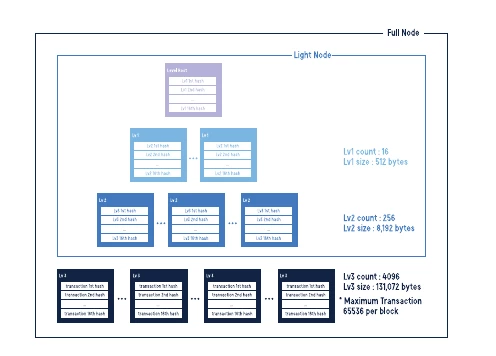
In addition, FLETA employs a hybrid method, which combines UTXO and Account. UTXO, which can be used immediately without creating an account. And the account, which can be used with less execution rate and data. Both coexist in harmony to improve ease of use and efficiency.
-
Storage mechanism
-
On existing blockchain platforms, the main chain included many dApps and the mining group had to operate the main chain and all other secondary chains. This easily led to the overload of the mining group. On the other hand, FLETA employs a structure in which each substring operates independently its own chain, solving the problem mentioned above. Therefore, FLETA separates the function and the data field so that the DApps are not affected by each other, which provides infinite scalability for Dapps.
Summary of specifications of more popular platforms for dapps.