Stablecoins were created primarily as a lifeboat for the volatility of the crypto market.
Later, mainstream finance also turned to this type of cryptocurrency as a maintenance of the purchasing power of fiat currency.
As we all know, all investors, both large and small to preserve the purchasing power of their money, resort to so-called safe-haven assets.
The best known are precious metals or gems: all of which appreciate more and more over time: this limits the erosive effects of inflation.
Types of stable coin
Stable coins are mainly divided into the two broad categories: collateralized and uncollateralized.
Collateral refers to a backup asset to which the price of the stable coin can be pegged; therefore collateralized or backed, in this specific case we can consider them synonymous
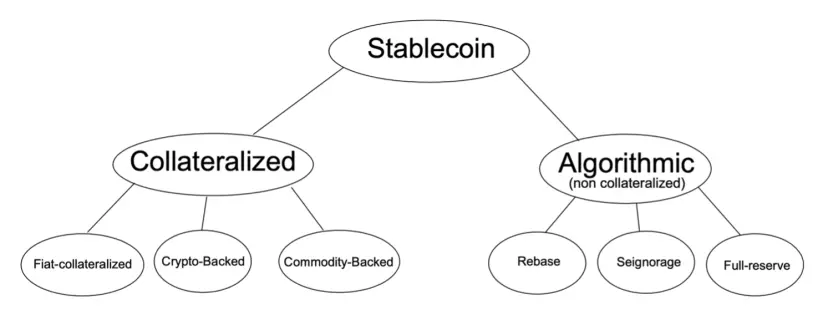
Collateralized Stablecoins (with underlying)
This group of Stablcoins has its price pegged to a specific asset and therefore is not subject to sudden changes.
Fiat-collateralized
Before we delve into stablecoin, a little clarification:
Why fiat?
It obviously has nothing to do with the Italian car producer. Fiat is a Latin term meaning "let it be done."
This is because since 1971 the currency is no longer pegged to a state's gold or silver reserves, so the value is nominal and not actual.
In practice it is a convention of the central authority to attribute to a banknote the value of it printed, because in fact it is not.
This type of stablecoin is the best known and simplest in its use. Its price is pegged with a ratio of 1:1 to any current currency (precisely fiat). The amount of tokens created has a backup consideration in a bank account equal to its value.
When a user exchanges tokens to obtain fiat currency, the tokens are taken out of circulation (burn) and the dollar equivalent reclaimed into the user's account.
In this manner for every $ in the account corresponds to one token.
The best known stable coin that uses this type of anchor is Tether.
In fact, we recall that some time ago it was deferred to the FED because it was supposed to create tokens without collateral.
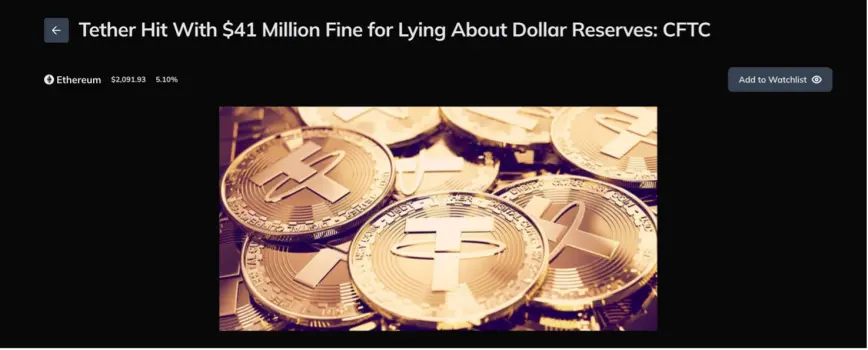
https://coin.fyi/news/ethereum/tether-hit-with-41-million-fine-for-lying-about-dollar-reserves-cftc-q8rr6o
Stablecoin crypto-backed
Yes you got it right, apparently it is a nonsense: stable coins are created to limit volatility (sudden price changes) and as a backup they have cryptocurrencies, whose price is constantly changing.
This type of stablecoin has the main function of increasing decentralization. By entering a cryptocurrency as a backup, there is no central authority managing the whole process.
Effectively said so is nebulous, let's give an example to clarify the process well:
In order to get $500 of stablecoin, one needs to deposit $1000 in Ether. In practice, the stablecoin coverage is 200%; by doing so, a 25% drop in price can be absorbed.
Should the price fall beyond a certain level, stablecoins are subject to liquidation.
Broadly what happens for collateral in DeFi loans.
The fact remains that through decentralization, transparency and security increase and there is no danger of being in the situation Tether has found itself in.
Commodity-backed stablecoin
This type of stablecoin works likely to those that have fiat currencies as collateral.
In this case, however, the backup is commodities; the most widely used is gold.
In addition to Digix Gold which we will see a little further below, it is worth mentioning Tiberius Coin which has pegged the price to 7 different types of metals in different proportions and they are:
- Copper at 24.959%
- Tin at 15.838%
- Aluminum at 8.713%
- Nickel at 13.269%
- Cobalt at 11.057%
- Gold at 19.595%
- Platinum at 6.569%
The choice of different percentages to mediate increases in individual commodities.
It is also good to mention the SwissRealCoin, which pegged the value of the token to a real estate portfolio that is self-supporting by reinvesting 80 percent of rental yields.
An important aspect of this type of underlying (commodities) is the appreciation they have over time.
To bring you a tangible example, let us take gold.
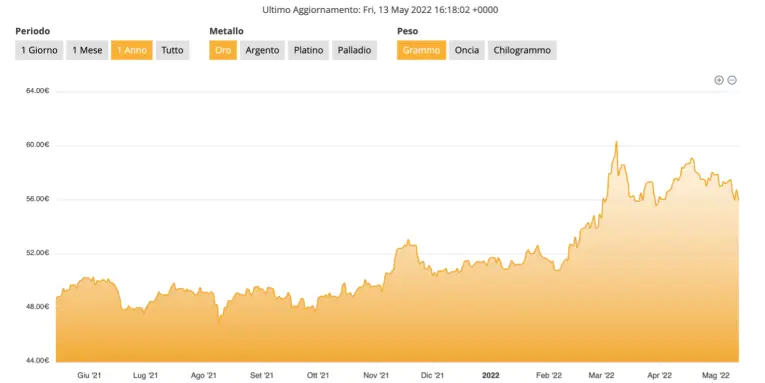
In the graph you can clearly see that the appreciation in about 1 year has been about +50%. Of course we have to take into account the particular world situation we are experiencing first with the pandemic now with the war in Ukraine.
Anchoring stable coins to commodities opens up the market to a larger catchment area: before this possibility the purchase of precious was reserved only for investors with certain economic strength, now almost anyone can access it.
In this regard why not mention the stablecoin pegged to the price of gold the Digix Gold or $DGX.
This stable coin is an ERC-20 token created on the Ethereum blockchain that has as its backup the physical gold found in Singapore's reserves. An audit is conducted every 3 months to ensure transparency.
The first part of stable coins ends here. Let’s catch up again in the next installment to understand Algorithmic Stablecoins and also to understand what happened to TERRA/LUNA Ecosystem.
See you there.