
After analyzing the Faucets, that we understood they are not the most powerful tool for accumulating Bitcoin, let's see what the development of this technology is offering us and we can grasp.
For convenience, I have divided the possibilities offered into 3 large groups:
- Lending exploiting the possibilities of CeFi;
- Mining and Staking;
- Cash Back.
Lending
With the advent of CeFi, various platforms have developed that allow investors with minimal resources to have a return.
The platforms are many, from BlockFi to Nexo, passing from Celsius Network.
But how exactly do they work?
Well, the investor opens an account and enters a certain amount of cryptocurrency into this account; over time, these coins positioned in stock, but not blocked, without "doing anything" produce an interest, which in some cases can even reach quite interesting percentages over the year: almost 9%.
This is because we are letting the platform borrowing our assets, to lend them to traders that will pay fees on the duration of the position.
The classic example of a loan.
However, it is necessary to make a clarification: the supply that we pay into this account gives the possibility to receive a part of it on loan.
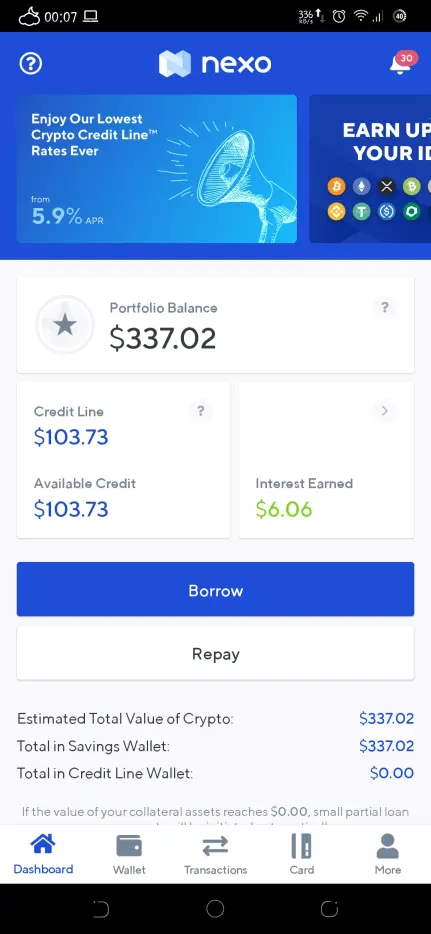
For example, Nexo makes about 30% of the allocated amount available.
The sum that is made available is not free of charge, but a share of interest must be paid for its use.
Obviously, if we do not access credit, we do not have passive interests, but only active ones.
As you can see, the account that a friend of mine sent me has a credit line of about $ 100 against the $ 300 deposited in the account and has totaled about $ 6 in interest.
Please note, without doing anything!
Very important when it comes to lending, it is necessary to make a supply available without drawing on the credit line, as the risk becomes very high: if the token undergoes downward variations, there is also the risk of losing part of the capital.
In this case, the Celsius Network platform has really interesting returns and, I must say that it deserves further information on a future article.
Mining & Staking.
Of the two terms, certainly the best known is the first: mining.
As we all know, however, in order to carry out profitable mining, you need a battery of high-performance machines and have an electricity supply at very advantageous rates, all this is better explained in this post.
As for Staking, we hear less about it, but it is no less advantageous for this.
In this video
And in this
I explain how to have a passive income that is around 10% with TRX and around 9% with ALGO.
The beauty of this passive income? The risk is almost nil, because the coins do not leave the Wallet, so they are not stored on third-party platforms that can be subject to hacking.
In this article I talk about what happened to IOTA thanks to a third-party platform.
Cash Back
Cash Back is nothing more than the return of a percentage of value on a purchase. Obviously this purchase will have to be made in cryptocurrency.
The best known platform that offers this service is Crypto.com; among other things, against the $ 200 freeze, $ 50 is credited directly to the wallet in $ Mco.
Obviously, "only" $ 50 can be withdrawn from the wallet while the others remain in staking for 3 months, after which they can be withdrawn.
Personally, the market played in favor and when I demobilized the $ 200 and transferred it to the binance exchange, I sold it with a 1% profit!
The cash back functionality is also provided and supported by browsers, in fact by downloading the Lolli extension, you can have a cash back by purchasing in affiliated stores.
As we have seen it is possible to have a return of cryptocurrencies simply by owning them; clearly these are methods that can be activated by those people who are not willing to expose themselves to any risk even if it may be minimal, as it could be, for example, a well-done trading with a strict money management!
This is an introductory article, as the forms of investment I have talked about need to be explored to avoid capital losses.






