
Bitcoin (BTC) facilitates medium and long-term economic planning better than the dollar. Although at first glance it may seem counterintuitive under the argument of BTC volatility, the fixed issuance schedule of Bitcoin, which becomes even more palpable with the supply shocks produced by halvings, usually has effects on demand and, therefore, in price, which allow personal and business finances to be organized in four-year cycles, a degree of predictability impossible with money issued by States.
The dollar and, in general, all money issued by State decree is subject to the monetary policy established by the current management of the Central Bank or Federal Reserve (FED). It is no secret to anyone how a large part of the fiat economic system is articulated around the FED's periodic announcements about what the next interest rate will be and, in that sense, the cost of money, as if it were a contemporary oracle. And, even more so, it is worth remembering the massive monetary issue that this institution has historically carried out, which, although it was accentuated during the pandemic, has followed an upward slope since its founding.
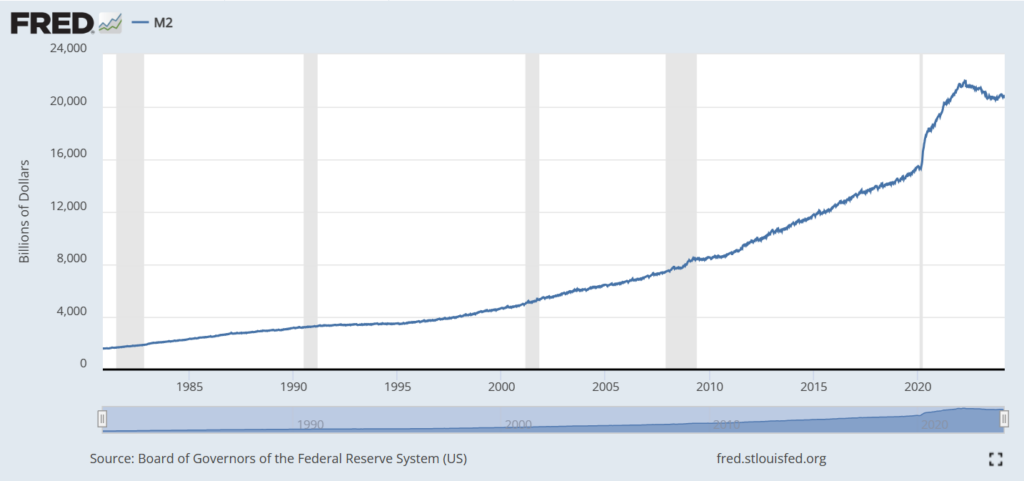
This level of unpredictability makes economic planning over long periods of time difficult. Therefore we have become accustomed to making the educated assumption that fiat money will always tend to be worth less. The discretionary increase in the money supply leads to each person's money having less purchasing power over time.
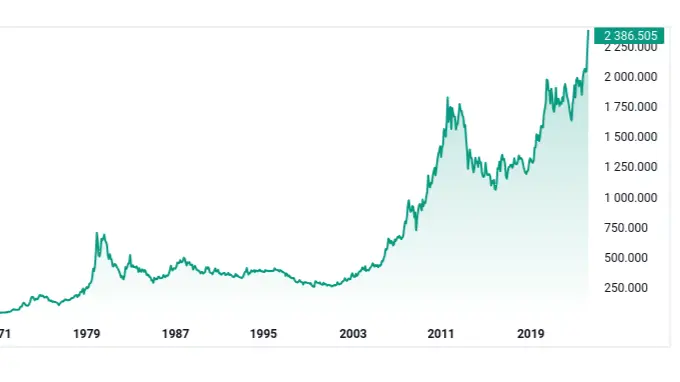
The graph of gold against the dollar is an objective demonstration of this, although it could be compared with any other good and note that, it is not that things are more expensive, it is that money is worth less and less.
Especially since 1971, when the gold standard was completely eliminated and States gained full discretion regarding the issuance of money without the need to have cash backing, it can be noted how the dollar has significantly lost its purchasing power.
Savings, at least significant savings, become impossible in the fiat economy. Even if you are not an economist or not versed in finance, public opinion shares the certainty that cash is not a good store of value.
While the increase in the monetary mass contributes to the depreciation of the currency, as soon as extra cash is available, one eagerly searches for another instrument to convert it to. And the more inflationary a currency is, the more this spending is encouraged, since it is known that it is leaking value all the time.
If as a result of your work you had the ability, by postponing spending, to amass enough capital to invest in your own business or dedicate it to any project of your interest, you would have the independence to fail or be successful without the sword of debt hanging over you. head. The game theory of the fiat system incentivizes spending and debt, while penalizing saving. In this way, it also hinders freedom. Therefore, long-term financial planning becomes inaccessible to most people.
Bitcoin, a Savings Technology
This is precisely what is referred to when it is said that Bitcoin is a savings technology, and halvings have historically been a key part of this.
At least during the last three halvings that Bitcoin has had , the halving of the issuance of new units has been followed by significant price increases.
In most of the previous halvings, a few months after the end of the 2016 block cycle, the supply shock has shaken new investors, who are attracted by the fear of being left out under the awareness that there will increasingly be less bitcoin available to each. In this cycle, this awareness seems to have been brought forward by the fact that there are people and institutions accumulating at a faster rate than new units are generated.
It is a simple law of supply and demand: there is awareness that the supply is gradually reducing, with fewer and fewer bitcoins being issued. As demand remains constant, or increases, the price will be affected upwards.
With Bitcoin, the entire monetary policy is known in advance, with a fixed and invariable issuance schedule being written in the code. Anyone can calculate not only when each halving will occur, but how many units of bitcoin will be issued each day for the rest of history, offering complete certainty about the supply of Bitcoin.
As far as demand is concerned, it depends on new people knowing about you and valuing your properties. Most so-called long-term holders recognize this, and that is why they hold on to their holdings. But with each new bull market, new people are attracted to the technology, creating a virtuous cycle. This differs from the demand for the dollar, which remains relatively unchanged in the world (although geopolitical phenomena such as de-dollarization could negatively affect it).
But just as summer is followed by fall and winter, Bitcoin bull markets are followed by bear markets. This is not necessarily a bad thing, but a natural part of the cycle and a feature that rather than hinders, contributes to Bitcoin-based economic planning. In a relatively simplistic way, it could be said that periods of increase become moments of spending and moments of decline become periods of savings. If you are frugal during the winters of the market, during the summers you will be able to reap what you sowed.
Although it is worth remembering that past performances do not guarantee future profits, this halving would be the fourth time we have observed this phenomenon, having broken the historical maximum price of the previous cycle even before the emission reduction took place.
It is often said that halvings are discounted from the price and should not affect volatility since it is information known in advance. However, markets are above all things an expression of human psychology, and even if it is in the form of a self-fulfilling prophecy, the halving effect continues to happen.
It is worth clarifying that, in effect, its impact has been reduced percentage-wise over the years and will continue to be reduced as two things happen: the introduction of new units to the bitcoin circulation becomes less and less pronounced; and to the extent that more people know about Bitcoin.
Because yes, halvings are a known event in advance, but only by people who know about Bitcoin. The information is still not evenly distributed and, therefore, when new waves of adoption occur, these people who begin to study the technology once again feed the price dynamics around the halvings. But this will have a limit with the normalization of Bitcoin.
At the moment, Bitcoin's immutable economic policy offers a degree of predictability impossible to achieve with money issued by the State and, with this, economic planning in cycles of 2016 blocks is facilitated, giving the opportunity for savings and a life freer compared to that forced to spend and debt.






