
Fees for making transactions in Bitcoin skyrocket again. Although they do not reach the records of May, when network congestion brought the cost of commissions to USD 30 (or 500 sats/vB), they remain at figures that many users suffer from.
According to data from mempool.space, the fees to make a common high priority transaction ( 10 minutes) are in a range of 200 sats/vB and 300 sats/vB, this averages about $15 for a transaction weighing less than 144 v/B. In other words, if at this moment someone wanted to send 0.0024 BTC or USD 100, they would have to pay that amount for confirmation in a short time.
The main cause of this situation is the current network congestion, motivated by an increase in the demand for block space from traders of BRC-20 tokens that are recorded in the Bitcoin archive through the Ordinals protocol.stamps (NFT):
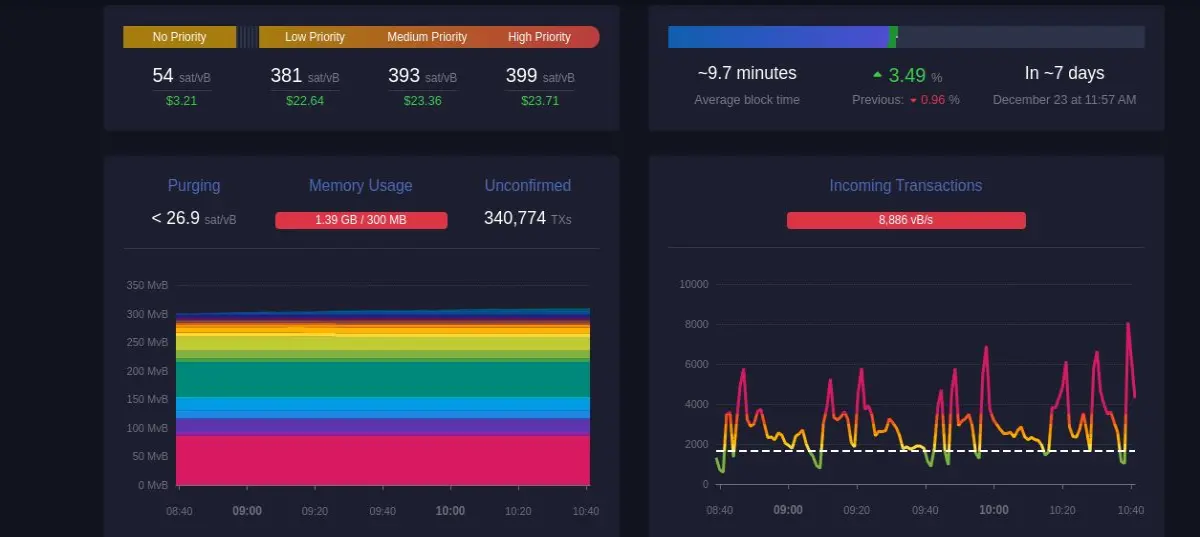
Mempool.space indicates that for several days the transactions waiting in the Bitcoin mempool are equivalent to more than 370 MvB, with 300 blocks waiting on average and more than 295,000 transactions. This became the heaviest mempool in the history of Bitcoin, surpassing the mark reached in January 2018. It should be noted that during the similar records were also reached in the congestion at the beginning of 2021 and in May of this year.
The main cause of the increase in fees is the BRC-20 token markets, which use Bitcoin to record their issuance and traders' operations. According to data from BRC-20.io, the market capitalization of these tokens is 1.6 trillion dollars, with a daily volume of 80 million dollars. One of the triggers for these markets has to do with the 1000SATS token, which arrived on Binance and led to an increase in the volume of trade.
As a result of the rise in the price of these tokens, traders are willing to pay high commissions to have their transactions executed in the shortest time possible. The result can be considered negative for people who use Bitcoin only as a means of payment, because if they wanted to make a transfer equivalent to USD 20, they would have to pay an equivalent sum in commissions.
On the other side of the coin are the network's miners, who receive the profits from user fees. Since the emergence of the Ordinals protocol, which allows all these token and NFT operations to be recorded in the Bitcoin archive, miners have raised 3,700 BTC or USD 159 millions in commissions.
The controversy over the use of Bitcoin as a database and beyond purely monetary exchange increases with the emergence of stamp and rune marketsrunes, two types of inscriptions that use a function called Op_Return to add arbitrary data in Bitcoin transactions. Although Op-Return has been used for a long time for different types of operations (as long as the added information has a limit of 80 bytes), since a couple of weeks its use has increased more than 200%, by going from an average of 8,000 transactions of this type to more than 35,000 in a single day.
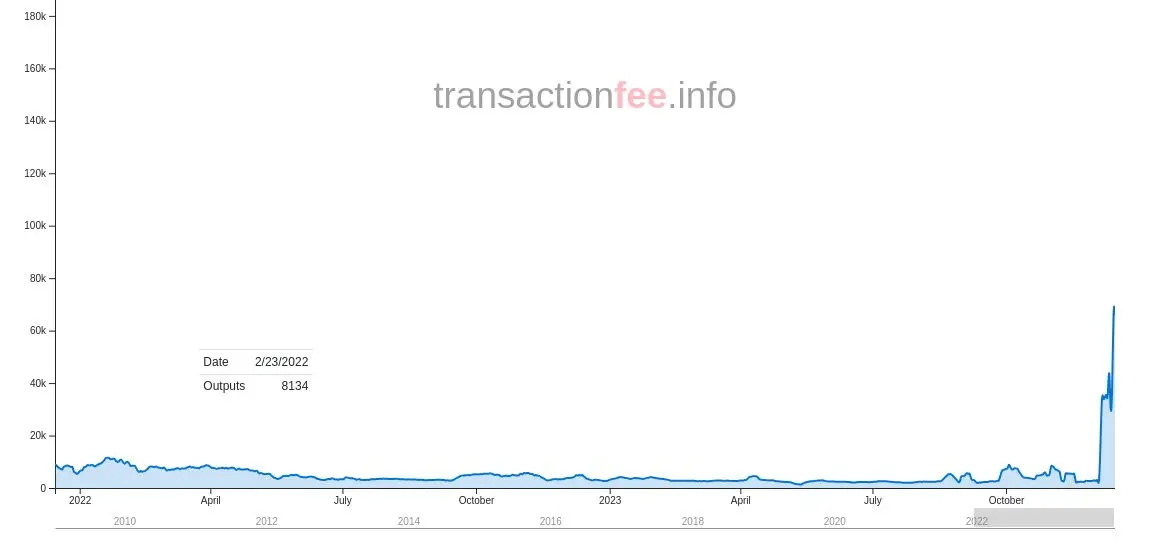
Between the increase in the use of transactions that execute Op_Return and the registrations of BRC-20 tokens, the average weight of transactions in Bitcoin has increased, since the information included has that effect. It is for this reason that although there are fewer transactions waiting than in May (when they reached a daily average of more than 400,000), the whole is heavier. That weight, which is used to calculate the value of the fees, contributes to the current mempool situation and the cost of making transactions in Bitcoin.






