
The specter of a Bitcoin fork has been invoked again, likely for the second time in 2025. The first time was during the "war" between clients: Bitcoin Knots and Bitcoin Core.
The second is happening now, after revealing private messages from one of the Bitcoin protocol's longest-serving contributors, Luke Dashjr, were leaked. The presence of this phantom is felt by the community, which doesn't mean the fork will actually happen.
It's impossible to predict with mathematical accuracy what would happen to the price of Bitcoin (BTC) if its protocol undergoes a hard fork. However, there are historical precedents, both in Bitcoin and other cryptocurrencies, that we can use to roughly estimate the market effects of a chain divergence.
A cryptocurrency fork, by "splitting" a network in two, has the potential to impact the price of the original coin due to the uncertainty this creates among holders. A fork forces them to bet on which chain will be the "legitimate" one, inciting them to sell their coins for fear of supporting the wrong option.
This selling pressure, coupled with community fragmentation, can depress the price of the original chain's asset if fear is contagious.
Bitcoin Cash (BCH), the most significant Bitcoin fork to date, is a clear precedent. This hard fork took place on November 18, 2018, after a long and drawn-out battle known as the blocksize wars.
As CoinMarketCap reports, the Bitcoin price candle covering that month opened at $4,024 and closed at $3,191.
Assuming no other major variables affected it, this price volatility was small for Bitcoin, especially considering that this was a more volatile and unpredictable time for the price.
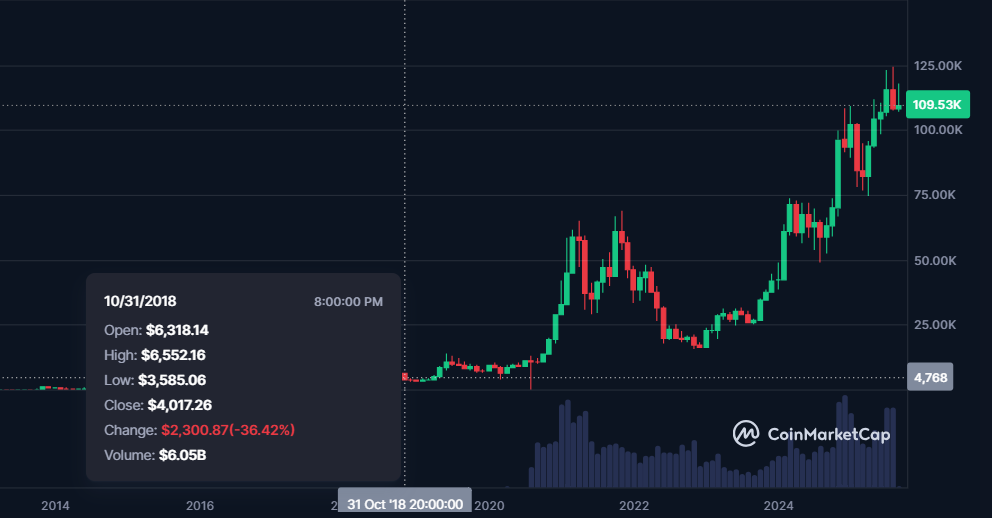 Bitcoin Cash has not affected the price of BTC in the medium or long term. Source: CoinMarketCap
The following month, in December 2018, the price remained unchanged between $3,000 and $4,000, so the fork would not have had a delayed effect on the asset's price until that date.
In May 2019, in fact, the price of Bitcoin surpassed $13,000. The July 2020 monthly candle closed above $10,000, and the largest drop that year was due to the COVID-19 epidemic, not the effects of a hard fork.
The data described reveals that the Bitcoin network, which we know today as the main and legitimate network, cared little about the Bitcoin Cash hard fork. In the case of this currency, there was no reason for Bitcoiners to fear.
Each user who held their BTC in a wallet where they controlled the private keys received an equivalent amount of BCH. They were in a privileged position, able to hold both coins without having to bet on the future of one protocol or the other.
Another Bitcoin Cash fork that occurred around the same time also had no impact on the price. It occurred in November 2018 and was known as Bitcoin Satoshi Vision (BSV). The Bitcoin price also didn't care much about this event, as the chart above shows.
Has a fork affected the price of Ethereum?
Ethereum also forked its original chain with Ethereum Classic. This fork, which occurred in July 2016 following a hack into The DAO, retains proof-of-work (PoW), the consensus algorithm also used by Bitcoin. The main network has used another consensus algorithm since 2022, called proof-of-stake (PoS).
Did the Ethereum Classic fork affect the price of ether (ETH)? CoinMarketCap indicates that ETH stagnated during July and August 2016. In December of the same year, it fell to $6.26.
In the short term, this drop, which could have been due to other reasons, was irrelevant. Starting in January 2017, the cryptocurrency's price rose to $1,400 before entering a bear market.
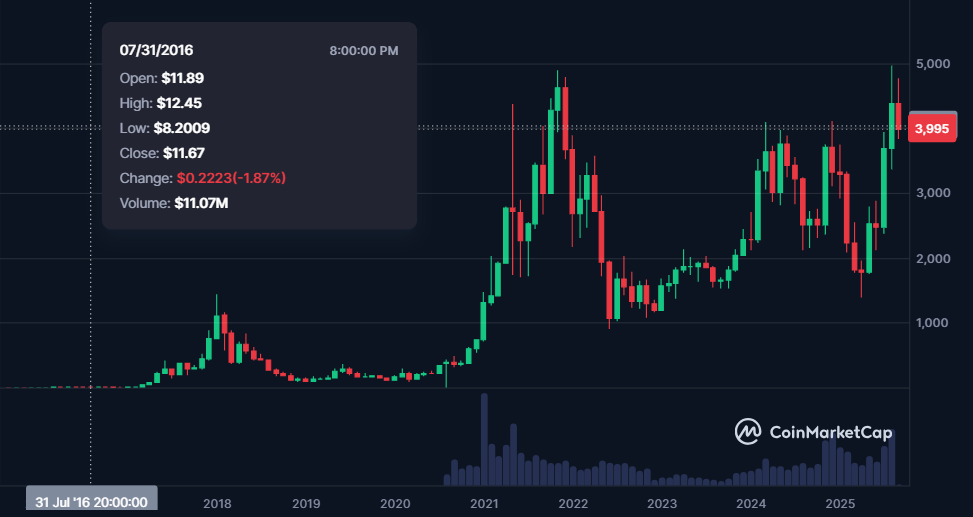 ETH also didn't suffer the effects of Ethereum Classic in the medium and long term. Source: CoinMarketCap
Summary: Bitcoin price doesn't care about forks
Ethereum, therefore, also didn't suffer significant price drops in the medium and long term due to hard forks on its chain. Competing chains to Bitcoin and Ethereum, in fact, have fared much worse than Bitcoin since its inception.
Bitcoin Cash hasn't surpassed $1,000 since briefly doing so in March and April 2021, and its price has been depressed and without any positive news for years. Bitcoin SV has been even less fortunate: its price is at historic lows ($23 per coin), creating continuous lower floors since at least December 2021.
Ethereum Classic is hovering around $18 and has been trading sideways since June 2022. Its peak price was $68. The specter of a fork is just that, a specter. An idea that haunts the minds of critics, developers, and social media commentators whenever debates about the Bitcoin protocol become tense.
However, if something like this were to happen and the integrity of the current Bitcoin network remained intact, there's no reason to think a fork would affect the price of BTC. However, history never repeats itself, so a degree of uncertainty regarding the effects of a fork on the price of Bitcoin is healthy and even desirable.






