
Ripple, the company behind the XRP cryptocurrency, announced that its stablecoin Ripple USD (RLUSD) will be launched “in weeks,” according to statements by its CEO, Brad Garlinghouse.
RLUSD stablecoin pegs 1:1 to the US dollar
RLUSD would guarantee its peg to the US dollar through a backstop system based on cash deposits, short-term US Treasury bonds and other cash-equivalent instruments.
Ripple announced its stablecoin in early April 2024 and, although the company did not explain where it will store the assets that will function as a reserve, in June 2024 it announced its partnership with Standard Custody, a digital asset custody company.
Standard Custody employs a segregated account security method for each client on the blockchain. This means that each client’s funds would be separated and can be audited and tracked on the public network.
In addition, this company uses technology that includes end-to-end encryption and secure cryptographic keys. Unlike traditional cold storage, which may require manual operations, Standard Custody employs hardware and encryption to protect assets without human intervention. This security approach aims to minimize the risk of human error and insider attacks.
Ripple did state, however, that it will conduct periodic audits by an external accounting firm, publishing reports certifying the existence and stability of its reserves. This is intended to ensure that users of this stablecoin can redeem RLUSD for real dollars at any time.
Ripple's multi-chain stablecoin launches
Initially, the RLUSD stablecoin will be based on both Ripple's network, XRP Ledger, a first-layer blockchain, and Ethereum (ETH).
However, Ripple plans to expand its stablecoin to other networks. The choice to issue RLUSD on Ethereum, one of the most used ecosystems in decentralized finance ( DeFi ), could favor the adoption and interoperability of RLUSD.
Being a token that uses the ERC-20 standard , RLUSD will be able to easily integrate with decentralized applications (dApps), decentralized exchanges ( DEXs ), financial lending platforms, and DeFi protocols existing on the network co-founded by Vitalik Buterin.
The ERC-20 standard is flexible enough to accommodate multiple use cases, such as utility tokens, governance tokens, stablecoins , and representative assets. This has allowed its adoption in different industries, from finance to gaming. RLUSD aims to take advantage of this feature to facilitate its adoption.
Despite its advantages, Ethereum is also known for its high transaction costs (gas fees), especially during times of congestion. However, Ripple claims that its stablecoin can be sent “globally in near real-time with minimal fees and without the need for a bank account.”
How will RLUSD compete against USDT or USDC?
The current market for stablecoins that replicate the value of the dollar is dominated by the cryptocurrencies of the company Tether, USDT, and USDC, from the company Circle. These stablecoins have the two largest market capitalization, according to data from CoinMarketCap.
In a recent statement, Ripple indicated that RLUSD is not designed solely for individual users, but would focus on solving the needs of businesses and institutions. This would include “cross-border and international payments, treasury management, and other corporate processes.”
Additionally, according to the announcement, RLUSD would especially target markets in regions such as APAC (Australasia, East Asia, South Asia, and Southeast Asia), the European Union, and Australia.
In this sense, USDT already has a strong position in Asian countries, such as China and South Korea, as well as in Latin America, Nigeria, Africa, and Turkey and Russia. For its part, Circle has significant adoption in the United States and European countries.
Along with 40 other RLUSD issuance licenses, Ripple plans to issue RLUSD under a New York State fiduciary license following its acquisition of Standard Custody. These licenses are regulatory permits that companies must obtain in order to legally operate in the markets where they wish to offer their stablecoins, ensuring that issuance and operation activities comply with regional financial laws and regulations.
This fiduciary license would imply a “more robust strategy” than issuance through a money transfer license (MTL) like those held by Circle and Tether, according to Ripple. Fiduciary licenses, such as the one granted by the New York Department of Financial Services (NYDFS), require institutions to maintain stricter risk management practices and meet higher financial requirements.
Under New York Department of Financial Services (DFS) guidelines, stablecoin issuers, such as Ripple, are required to maintain reserves equal to 100% of the nominal value of the stablecoins in circulation.
These reserves should be composed of low-risk and highly liquid assets, which would guarantee optimal and transparent management of the reserves.
Ripple's stablecoin testing phase continues
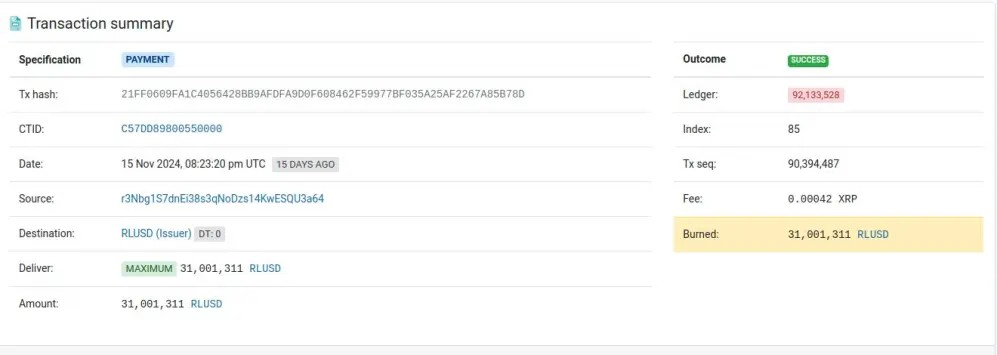
In movements linked to the testing phase of its stablecoin, on November 22, 2024, Ripple issued 10,500,000 RLUSD. Moments later, it distributed 10 million of those tokens to 4 unknown addresses. Days before, another operation linked to Ripple's tests was known in which it burned more than 31,000,000 RLUSD.
Ripple has issued 10,500,000 RLUSD as part of testing of its stablecoin. Source: XRP Scan
There are contradictions regarding the total issuance of RLUSD. For example, on ETH Eplorer it is stated that the total supply is 420 billion. However, on Ether Scan that number is 34 million.
A post on the X network from a user tracking the XRP and RLUSD token movements indicated that the total supply of RLUSD as of October 14 was 47 million.
One factor that could impact the circulation of RLUSD could be the burning of these tokens carried out by the team working on the testing of Ripple's stablecoin.
On the other hand, on October 19, 2024, Ripple confirmed the cryptocurrency exchanges on which the stablecoin RLUSD will be listed. Among them will be Uphold, Bitstamp and Bitso.
Thus, given that the Ripple CEO affirmed the early insertion of RLUSD and the constant testing done by the team behind this stablecoin , a new stablecoin would be inserted into the market to dispute the dominance of USDT and, secondarily, of USDC.





