
A section of the Ethereum community is concerned that the crisis of effective leadership within the network is affecting the price of ether (ETH). Days after the most heated moment of the debate, Vitalik Buterin, the creator of the network, shared in a blog some plans to scale Ethereum and protect the price of the cryptocurrency.
According to the creator of Ethereum, several solutions could lead to improvements in the Ethereum economy. One of them is to give more importance to ether in the economy of the main network and second layers of the network.
Another solution is to encourage the use of ETH, across Layer 2s, with a percentage of the fees. “This could be done by burning a portion of the fees, staking them permanently, and donating the proceeds to the public goods of the Ethereum ecosystem,” Buterin wrote. These fees would be levied on Layer 2s to support the mainnet.
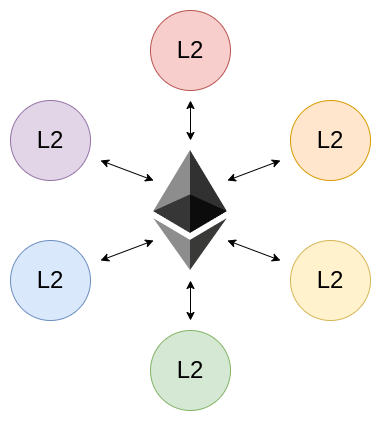
Representational model of L2. Source: Vitalik Buterin's Blog
The third idea to promote an improvement in the Ethereum economy is to support the use of rollups capable of providing contributions to the main network through the MEV (Maximum Extractable Value).
Called based rollups, these second-layer solutions can leverage the transaction sequencing capabilities of the main chain (L1) on which they are built. The maximum value, meanwhile, refers to the profits that Ethereum validators can earn by optimizing the order of transactions within a block. According to Vitalik, giving greater support to this kind of rollups can help capture this value on the main network.
Support for rollups is partly a way for L1 to capture value through MEV, but don't try to force all rollups to be like this (because it doesn't work for all applications) and don't assume that this alone will solve the problem.
Vitalik Buterin, creator of Ethereum.
Finally, the creator of Ethereum believes that increasing the number of blobs (binary large objects) is a real possibility. Blobs are units of data that can be added to Ethereum blocks to improve the scalability and efficiency of the network. Since they are temporary data, they take up less space and require less work from the network.
If these blobs were priced at a minimum, Vitalik says, they could function as an extra revenue stream on Ethereum. Users who want to improve the efficiency of their transactions on the network could pay extra for each blob. This would yield more revenue on the Ethereum network, and would provide more coins to be burned.
Increase the blob count, consider a blob floor, and consider blobs as another potential revenue generator. As an example of a possible future, if you take the average blob fee for the past 30 days and assume it stays the same (due to induced demand) while the blob count increases to 128, then Ethereum would burn 713,000 ETH per year. However, such a favorable demand curve is not guaranteed, so don’t assume this alone will solve the problem either.
Vitalik Buterin, creator of Ethereum.
Vitalik reacts to community concerns
Part of the current concern around Ethereum is that, community members feel, the Foundation and the core developers of the network do not seem to be too involved in the use of DeFi protocols and the digital assets they themselves create.
The initial concern that the above stems from is that the Ethereum Foundation prioritized the direct sale of ethers to finance itself, instead of prioritizing staking protocols and other ways of covering its expenses that do not involve the sale of the network's coins. The community's dissatisfaction is that these sales would be excessively affecting the price of ether.
Vitalik Buterin, in his post, made a nod to complaints that developers do not use Ethereum, clarifying that this is a social technology used by millions of people, including himself.
Ethereum does useful things for people, on a massive scale. Millions of people hold ETH or stablecoins as a form of savings, and many more use these assets for payments – I am one of them.”
Vitalik Buterin, creator of Ethereum.
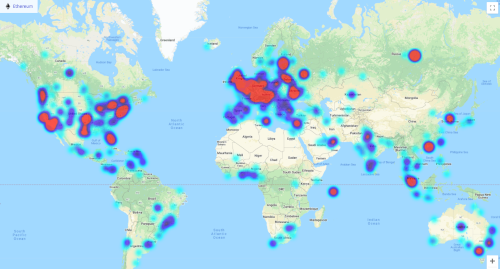
Places around the world where you can pay with Ethereum. Source: Vitalik Buterin's Blog
He then went on to list the features that make Ethereum a globally useful social technology:
“[Ethereum] has effective and functional privacy tools that I use by paying for VPNs to protect my internet data. It has ENS, a robust decentralized alternative to DNS and more broadly to public key infrastructure. It has functional and easy-to-use alternatives to Twitter. It has DeFi tools that offer millions of people low-risk, higher-yield assets than they can access in TradFi [traditional finance].” Brackets are the author’s.
Vitalik Buterin, creator of Ethereum
The community's concerns have reportedly reached such a point that certain figures have announced the creation of a second Ethereum Foundation. However, Konstantin Lomashu, the person credited with the initiative to "fork" the governance of the network, denied that he is presiding over a new leadership body within the community.






