
The U.S. Treasury Department announced today the lifting of economic sanctions against Tornado Cash, a decision aimed at protecting the digital asset industry from North Korean abuse, according to an official statement posted on its website.
The measure, which reverses restrictions imposed in 2022, reflects the current administration's position after reviewing the legal and technological implications of the sanctions imposed by the Joe Biden administration on decentralized platforms. Now, the Donald Trump administration is prioritizing promoting financial innovation for American citizens. However, the Treasury remains committed to monitoring transactions that could benefit malicious actors or the North Korean regime.
The new resolution removing Tornado Cash from the blacklist follows an administration assessment of how financial sanctions interact with evolving technological environments. The Ethereum -based cryptocurrency transaction mixing protocol allows users to anonymize transactions, which sparked controversy when it was linked to illicit activity.
Now, the Treasury argues that removing these sanctions encourages the development of the digital asset industry while remaining vigilant against potential abuses. This decision comes after a court lifted the sanctions against that protocol, as this outlet reported in January.
“Digital assets present tremendous opportunities for innovation and value creation for the American people,” said Treasury Secretary Scott Bessent, who emphasized the need to protect this sector from actors like North Korea to consolidate U.S. financial leadership.
Tornado Cash's history with U.S. authorities began in August 2022, when the Office of Foreign Assets Control (OFAC) included it on its sanctions list, accusing it of facilitating the laundering of more than $455 million in stolen cryptocurrencies, mainly by the North Korean group Lazarus.
This sanction set a precedent for open-source software, sparking criticism from the cryptocurrency community that it criminalized privacy.
Since then, the protocol's founders have faced legal repercussions, with varying fates. Alexey Pertsev was arrested in the Netherlands in 2022 and sentenced to 64 months in prison for money laundering in May 2024, while Roman Storm and Roman Semenov were indicted in the United States in August 2023 on similar charges.
In addition to removing Tornado Cash from the OFAC list, the Treasury also removed Roman Semenov, one of its co-founders, from the Sanctioned Persons List. This action has significant implications for Semenov, who remained a fugitive following the indictments, as it removes the direct economic restrictions placed on him in the United States, such as asset freezes and prohibitions on transactions with U.S. citizens.
Although the administrative sanctions have been lifted, the criminal charges against him and Storm remain, suggesting that their legal status will depend on the course of the ongoing legal proceedings. For Semenov, this could facilitate financial transactions , but it doesn't exempt him from facing trial if he's caught. Roman Storm believes the battle has barely been won, but the war is still a long way off. Source: X/rstorms.
Other cases similar to Tornado Cash
This Treasury decision could also influence similar cases, such as that of Samourai Wallet, another privacy tool facing legal scrutiny, as widely reported by CriptoNoticias. Samourai developers Keonne Rodríguez and William Hill were arrested in April 2024 and charged with money laundering for facilitating anonymous transactions.
Their trial, scheduled for the coming months, could be impacted by the Tornado Cash precedent. The removal of sanctions on a decentralized protocol suggests a possible rethinking of how authorities approach these technologies , which could benefit the defendants by challenging the legal basis for sanctioning open-source tools. However, the Treasury emphasizes that it will continue to monitor any misuse, which keeps the pressure on developers.
Since its initial approval, Tornado Cash has sparked a global debate about privacy regulation in the cryptocurrency ecosystem, with proponents arguing that the software is neutral, and its misuse falls on the actors, not the creators.
The platform, which operates through immutable smart contracts, continued to operate despite the sanctions, highlighting the challenges of regulating decentralized technologies.
The Treasury assures that its approach now is pragmatic, seeking to balance innovation and security, while warning Americans about the risks of interacting with platforms that can be exploited by malicious actors.
Following the Treasury Department's announcement, the price of TORN, the cryptocurrency behind the Tornado Cash protocol, soared 63.9% from $7.50 to $14.30 at the time of writing.
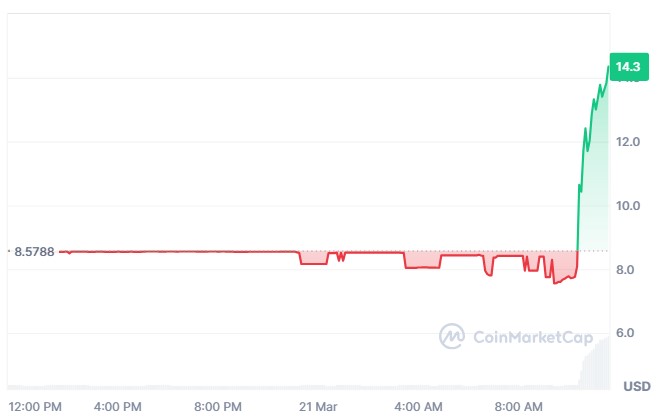 The price of TORN has skyrocketed 69% in just a few hours. Source: CoinMarketCap.
For the community, this news represents a step forward in the defense of financial privacy, with implications that go beyond Tornado Cash and reach into cases like Samourai Wallet, where developers hope for an outcome that reflects this new stance.
The Treasury, for its part, reaffirms its commitment to combating illicit financing, especially of North Korean weapons programs, but opts for an approach that does not directly punish the underlying technology. The future of the founders of Tornado Cash and other similar projects will depend on how both the laws and judicial interpretations evolve in this rapidly changing field.






