
Although the boom in bitcoin (BTC) reserves continues to flourish in the United States, with more than 20 states proposing their own laws to create them, there are 3 cases where this was not successful and the different BTC treasuries were far from becoming state laws.
In North Dakota, Wyoming, and Pennsylvania, legislative proposals to create BTC reserves and allow investment in digital assets did not make it past their discussions in Committee, with some cases being frozen by the arrival of a new legislative period.
In two of the cases, there were clear coincidences: they consider that a law to authorize investment in BTC is “unnecessary”, since this is currently under the power of state treasurers.
Proposals to create bitcoin reserves in the US are constantly being presented in state legislatures. According to data from BitcoinLaws, there are a total of 20 bills currently active and in the legislative process, which seek the creation of different strategic bitcoin reserves.
Furthermore, 31 states introduced bills to include bitcoin and the cryptocurrency ecosystem in their monetary policies, promoting investment and advocating for privacy protection and self-custody.
Now, what happened to the projects in North Dakota, Pennsylvania and Wyoming?
1. North Dakota
North Dakota’s bill, HB 1184, which proposed allowing the state to invest in digital assets and precious metals, the former with market capitalizations exceeding $500 billion, as well as stablecoins, failed on January 31, 2025.
In the plenary vote, the bill received 57 votes against, 32 in favour and 5 abstentions. Thus, the proposal died before ever seeing the light of day.
What led to this bill being scrapped is that, according to the Wyoming House of Representatives' Business, Labor and Industries Committee, legislation of this type is unnecessary.
Committee Vice Chairman Mitch Ostlie said during the plenary that there is evidence that Wyoming's financial authorities, including the Board of Investments, have the authority to invest in digital assets and precious metals.
“Therefore, this bill is not necessary,” the congressman said.
Ostlie also commented that proponents of the bill, including Nathan Toman and other congressmen, argued that while these entities have this authority, they are not currently investing in digital assets or precious metals. And that by passing this bill, a clear message would be sent to authorities to start including them.
“The majority of the committee did not agree with this and we ask that they follow the committee’s recommendation and vote red (negative),” the congressman said.
An interesting fact about the Wyoming project is that one of the co-sponsors of the proposal was Congressman Josh Christy. During the plenary vote, he strangely voted against its approval, as recorded in the minutes of the session of January 31, 2025. The politician died on February 18, at the age of 43.
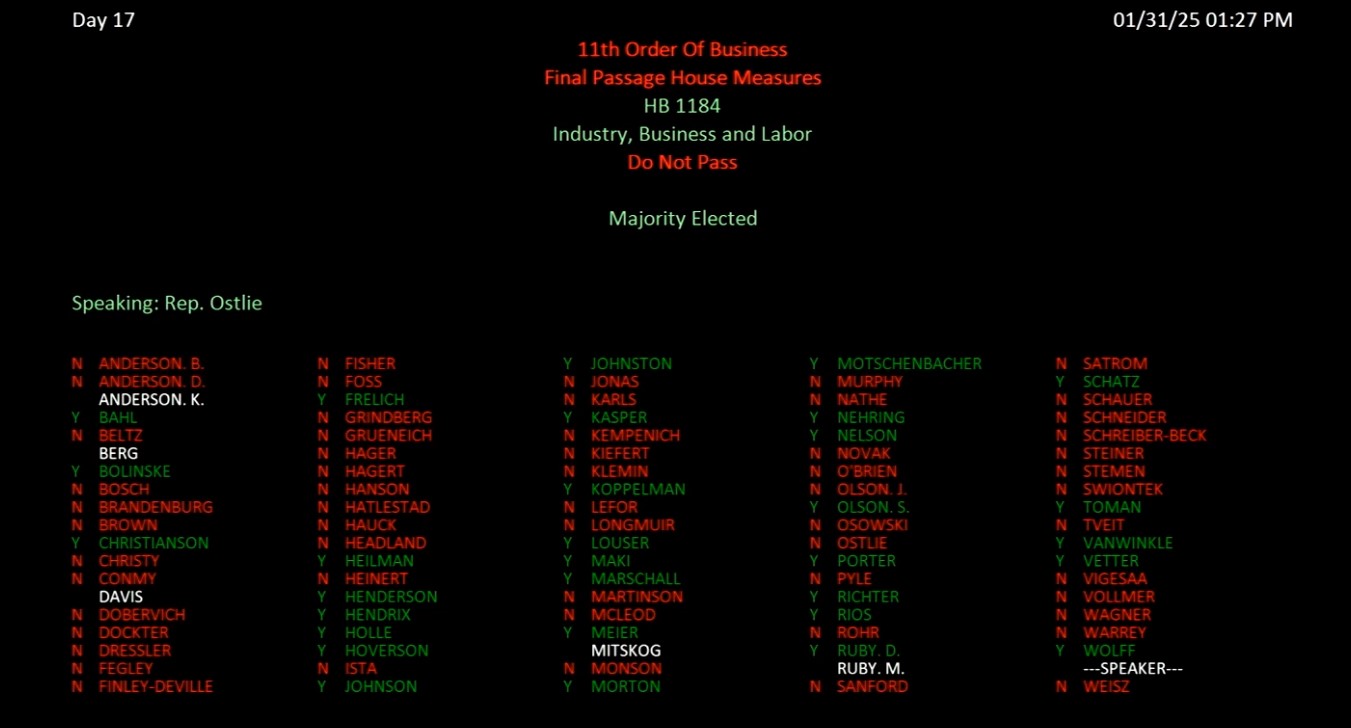 North Dakota voted against the pro-BTC proposal. Source: North Dakota Legislature.
2. Wyoming
A similar situation to North Dakota arose in Wyoming. House Bill 0201, which sought to allow public funds to be invested in bitcoin, was unsuccessful and fell behind in the legislative race. On February 10, the Wyoming Legislature's Minerals, Business and Economic Development Committee voted against the proposal by a vote of 7 to 1.
Before being rejected by the Committee, this legislative proposal, presented by a group of congressmen led by Jacob Wasserburger, received harsh criticism in a session of the same legislative body, held on January 27, 2025.
At that session, Wasserburger defended his arguments, proposing that Wyoming open its own BTC reserve, based on the benefits that could be granted to the state through this proposal in terms of inflation and coverage against the devaluation of the dollar. But he was overwhelmed by representatives of the State Treasury.
State Treasurer Curt Meier weighed in on the debate and stated that one of the biggest risks he sees in BTC is the “concentration of holdings in a few people,” claiming that during the prehistoric times of this ecosystem, the “original founders” mined Bitcoin in large quantities and now “hold a large percentage of all BTC in circulation.”
He referred to Satoshi Nakamoto, the creator of Bitcoin, who is estimated to hold more than 1.1 million BTC in different wallets. Nakamoto obtained these coins through digital mining, which at that time offered rewards of 50 BTC. This has been reduced by 93.5% in a matter of 16 years.
“I think that depending on how they market that large percentage, there will be extreme fluctuations in price. There is a risk of volatility there,” said Meier, who then finished by clarifying that investing in bitcoin will not help the success of the state investment portfolio, since he believes that there are things “that give us higher returns.”
A similar statement was made by Wyoming Deputy Treasurer Dawn Williams, who does not see the need for a bill to govern bitcoin investing.
“We have our own set of rules, it’s called the investment policy statement, for the state of Wyoming. It’s developed in conjunction with our staff, our professionals, our investment fund committee, which is the volunteer advisory group of professionals, as well as the state lending and investment board, which is comprised of the state’s top five elected officials. So those are our rules. We don’t really need new ones,” he said.
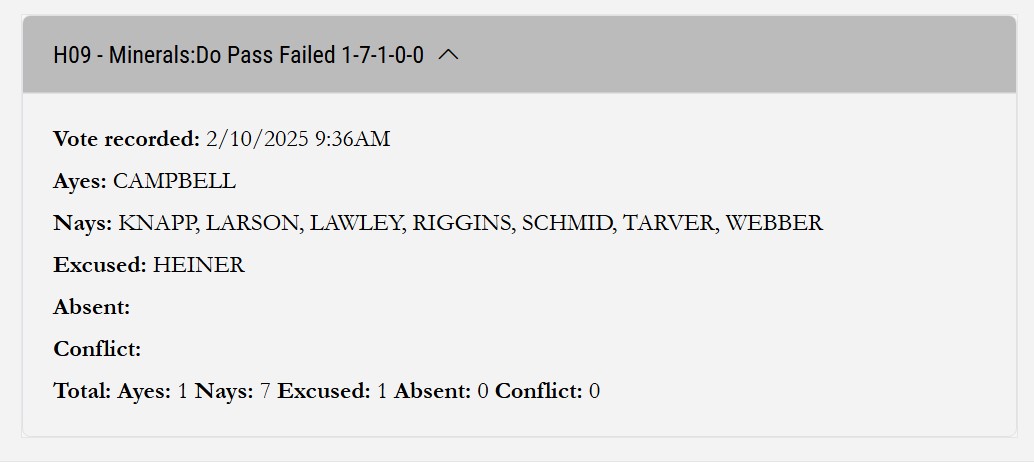
Wyoming sees bitcoin investment as unnecessary. Source: Wyoming Legislature.
Something problematic
Meanwhile, Patrick Fleming, chief investment officer for the Wyoming Treasurer's Office, said the bill forces them to invest in bitcoin, "which is problematic from the treasurer's perspective."
According to Fleming, the state has more than $4 billion in non-denominated securities. “So it’s not like the dollar has a problem and we don’t have any other options in this regard. In fact, the dollar has been extremely strong,” he said.
Fleming also dismissed the issue of inflation's impact on Wyoming, which has averaged 2.6% over the past 20 years, "and we beat inflation easily." "Beating inflation hasn't been a long-term issue, so that's not the concern," he said.
This executive also pounced on bitcoin, saying that it has no intrinsic value, nor do cryptoassets.
“The way we’re working now is that if you have a stock that pays a dividend or you have a bond that pays a dividend, you can determine what the intrinsic value is, you understand what the company is worth, the value of that. Versus other assets like bitcoin, you can’t do that with those types of assets, whether it’s BTC, solana, cardano. That’s something you just can’t determine. That’s problematic,” he argued.
Returning to the topic of BTC volatility, he stressed that this characteristic factor of the world's most important digital currency "is a problem for us."
“Because with our assets, even a 3% weight would definitely skew our volatility-weighted returns. So investing $3 billion in BTC would force us to reduce our equity position by 6-9% for that volatility adjustment,” he said.
He said bitcoin, over the past decade, “has been one of the best investments out there. It’s just been a moonshot.” “But when you look at the volatility of that, for example, in 2021 it was down 77%. Those are the kinds of things we don’t want in our portfolio.”
In that regard, Fleming highlighted the role of stablecoins, which, according to him, “are the future of cryptocurrencies.” “Because we don’t manage the volatility of the price of bitcoin. There is no value in that. But a stablecoin is a dollar, and that has value.”

Fleming believes BTC has no intrinsic value. Source: YouTube.
“Bitcoin doesn’t pay interest, we need securities that generate interest because we have a 5% spending policy that we have to adhere to and when you don’t have a security that has no intrinsic value and doesn’t pay anything, it’s problematic. At least with a stablecoin we wouldn’t lose that 4.5% interest.”
Fleming, however, did not rule out investing in bitcoin, although it would be indirectly, through any of the 12 BTC spot price exchange-traded funds that are being traded on the US stock market. However, to do so, the guidelines already established for the state to invest must be met, he stressed.
3. Pennsylvania
The least traumatic case for a bill seeking to create a bitcoin reserve is that of Pennsylvania. In this case, the bill HB 2664 was not voted on in Committee. It was simply frozen.
On November 19, 2024, the Pennsylvania Legislature decided to refer the legislative proposal presented by Congressman Mike Cabell to the Finance Committee of the State House of Representatives.
However, this was left as it was, as the referral was made during the now-concluded 2023-2024 legislative period, and was never discussed or voted on in the legislative bodies of the Pennsylvania General Assembly.
In addition, no new projects of this type have been proposed in the new 2025-2026 legislative period. The proposal was therefore put on hold.
Cabell, in his presentation, clarified that the goal was to provide the Pennsylvania treasurer, as well as state treasury funds, “with additional tools to protect against inflation that has eroded the purchasing power of our state and its retirees.”
According to his arguments, “studies suggest that holding a small percentage of reserves in BTC can contribute to a well-diversified and resilient portfolio.” And he recalled that “inflation has impacted Pennsylvania’s purchasing power by almost 20% over the past 4 years.”
“We need solutions that can offer stability in uncertain economic times. Bitcoin, which has appreciated significantly over the years, can help Pennsylvania keep pace with inflation and economic change,” the bill’s sponsor said at the time.
Cabell was not elected to remain a House representative in the November elections, so he no longer has the authority to continue pushing for this bill. Therefore, everything indicates that the discussion for a BTC reserve in Pennsylvania is back to square one.
Beware of other states
Given that legislative proposals to create bitcoin reserves in North Dakota, Wyoming and Pennsylvania failed, other states could take similar paths. This is taking into account that there is a visible pattern, which is to see investment in BTC as something “unnecessary.”
But history has shown the need to seek refuge in high-value assets, such as bitcoin, and perhaps it is history itself that will judge the condition of politicians who, unlike a few exceptions, remain faithful in defending the inherited financial system , which, by the way, is in constant decline.






