
The search for digital assets as a store of value has led publicly traded companies to explore new frontiers beyond bitcoin (BTC) and ether (ETH), Ethereum's cryptocurrency.
Now, Solana (SOL) has become the new focus of corporate treasuries. This move reflects a strategic shift in how companies manage their reserves, seeking to diversify risks and take advantage of opportunities in the decentralized finance (DeFi) ecosystem.
Currently, 13 publicly traded companies have accumulated 8.9 million SOL, a volume that grew by 7% in the last month.
Sharps Technology tops the list with 2.14 million SOL, valued at $461 million. It's followed by DeFi Development Corp, with 2.02 million SOL ($437 million), and Upexi, with 2 million SOL ($431 million).
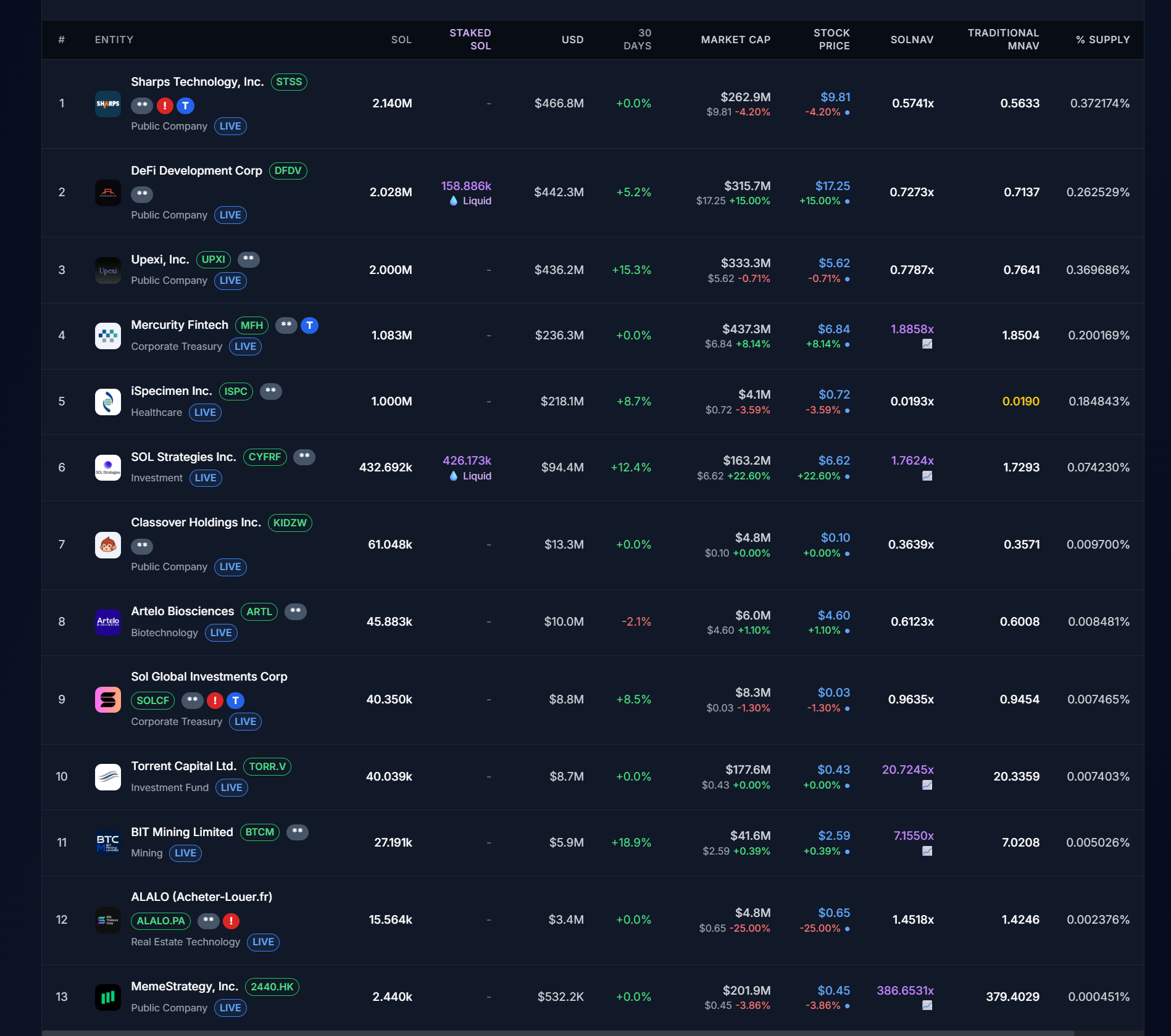 13 companies accumulate 8.9 million SOL. Source: Strategic Solana Reserve.
These figures demonstrate the growing interest in Solana as a strategic asset, driven by its potential to generate 5% annual returns (paid in the cryptocurrency itself) through staking, a process that allows SOL holders to earn income by participating in the validation of transactions on the network. Of course, if SOL suffers a significant price drop, that 5% return on the cryptocurrency will be dwarfed.
Institutional treasuries in Solana are now joined by Forward Industries, a design firm serving the medical and technology sectors, which is seeking a prominent place in this trend.
The company announced on September 8 that it raised $ 1.65 billion through a private investment in public equity (PIPE) led by Galaxy Digital, Jump Crypto, and Multicoin Capital. If it makes its purchase at the current price of $213 per SOL, it would acquire $7.7 million in SOL, surpassing all other companies and cementing itself as a leader in this strategy.
A strategy inspired by bitcoin
Solana's move follows the model of Strategy (formerly MicroStrategy), the firm led by Michael Saylor, which transformed the concept of corporate treasury by accumulating large amounts of bitcoin through debt issuances such as convertible bonds and stocks.
This approach allowed Strategy to fund its purchases without relying on operating income and become the company with the most bitcoin in its treasury. Now, companies like Forward Industries are replicating this tactic, but with SOL.
Interest in the cryptocurrency was also shown by companies Galaxy Digital, Multicoin Capital, and Jump Crypto, which announced plans to raise $1 billion and form a SOL strategic reserve.
These firms see SOL as an asset with the potential to diversify portfolios and strengthen their exposure to the DeFi market , where protocols based on this network have gained ground due to their speed and low cost.
Critical voices against Solana's treasuries
However, not everyone shares Solana's enthusiasm for treasury assets. Bruno Vaccotti, founder of the Paraguayan Chamber of Digital Asset Mining, maintained that none of Solana's features make it comparable to Bitcoin for serious treasury purposes.
 Bruno Vaccotti, founder of the Paraguayan Chamber of Digital Asset Mining. Source: Peztresojos – X.
“Bitcoin is not just another digital asset; it is sound, decentralized, and neutral digital money, with the highest monetary security, liquidity, and predictability in the world. Its supply is immutable, its network is the most resilient in existence, and its adoption is global and growing,” Vaccotti stated.
According to him, Ethereum and Solana, while offering speed and low cost, sacrifice decentralization, suffer arbitrary changes, and face repeated technical failures, which undermine long-term trust. "A corporate treasury doesn't look for ephemeral promises; it looks for security, liquidity, and a decades-long horizon. In that sense, the only reliable option is Bitcoin, and only Bitcoin," he concluded.
For their part, analysts at the investment firm Galaxy Digital, who call this phenomenon "The Treasury Trend," warn of the risks of financing these purchases with debt, especially through zero-coupon convertible bonds.
These instruments allow investors to convert debt into equity if the equity price exceeds a threshold at maturity. Otherwise, companies must repay the capital in cash, which could lead to liquidity issues if markets become volatile. While Galaxy assures there is no "imminent threat," it acknowledges that the history of leverage in the crypto industry warrants caution.






