
On September 25, a media outlet reported alleged private messages from Luke Dashjr, maintainer of Bitcoin Knots and the OCEAN pool, in which the developer stated that he was "considering a hard fork to implement a trusted multisig committee that could retrospectively alter the blockchain to remove illicit content."
According to the post, Dashjr has admitted that the current strategy of "monitoring the mempool" would not be enough to prevent nodes from storing CSAM (Child Sexual Abuse Material).
This type of content, although extremely marginal on the web, has been part of technical debates due to its potential to be inserted into transaction attachments.
The report details that the proposal would entail a change to Bitcoin 's consensus. Specifically, it would establish a multisig committee with "the power to review transactions and replace any data identified as CSAM with a zero-knowledge proof (ZKP)."
This way, node operators could delete the contents of their computers while maintaining the cryptographic validity of the affected transactions.
One of the messages attributed to Dashjr reads: "Right now the only options are Bitcoin dying or we have to trust someone. "This position, expressed by the media outlet in question, distances itself from the principle of immutability that characterizes the network, given that it would introduce a retroactive censorship mechanism administered by a small group of participants.
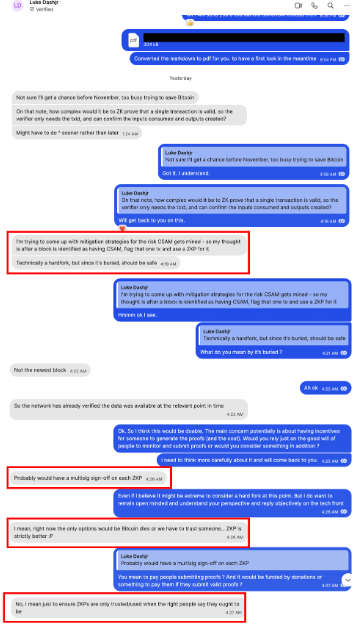 Luke reportedly said, “Right now the only options are either Bitcoin dies or we have to trust someone.” Source: The Rage.
What does Luke Dashjr think about a Bitcoin fork?
Hours before the article was published, Dashjr, in a poll on X asking whether a Bitcoin fork was necessary, wrote: "If we have community support, a fork is not necessary. If we don't have community support, a fork is not possible."
While it doesn't seem to completely rule out the possibility of a fork, that statement contradicts what the outlet reported.
On social media, Dashjr rejected the accusations and denied proposing a hard fork. “The truth is, I have not proposed a hard fork or anything like that, and these bad actors are just looking to smear me and try to undermine my efforts to save Bitcoin again,” he wrote in an X thread.
He also responded directly to a publication by the outlet, accusing it of misrepresenting his positions: "To top it off, they have to fabricate 'what Luke thinks,' and they don't settle for honestly representing what I really think (which is still often controversial)."
In another post, he called the report "defamatory fake news" and asserted that his real goal is to "defeat the Core30 attack by spreading awareness so no one upgrades to that version."
He even went so far as to warn that if Bitcoin were left in the hands of its critics, the network "would cease to exist when Core30 turns it into a CSAM file-sharing platform."
The notion of a hard fork in Bitcoin raises far-reaching technical and political implications. That circumstance does not seem to be close, although if the dispute between the Knots client defenders against those of Core were to grow, the scenario could change.
A hard fork involves a change in the consensus rules that divides the network between those who adopt the new rules and those who remain on the previous version, which can result in two distinct chains.
In this case, the point of discussion would be whether or not there should be an authorized entity to retroactively modify the network.






