
The Bank for International Settlements (BIS) suggests that inflation, which is already persistent, will remain high, especially in labor. In a new report, the financial institution points out that “the possible slowdown in disinflation could cause monetary policy to remain more restrictive for longer.”
The report itself points out that inflation, caused by the high cost of services, is likely to remain high this year and could cause central banks to delay interest rate cuts.
It refers to the fact that the service sector requires a lot of increasingly scarce labor; and, therefore, more expensive.
So, with wages influencing the prices of services, these will also increase further. And, consequently, the “possible slowdown in disinflation could lead to monetary policy remaining tighter for longer,” the report adds.
In this scenario, the BIS adds that the persistent growth of services inflation has proven to be an obstacle to addressing the “last mile” of inflation.
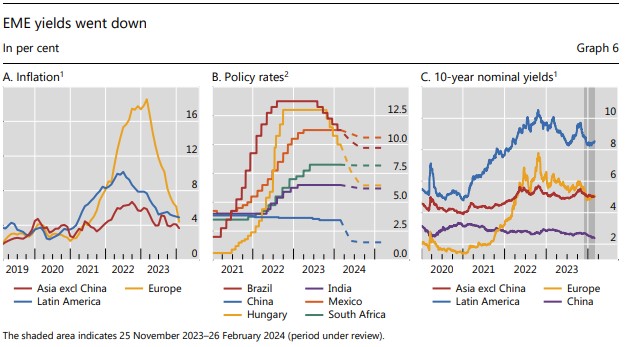
Prices for services have remained high even as the cost of food and energy has fallen in the eurozone and other major economies, since Russia's invasion of Ukraine.
What is happening currently is that there is a convergence effect in which wages continue to rise while other prices have been moderating, especially in Europe and the United States.
Given this, some economists have warned that inflation has been driven further by unexpectedly high consumer demand for services and, therefore, it may take longer to respond to disinflationary pressures.
The BIS makes it clear in its quarterly report published yesterday that it is "cautiously optimistic" about the performance of each country's central banks in controlling inflation.
Regarding the global economic situation, the report brims with optimism. In this regard, he says: “Central banks took decisive measures to prevent inflation from solidifying” and adds: “economic activity was surprisingly resilient and the financial system held up well.”
However, not everyone is so optimistic about fiat money, rather the enthusiasm and excitement currently revolve around the price of bitcoin, which today climbed towards 69,000, touching its all-time high.
In that sense, it is evident that while the world's central banks are concerned about controlling inflation, there are a good number of people, from all over the planet, pointing towards bitcoin, precisely an asset that they turn to as a store of value.
So there are many people in the world adopting bitcoin as a solution to what banks still do not solve.
The explanation for this was recently given by macroeconomic analyst Lyn Alden. For her, the fiat money of the world is broken and this is due to a broad impression that leads her down the path of “rapid monetary degradation.”
"When you look at the long tail of most currencies, which is actually where most people in the world live, they experience rapid monetary debasement."
Lyn Alden, macroeconomic analyst.
Alden adds that while nations' money, which is what salaries and savings are denominated in, continues to be broken, there are also more and more people turning to bitcoin to protect themselves from devaluation and inflation.
The macroeconomist maintains that “our current monetary system has fallen behind technological advances and that in contrast there is bitcoin, which is a technology that is a better version of money, given that it is scarce, like gold.






