
The SWIFT interbank network published the Standards MT November 2025 document, announcing the incorporation of a new standard into its messaging system: compatibility with blockchain wallets (cryptocurrency networks).
The update, announced on July 19, is part of the update to its ISO 20022 standard, which will come into effect in November of this year. The update aims to connect traditional operations with the growing digital asset ecosystem.
ISO 20022 is a common messaging language for financial institutions, designed to standardize how data is transmitted in payments, securities, and foreign exchange. The integration of blockchain addresses into this standard marks a step toward interoperability between global banking infrastructure and decentralized networks.
Among the changes introduced in SWIFT's Standards MT November 2025 document, three elements stand out that directly address the integration of digital assets into the global banking infrastructure.
New BCAW Format For Blockchain Accounts
Until now, SWIFT messages could only identify traditional bank accounts using a 35-character field known as "97a Cash Account." This space was sufficient for conventional account numbers, but too short for blockchain addresses, which are typically longer and more complex. With the introduction of the BCAW (Blockchain Account Wallet) format, it will be possible to include full addresses representing both cryptocurrencies and central bank digital currencies (CBDCs).
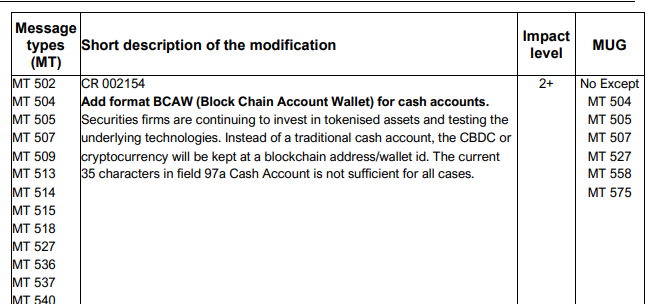 “Brief description of the modification: add BCAW (Blockchain Account Wallet) format.” Source: SWIFT.
In practice, this means that an international transaction will be able to directly point to a blockchain wallet as the source or destination account, something that was not possible before.
Incorporating Oracles as a price source
Another change is that financial reports under ISO 20022 will be able to explicitly recognize the role of oracles.
These systems act as intermediaries that transmit real-world data to blockchains, for example, the price of an asset or the result of a financial index. The new standard categorizes them as a "location code" within the message, which in practical terms means that prices used in a transaction can have a verifiable and standardized reference.
Thus, when a bank reports the value of a token or digital security, it will be able to record which oracle provided the data.
Definition of blockchain network fees
Finally, a qualifier is added that allows for explicit description of network fees, that is, the rates that users pay on blockchain networks to have their transactions validated and processed.
Until now, international transfers via SWIFT did not include these types of fees. With this new feature, messages will be able to more accurately reflect the true cost of operating with digital assets, including both the transaction and the associated network fee.
Together, these changes demonstrate that SWIFT recognizes the advancement of digital assets and decentralized infrastructure in global financial flows. The fact that ISO 20022 incorporates these elements represents a bridge between centralized banking messaging and the distributed ledger inherent to cryptocurrencies.
For banks, securities firms, and regulated entities already experimenting with tokenization and digital currencies, this provides a common framework that makes it easier to integrate these instruments into their daily operations.






