
In an opinion piece published in RIA Novosti, Olga Samofalova said that Bitcoin could become a strategic ally for Moscow in 2025. According to the journalist, Russia needs a currency for cross-border payments that no one can ban, in order to circumvent sanctions imposed by the United States.
Samofalova notes that in 2024, the West will tighten its economic sanctions, affecting not only Russian assets and companies, but also foreign banks that process transactions linked to restricted Russian entities.
These economic challenges coincide with efforts discussed at the recent BRICS summit in Kazan, where the bloc's leaders agreed to create the BRICS Bridge – a cross-border payments system designed to streamline international transactions between member countries.
In fact, Olga mentions the recent moves by BRICS, stressing that Washington seems concerned. According to the columnist, the fact that Donald Trump threatens to impose 100% tariffs on the countries of the bloc shows that important negotiations are taking place behind the scenes. However, the article highlights that, although the development of a unified payment system between the BRICS countries was already a complex process, tensions with the United States may lead to a stagnation of the proposal.
All these difficulties have led Moscow to take the lead in issues of adoption, implementation and development of new payment systems through Bitcoin and other cryptocurrencies. Russia has established a specific legal basis that allows for the regulation of mining, cryptocurrency trading, investments and taxation in this sector.
Olga Samofalova.
The letter highlights the need for Russia to speed up its trade with allied countries, stressing that “Bitcoin and other electronic means of payment cannot be banned, even by the United States.” These statements coincide with Vladimir Putin’s statements in early December , when, during a panel, he stated that new technologies will continue to develop regardless of what happens to the US dollar.
Samofalova also touched on the digital ruble that has caused such a stir in some quarters of the Eurasian country. She acknowledged that, while it is a modern and more secure format than paper money, its benefits are mainly limited to the domestic sphere and not to cross-border payments. The reporter stressed that, in the future, “It will be impossible to commit financial fraud using digital rubles,” due to the higher level of state control compared to traditional payments. However, on the international level, its advantages will be limited, since “The digital ruble would be tracked in the same way as the regular ruble.”
This is where, according to Olga, Bitcoin becomes even more relevant:
In this sense, Bitcoin is a super currency, since it does not depend on the Russian Central Bank or the policies of the US Federal Reserve or the White House; that is, it is created by mining according to a pre-established algorithm and without the intervention of any entity, but the important thing is that BTC transfers are completely anonymous. How can sanctions be introduced here? There is no way.
Olga Samofalova.
The journalist also highlighted the decentralization and security of Bitcoin , stressing that it is almost impossible for a hacker to dismantle the architecture of this payment system, unlike the infrastructure of a Central Bank, which can be vulnerable.
The article concludes with the following excerpt:
For sanctions evasion, Bitcoin is unmatched. However, this currency is also complex and must be handled carefully, especially when a country wants to operate within the legal framework. Due to its anonymity, Bitcoins can be used in illegal activities, such as drug trafficking, arms trafficking, fraud, and more. Furthermore, controlling export and import operations with BTC is complicated for the government. However, difficult times in the global economy require unconventional and risky measures. An example of this is the export of Russian oil, which remains possible thanks to the fact that oil tankers can move invisibly. Bitcoin offers something similar: it makes the financial transactions of Russian importers and exporters with their partners invisible, making them inaccessible to adversaries.
Olga Samofalova.
While Bitcoin can be used for illicit activities, it is important to note that the number of cases is not exactly high . According to Chainalysis’ report published in January 2024, criminal transactions involving BTC and other crypto assets decreased by 38% in 2023 compared to the previous year. In 2022, cryptocurrency-related crimes were valued at $39 billion, but in 2023 they accounted for only 0.34% of the total transaction volume, indicating a notable reduction in criminal activity. Furthermore, a 2023 US Treasury Department paper noted that criminals prefer fiat money over Bitcoin and other cryptocurrencies.
On the other hand, it should be noted that Bitcoin is not completely anonymous. While it is true that transactions are recorded on a public blockchain , they do not require users to provide personally identifiable information. However, this anonymity is limited. Since BTC transactions are transparent, it is possible to use techniques to track patterns and associate them with a specific person or entity, especially if the movements were made through exchange platforms that require identity verification processes (KYC).
This analysis of Russia’s adoption of Bitcoin resonates with recent statements by Max Keiser, who also highlights the central role of the leading cryptocurrency in the global economic future. According to Keiser, BTC not only represents “perfect money,” but is beginning to displace other forms of value, such as fiat money and traditional assets.
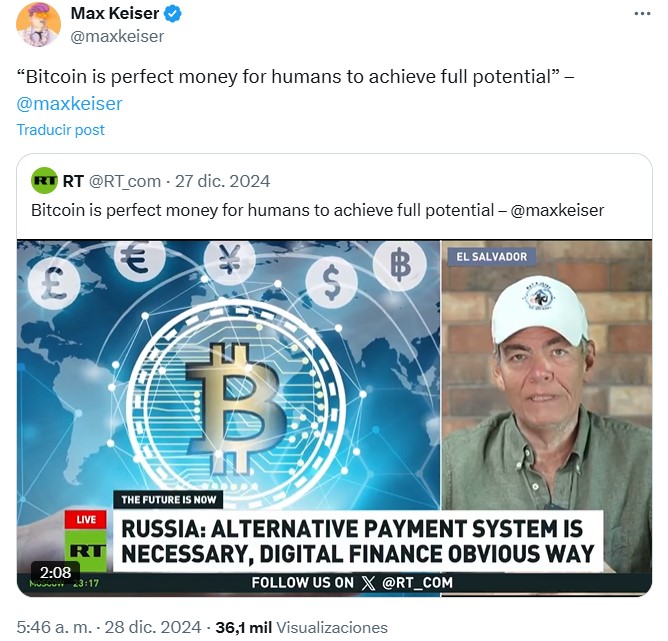 Source: @maxkeiser
Bitcoin fulfills the promise that humanity has been seeking since the beginning of time: perfect money. And perfect money allows humans to reach their full potential… We are now seeing Bitcoin superior to other stores of value, such as fiat money, property, art, or even the stock market. We are witnessing trillions of dollars leaving those other stores of value and finding their way into Bitcoin.
We are facing what could be considered a 'new Sputnik moment'; that is, a historical milestone in which several nations are rushing with unprecedented urgency to accumulate as much Bitcoin as possible. It is a decisive moment, comparable to the space race of the 1960s… It seems that Russia is ready to enter this space race, or the global race for Bitcoin.
Max Keiser, financial commentator, TV host and Bitcoin advocate.






