
EigenLayer, the leading re-staking protocol on the Ethereum network, reached $15 billion in total value locked (TVL). This represents the sum of all assets deposited on the platform.
The increase in TVL was 30% in just nine days, when the figure was 11.5 billion dollars, as can be seen in the following graph.
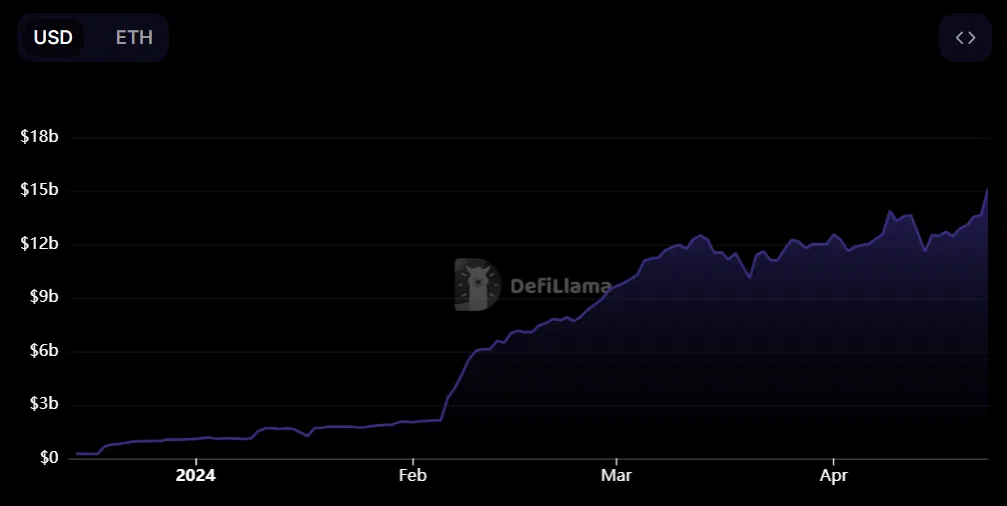
The increase was mainly due to a series of changes and updates implemented by the EigenLayer developer team. “With the help of the entire community we are proud to launch EigenLayer and EigenDA on the mainnet,” said a statement from the protocol.
The new functionalities allow, among other things, that re-stakers (person or entities re-staking cryptocurrencies) can delegate all their participation to an operator of their choice. Operators can register with EigenLayer and choose to run Actively Validated Services (AVS).
AVS are various types of decentralized services and applications that require additional security and active validation. These AVS can register on the protocol, starting with EigenDA, a secure, high-performance, decentralized data availability (DA) service built on Ethereum , which is currently in beta, notes EigenLayer.
“Now that operators and an AVS (EigenDA) are active, being an active re-staker means delegating to one of the top 200 operators running AVS,” the statement said.
Another announcement made by the EigenLayer team was the culmination of the implementation phase that removes limits on all liquid staking tokens (LST) and in turn reactivates re-staking deposits.
With an established foundation, the platform ensures that it is time to “unlock the full potential of the EigenLayer network by removing Liquid Stake Token (LST) limits.”
In this way, platform users have unlimited access to re-staking with 11 LST tokens, those are: stETH (Lido); rETH (Rocket Pool); cbETH (Coinbase); wBETH (Binance); osETH (Stakewise); swETH (Swell); AnkrETH (Ankr); EthX (Stader); OETH (Origin ETH); sfrxETH (Frax Ether); lsETH (Liquid Staked ETH) and mETH (Mantle Staked Ether).
Re-staking consists of giving additional utility to the tokens delivered by liquid staking platforms as proof of deposit of ETH (or other cryptocurrencies). In the case of EigenLayer, it allows users to maintain full control over their assets while participating in staking, using derivative tokens like the ones mentioned above. This model offers investors the opportunity to maximize their profits and diversify their participation in the cryptocurrency ecosystem.
One way to obtain greater profits can be to put those tokens as collateral on a decentralized lending platform and use the money obtained to re-stake Ethereum or other networks.






