
On August 1, IBM announced that it has completed its quantum processor, called Quantum Nighthawk. Its launch is planned for this year, although they didn't specify an exact date.
The company described in a post on X that the chip will feature a network of 120 qubits, each interconnected with four others, allowing for greater efficiency in running quantum circuits. While the report doesn't clarify, these are likely physical qubits.
IBM also said about this chip that "we expect it to run circuits with 5,000 logic gates this year, scaling to 15,000 by 2028."
Unlike a classical computer, which operates with bits that can only have the value of 0 or 1, a quantum computer uses qubits, which can represent both values at the same time due to a phenomenon called superposition.
A quantum logic gate, in this framework, is an operation that modifies the state of one or more qubits, and the more gates a system can execute, the more complex the computational tasks it can perform.
According to IBM, the design of the new processor, with qubits interconnected in a lattice structure, seeks to improve the connectivity and stability of the system , two of the main challenges in the development of functional and scalable quantum hardware.
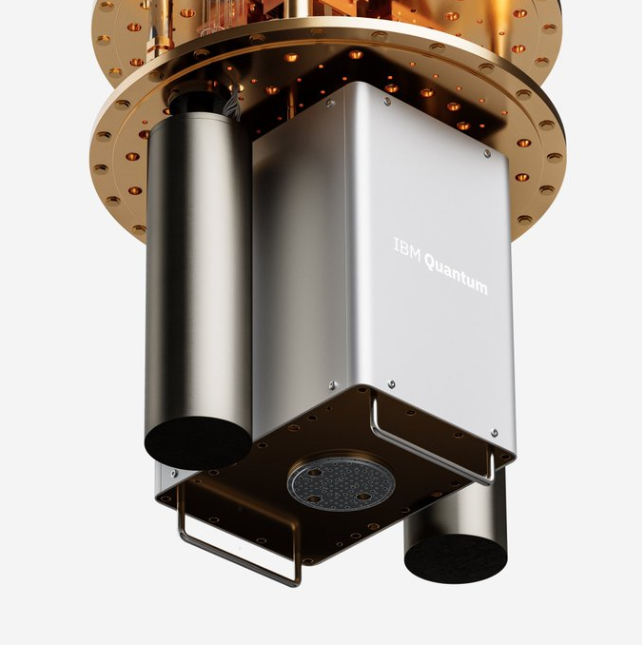 IBM has its quantum processor ready. Source: IBM/X.
A milestone on a roadmap toward fault-tolerant quantum computing
The aforementioned breakthrough is part of a roadmap that IBM unveiled on June 11 which aims to develop the first large-scale quantum computer with error tolerance, useful in real-world environments and that does not require constant external corrections.
In its plans, IBM envisions the creation of a system called Quantum Starling by 2029, with 200 logical qubits capable of executing circuits with 100 million logic gates. It should be noted that a logical qubit is built using multiple physical qubits to correct internal errors.
The concept of fault tolerance in quantum computing refers to the ability of a system to continue operating correctly even when some of its physical components exhibit errors, something common in quantum environments due to the sensitivity of qubits to factors such as temperature or electromagnetic interference.
Beyond the 2029 target, IBM has also charted a larger scale with the development of Quantum Blue Jay, a computer that by 2033 will incorporate 2,000 logical qubits and be able to execute more than a billion logic gates per circuit.
These figures, translated into practical applications, could allow for the solution of problems that are currently intractable for classical supercomputers, such as simulations of complex molecules, large-scale industrial optimization, or advanced machine learning algorithms.
The following image shows the roadmap proposed by IBM:
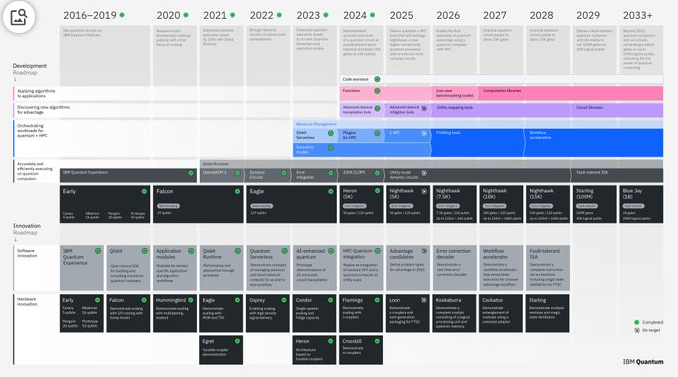 IBM is expected to have a quantum computer with 2,000 logical qubits by 2033. Source: IBM.
Additionally, the company detailed a parallel strategy focused on quantum software, focusing on four areas: application of existing algorithms, discovery of new algorithms with quantum advantage, coordination of workloads between classical and quantum systems, and precise and efficient execution.
This points to greater interoperability between quantum and classical systems, a crucial aspect for building mixed computing environments that can exploit the strengths of each paradigm.
Is IBM's progress dangerous for Bitcoin?
The cryptography that underpins Bitcoin, based on the ECDSA (Elliptic Curve Digital Signature Algorithm), protects the private keys that guarantee ownership of funds. Quantum computing, with its ability to solve complex mathematical problems, could potentially break this encryption in the future.
However, as CriptoNoticias explained, based on estimates from experts and analysts in the Bitcoin ecosystem, IBM's quantum development would not pose a risk to the cryptography that protects Bitcoin in the short term.






