
For the first time in its history, the Ethereum network reached its maximum block capacity on August 27th. Blobs were introduced with the Dencun update in March 2024 and are data packets that second layer (L2) solutions use to reduce transaction costs by storing information off the main chain.
According to data from a researcher at L2Beat, on that day, blob usage reached 225 MiB for one hour, slightly exceeding that threshold at times, with a peak of 228.5 MiB of effective data.
“MiB” or mebibyte is a unit of measurement for digital storage. In practice, 1 MiB is equivalent to 1.048 MB (megabytes). When L2Beat shows “225 MiB” of blob capacity, that figure equates to 236 million bytes of data per hour.
The following chart shows how the volume of data in blobs remained at high levels throughout the previous week, reaching an all-time high on August 27:
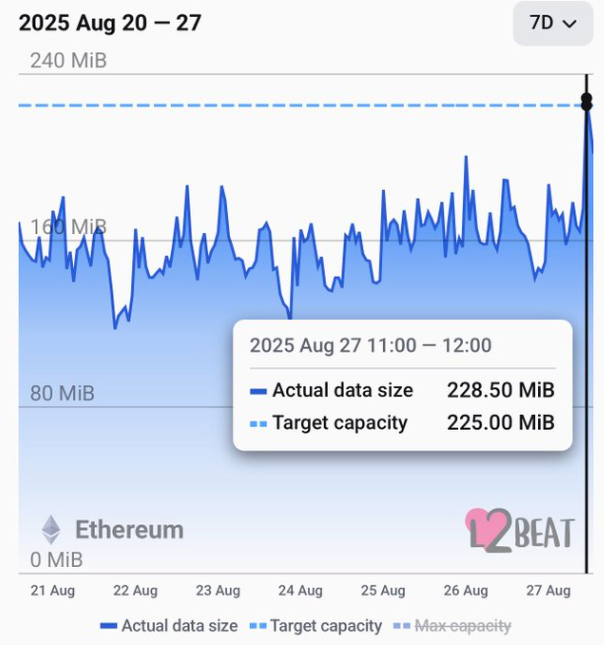 Ethereum blobs have reached capacity. Source: donnoh.eth / X.
The blue line shows the actual size of the data occupied in blobs, while the dotted line corresponds to the target capacity set by the protocol. Significantly, for the first time, both curves crossed, indicating that the system had reached its design limit.
A second chart, also from L2Beat, shows the on-chain costs of different types of data on Ethereum. There is a specific increase on August 27, coinciding with the moment when the blobs reached their maximum capacity.
Even so, the cost associated with this type of data remained below $0.01. This "cost" refers to the fees users pay to the Ethereum network to include blobs in a block.
This reflects that, despite the hour-long capacity saturation, blobs continued to offer a low-cost alternative to other forms of storage on the network, reaffirming their central role in Ethereum's scalability.
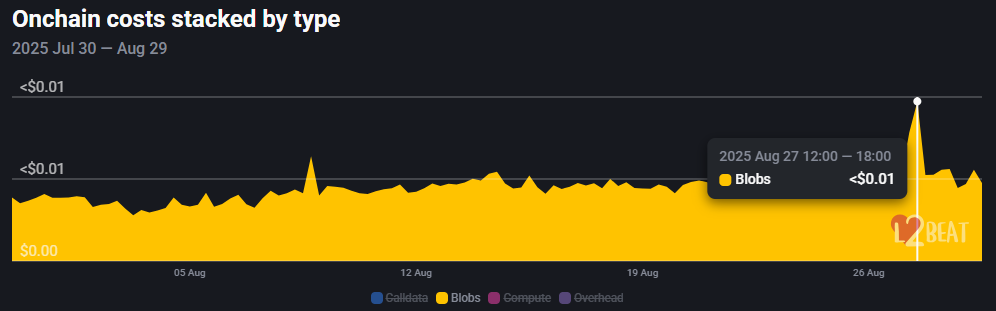 “Chain costs classified by type.” Source: L2Beat.
Implications of the blob limit reached
The fact that the network has reached its maximum block capacity reflects a sustained increase in demand for data space from Ethereum 's second layers. This can be interpreted in two ways.
On the one hand, it's an indicator of adoption: it means that more and more transactions are being processed through scaling solutions that rely on this resource. In that sense, reaching the limit confirms that blobs are fulfilling their function of alleviating the load on the main network and reducing transaction costs.
On the other hand, it also raises questions about the future. If demand for blobs consistently exceeds the 225 Mbps capacity, bottlenecks could arise that raise the fees associated with their use, just as they do when the main network becomes congested.
In technical terms, this event suggests that as Ethereum continues to scale through second-layer networks, it will be necessary to review whether the current blob capacity is sufficient or whether that threshold should be increased.
Any such adjustment would require new Enhancement Proposals (EIPs) and broad discussion within the developer community. For now, the fact that the limit was reached during a specific hour does not imply a structural problem.
However, it sets an important precedent: Ethereum has already operated at the theoretical maximum of a key resource for its scalability. The challenge will be maintaining that capacity as demand continues to grow in the coming months.






