
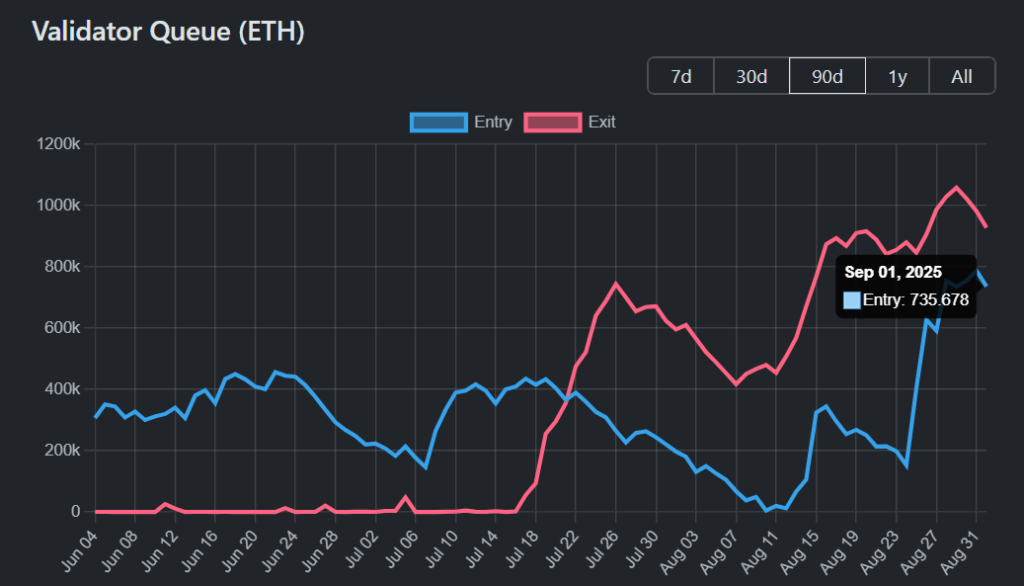
At the end of July, the balance was heavily in favor of withdrawals: nearly 800,000 validators were queuing to withdraw their cryptocurrency from staking. In contrast, the number of validators waiting to enter fell below 300,000.
On August 1st, however, the situation for validators on Ethereum couldn't be more different from what it was weeks ago. The output queue briefly surpassed 1 million. It continued to climb.
But the entry rate has seen a significant increase, with nearly 800,000 people now locking their coins into smart contracts. The wait time is similar: 15 days and 7 hours to enter and 15 days and 18 hours to exit.
 Ethereum uses proof-of-stake (PoS) as its consensus mechanism. Source: https://www.validatorqueue.com/
In certain situations, it's normal for validators to enter the exit queue. This is due to the profits they earn, resulting both from increases in the price of ether and from the fixed annual return on their coins offered by the staking pools where they work. Ethereum has a limit on the number of validators that can exit per day (controlled by the protocol to prevent mass withdrawals). This mitigates the immediate impact of exits on the price, as the unlocking of ETH occurs gradually.
At the time of writing, ETH is hovering around $4,400, near its 2021 all-time high. This is precisely a context of profit-taking: validators are queuing up to delist, access their coins, and sell some of them on the spot market.
This sell-off, of course, has the potential to tank Ethereum's price, and raises questions about where we are in the cycle: Is the bear market still a long way off ? Couldn't Ether fall and wipe out stakers' profits?
The entry queue indicates that new validators aren't worried about asking these questions. Judging by their behavior (locking up staking coins during the currency's all-time high), these 800,000 validators believe that ether will continue to rise, and that there are still profits to be made in this market.
The positive expectations of this group of users could push the price of ETH higher, especially if the entry queue exceeds the exit queue, which could happen in the coming days or weeks.
The entry of many validators into Ethereum staking also means a reduction in the circulating supply, because the locked ether cannot be liquidated immediately, which is good for the currency's price.
Ethereum has other bullish catalysts under its belt. These include the adoption of corporate treasuries and the revaluation of the network's technological offering, which was called into question when user participation in its ecosystem was low. However, daily transactions and active addresses on Ethereum are at all-time highs again. However, in a fragile geopolitical environment, any single incident can beat bull with bears!






