
As of August 13, the Ethereum network is experiencing censorship levels close to zero, according to data from the Censorship.pics website. This means that the vast majority of transactions are processed by validators without regard for their origin or destination, reinforcing the network's resilience.
As seen in the following graph, the majority of network participants do not apply censorship. Validators show a 99.5% "non-censoring" rate, relays reach 100%, and builders register 96.82%.
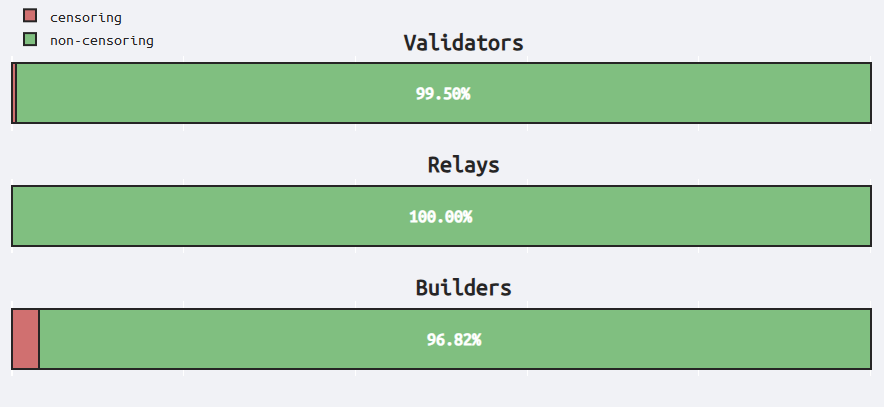 Ethereum validators include over 99% of transactions on the network. Source: Censorship.
In this context, a validator is a network participant who, after locking up a certain amount of ether (ETH) as collateral, verifies transactions and proposes new blocks.
Relays, on the other hand, transmit these blocks to validators, and builders assemble the transactions. The Censorship site classifies an entity as censoring when, over a 30-day period and with a sample of more than 100 blocks, it produces significantly fewer blocks that include sanctioned transactions.
To do this, it compares its uncensored block rate with half the network average over the same period. The analysis is performed block by block, reviewing each transaction and its traces to identify potential punishable violations. The last time Ethereum saw similar levels of validator censorship to the current one was in November 2022, and that time it only lasted a few days.
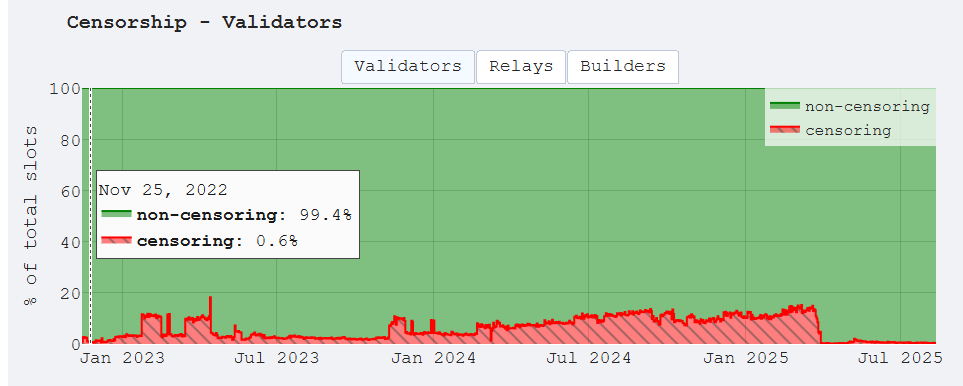 In March of this year, validator censorship reached 14%. Source: Censorship.
The graph above also shows that validator censorship increased from January 2024 to early April 2025. It reached up to 14% of transactions in March 2025. However, suddenly, at the beginning of April, those levels dropped dramatically, driven by the Tornado Cash platform case.
On the other hand, between December 2023 and the end of March 2025, relays had censorship rates between 40% and 60%. Since then, they have accepted all transactions. In the case of builders, between 2023 and 2024 they censored up to 70% of transactions, while today that percentage has been reduced to 3%.
Tornado Cash and regulatory pressure as a trigger
One of the reasons cited by analysts and developers to explain this drop is what happened with Tornado Cash, an Ethereum transaction mixing service that was sanctioned by the United States Office of Foreign Assets Control (OFAC) in August 2022.
OFAC accused him of facilitating the laundering of illicit proceeds and ordered regulated companies and entities not to interact with his smart contracts. However, on March 21st (just days before the validator censorship fell), a measure reversed the 2022 ruling and the financial sanctions against Tornado Cash were lifted.
In that context, Anthony Sassano, an independent Ethereum educator, noted in January 2025:
“…the US government made the Ethereum ecosystem prioritize work on better censorship resistance technology (FOCIL, ePBS) and has now been ordered to roll back the sanctions on Tornado Cash.” In March, he added : "In August 2022, OFAC added Tornado Cash contracts to the sanctions list. Since then, the Ethereum ecosystem has prioritized and worked tirelessly on solutions to strengthen Ethereum's censorship resistance (with FOCIL, ePBS, and more)."
FOCIL and ePBS, mentioned by Sassano, are technical improvements to mitigate the ability of a validator or set of validators to exclude transactions. FOCIL, a tool included in Improvement Proposal 7805 allows the first entity to see a transaction to include it in a block, while ePBS separates the function of proposing a block from that of building it, reducing the risk of coordinated censorship. Other ecosystem participants agreed that the reduction in censorship may be related to the elimination of certain sanctioned contracts, such as those for Tornado Cash, and a decrease in regulatory pressure from the United States government.
"It's probably due to the elimination of some OFAC contracts like Tornado Cash and less regulation from the US government," commented developer Anthony Caravello, though he closed with a warning: "Censorship is not solved." Another user, along those lines, stated that "the drop is due to the removal of some OFAC-sanctioned contracts, including Tornado, and not because validators have stopped censoring."
Thus, according to these voices from the community, the improvement in censorship resistance levels did not originate directly from internal changes to the protocol or in the behavior of validators, but was influenced by external events. Finally, at the beginning of June, Tomasz Stańczak, executive director of the Ethereum Foundation, pointed out that censorship resistance is a central feature to ensuring that the Ethereum network remains neutral and open to any participant, regardless of jurisdiction or source of funds.






