
One of the most important features of Bitcoin's monetary policy is the halving: an event programmed in the code that reduces the reward of the network's miners by half every 210,000 blocks (or approximately 4 years). Halving decreases the frequency with which new coins are issued, which are basically the payment that Bitcoin miners receive for contributing computing power to the network, keeping it secure as they confirm the validity of the new transactions included in each block. The first Bitcoin halving occurred in 2012 and today marks the eleventh anniversary of that event.
Originally, the first Bitcoin miners received 50 bitcoins for each block of transactions added to the Bitcoin file. Today, 3 halvings later, the reward for each block is 6.25 BTC, until the next scheduled reduction occurs (in April 2024, when the issuance will be reduced to 3.125 BTC per block). This event will only occur 33 times in total, as the 21 million BTC that will exist (of which there are already over 19 million in circulation) are issued. “Once there is a predetermined number of coins in circulation, the incentive (for miners) can shift entirely to transaction fees and be completely inflation-free,” as indicated in the Bitcoin White Paper.
Halving is one of the fundamental characteristics that differentiates Bitcoin from money issued by central banks, which tends to inflation or devaluation as the amount of coins, bills, electronic money or any asset that these entities put into circulation increases. circulation.
If we go back to the early days of Bitcoin, we won't find the huge industry that supports the network today with hundreds of thousands of specialized computer teams competing with each other for the reward. In fact, research by the programmer and co-founder of the custody company CASA suggests that during the first months, only 5 miners were dedicated to that activity. Among them, Satoshi Nakamoto, pseudonym of the person (or group of people) who created Bitcoin.
Lopp's research indicates that Nakamoto possibly mined with a 4-core CPU that could function independently, capable of generating 6 MH/s, although he never used all that computing power. At that time, Bitcoin mining was an activity that only interested a few geeks and it would have been practically impossible to know the value that bitcoin would acquire in a decade. after.
From CPU mining to GPU and FPGA
The first Bitcoin miners must have used CPUs with the famous Pentium 4 processor, and most likely many of them already had the 2 or 4-core Intel Core processors (Core i3, Core i5, Core i7), which arrived on the market between 2006 and 2008.
With these features and the growing popularity of bitcoin, competition increased and two years would not pass until October 2010 when the first software for mining with a GPU or graphics card was launched. In comparison, a GPU performs a greater number of calculations, and with lower power consumption, than a CPU.
One of the first people to mine Bitcoin with GPUs was Charlie Lee, creator of Litecoin, who at the time was working as a software engineer for Google. Lee began mining Bitcoin in early 2011 and keeps a photo of one of his miners, which consisted of 6 GPUs connected to a motherboard using risers.
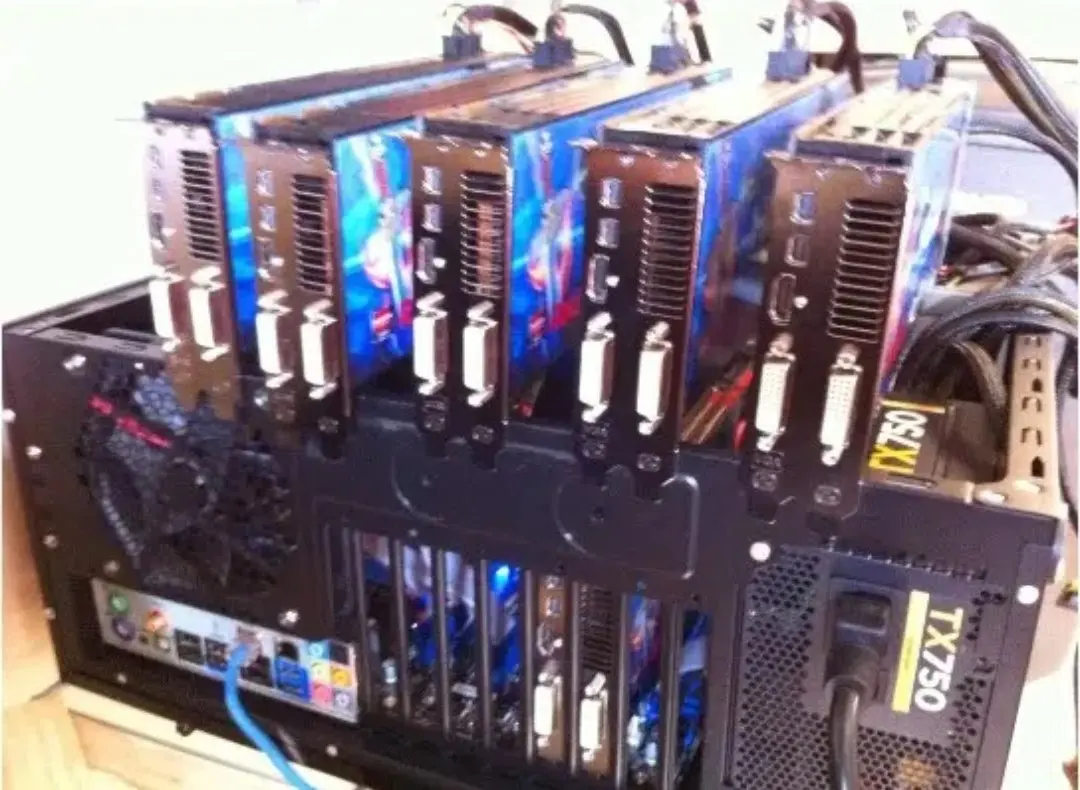
Bobby Lee, Charlie's brother and founder of BTCC, China's first bitcoin exchange, also mined with GPUs. In the following image you can see one of their equipment:
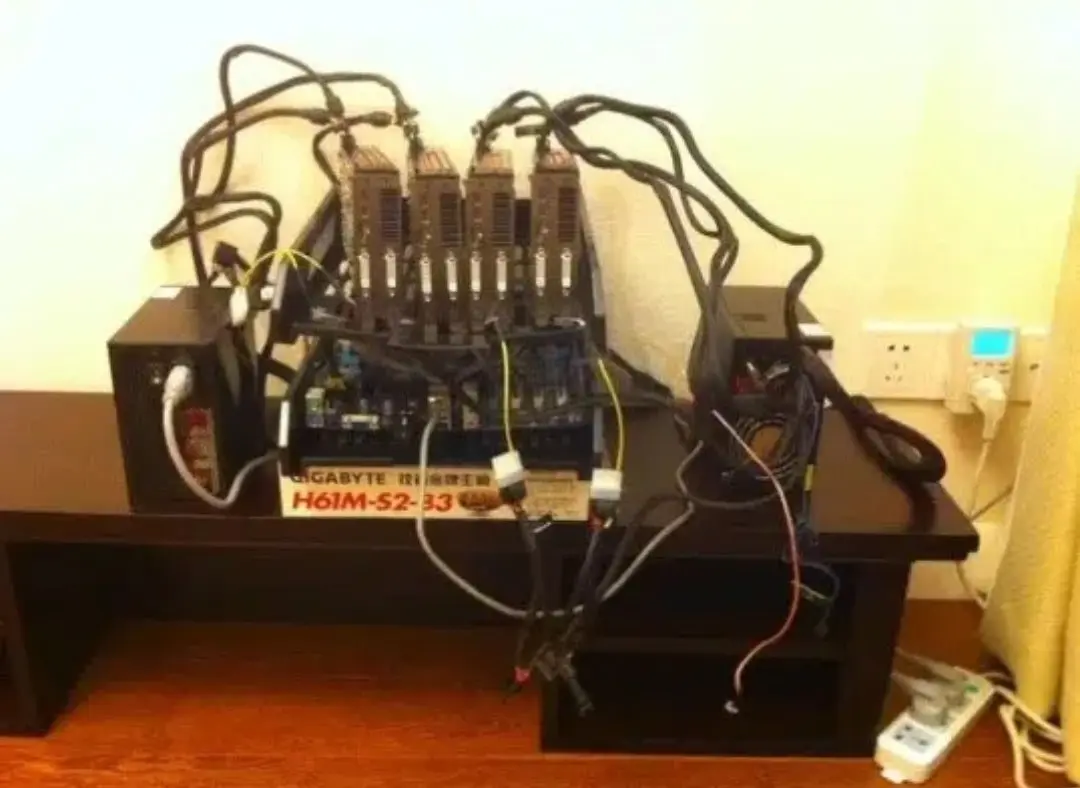
In July 2011, the price of bitcoin had reached USD 31 per unit, although in December, a year before the first halving, it fell more than 90%. The following year, the value of the currency increased and went from $2 to $13 in December 2012.
In those days at the end of 2012, FPGA (field programmable logic gate array) miners burst into the nascent industry, chips that could be programmed for specific tasks.
One of the first Bitcoin miners to use this technology is aTg is a long-time BitcoinTalk well-known person, having been introduced to Bitcoin when was worth just $3 in 2011. Although aTg began mining with GPUs, he soon became interested in FPGA miners, a brief period that lasted until emergence of ASIC (application specific integrated circuit) processors , which are still used to this day. FPGA miners were especially coveted because they allowed a circuit to be connected across a single chip. By comparison, GPU circuits were limited to a small number of cards per computer. FPGA devices at that time had a power of 215 MH/s and cost between EUR 200 and EUR 300.
aTg's journey began when he discovered an FPGA miner made by the company ZTEX, which he purchased to reverse engineer and build similar models from scratch. After sending the model to China and obtaining the circuit plans, he bought chips from Xilinx, a company that manufactured them in Madrid, and looked for an assembler in Barcelona, where he lived.
aTg invested about $5,000 in components and labor, but the clock was against them, as the difficulty of mining Bitcoin increased (as more people joined the network) and companies like ZTEX were already manufacturing boards with 4 FPGA, a device that would also copy aTg and in which he would invest $20,000 that he had earned.
Soon, FPGA miners encountered stiff competition, when Dr. Zhang Nangeng and Yifu Guo created the first ASIC with their own dual-core FPGAs, manufactured by them. These first ASICs had a power of 212 mH/s, but with much lower energy consumption and also took up less space. A board could have hundreds of chips.
Unfortunately, aTg never managed to make its business compete with Chinese manufacturers, who soon began to control the manufacturing of specialized chips, concentrating the business in a few companies. Between 2012 and 2013, Bitcoin mining grew considerably. 5 months after the first Bitcoin halving in history, the price of bitcoin went from $13 to $266. Incredibly, after a major correction in mid-2013, when the value of the currency fell to $100, BTC It appreciated in a matter of weeks and was listed on the markets at more than $1,200, just a year after the first halving






