
The idea that companies and institutions don't make the same investment mistakes as individuals is quite widespread in the general imagination. There's a reason they call it smart money. How could it be otherwise? They pay their analysts and researchers six-figure salaries to tell them the best place to invest their money. However, it seems that, in the Bitcoin industry, this isn't quite true.
Understanding Bitcoin has proven to be very difficult for the majority of the population, regardless of their educational level. This is not something to be criticized for, as it represents a radical paradigm shift. We must stop viewing the world through the lenses of fiat, but these already seem cemented on people's faces.
It's worth remembering Saifeadean Ammous and his thesis that the culture of the times is fiat: a devalued and devaluing culture, of immediate desire gratification, easy dopamine, and mortgaging the future in pursuit of the present. But, in more practical terms, a culture accustomed to pricing everything in dollars. And one of the key aspects of the paradigm shift is to start measuring everything in 21 million dollars, that is, using Bitcoin as a measuring instrument.
It's because of this difficulty that crypto or altcoins fall. This fall is so common that it's already part of the Bitcoin hero's journey. When you start giving Bitcoin a chance after overcoming the denial stage, shitcoin mirages suddenly confuse you and you end up straying. This, we're seeing, is also happening to corporate treasuries.
After a series of successful cases of Bitcoin adoption by various companies, a trend is emerging of wanting to be smarter than the smart, only with the prospect of greater profits in fiat. Two companies, SharpLink and BTCS, have already announced the raising of capital for their Ethereum treasuries, while VivoPower is raising funds to purchase Ripple's cryptocurrency, XRP.
We could see this as a rerun of altseason, but institutional. In a bull cycle that has been largely dominated by institutions and companies rather than retail investors, many have missed the arrival of the altcoin surge. It seems these three companies still have faith in the altcoin promised land.
Historically, altseasons have been characterized by retail and novice investors, after making some profit from the rise of Bitcoin, letting their greed drive them to sell the world's most scarce asset in exchange for the stock of a crypto company (or simply a meaningless memecoin) in the hope that its price will skyrocket and offer them greater profits in fiat.
As I said at the beginning, the problem stems from having the lenses of the fiat world glued to our eyes. Yes, ETH and XRP have grown relative to an inflationary dollar that's losing value day by day. But what happens if we compare it to Bitcoin?
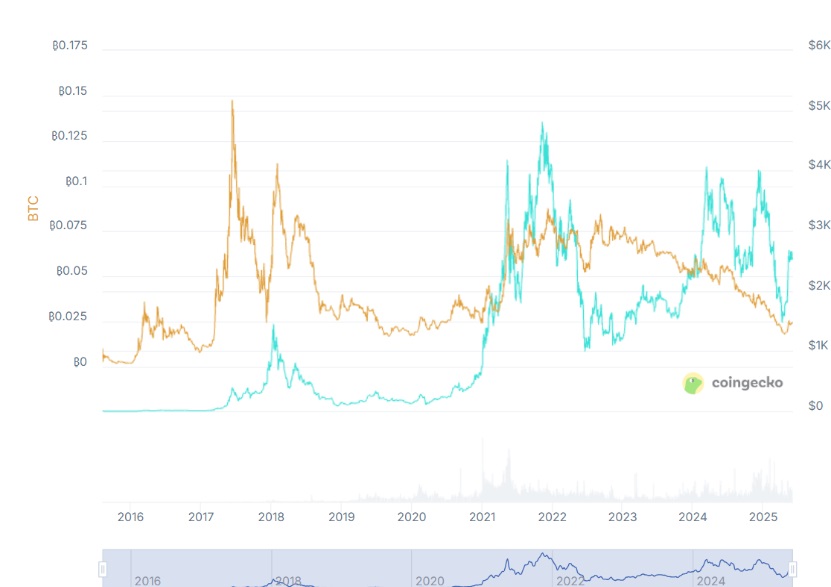 Price of ETH, the Ethereum cryptocurrency, expressed in dollars (blue line) and BTC (orange line). Source: CoinGecko.
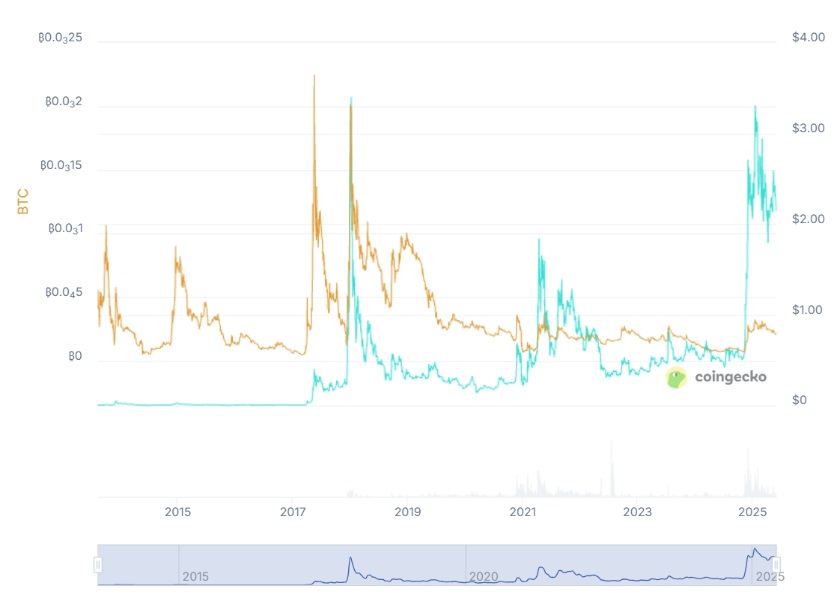 Price of XRP, Ripple's cryptocurrency, in dollars (blue line) and BTC (orange line). Source: CoinGecko.
With these charts in mind and a market lens, the gap between both assets' all-time highs in BTC and the current situation might seem like a sufficient argument to choose Bitcoin, even from a fiat perspective. But that still misses the point.
Just as I established that it was a mistake to buy altcoins in the US Strategic Reserves, I also believe it's a mistake to buy them for Corporate Treasuries, for similar reasons, but not to the same extent. Although, rather than a mistake, I consider it a misstep.
In the case of Strategic Reserves, buying altcoins would be equivalent to the government buying company shares with public money, which can be seen as market intervention. Since Bitcoin is a commodity, this isn't the case.
A company can do whatever it wants with its money, within the framework of the law. If the law allows it to buy shares in other companies with its investors' money, then so be it. The investors will tell you what they think by buying or selling their shares. However, wanting to buy altcoins emulating Strategy's strategy loses sight of the entire conceptual basis that motivates these purchases.
Bitcoin is not only the most scarce asset in the world. It's the most neutral. It's the most predictable. Bitcoin is a counterweight to political arbitrariness. When companies adopt Strategy's playbook, they do so not only because they have seen that it stimulates a virtuous cycle of demand for their shares, but also because, at the same time as the value of their shares rises, they are accumulating a piece of the future of money, of which they can have complete certainty because counterparty risk is minimized.
And we reiterate about ETH and XRP. Can the same be said of the ever-changing Ethereum, which, despite being considered a commodity, the constant innovations promoted by its leader have led to more hacks than any other network? XRP is out of the question, being publicly the bastard currency of a company.
I have no doubt that corporate treasuries with altcoins are simply seeking to capture the attention of unwary investors, who will fall back into the error of thinking that the Bitcoin train has already departed, and that they need to put their money into the next big thing to make their profits in dollars but as the charts above demonstrate, that's just a short-sighted fiat mentality.






