The People's Bank of China (PBOC) has stressed the need for regulation for the bitcoin (BTC) sector and other cryptocurrencies. This comes just a week after representatives from that Asian country met with those from El Salvador. During this meeting, bitcoin stood out as a key element in the strategy of the Nayib Bukele government to strengthen the economic growth of the Central American nation.
The government of El Salvador announced that its vice president, Félix Ulloa, held a meeting with the ambassador of the People's Republic of China in Salvadoran territory, Zhang Yanhui, with the aim of strengthening bilateral ties and advancing projects to improve digital connectivity and economic growth.
According to the Salvadoran vice presidential office, during the meeting Ulloa highlighted how the Central American country has become a model of financial freedom and digital economy, with a bitcoin treasury of more than 6,000 coins. Among the key initiatives mentioned are “El Salvador Vuela,” which focuses on the modernization and expansion of aeronautical infrastructure, and submarine cable, aimed at improving digital infrastructure to strengthen the country’s connectivity sovereignty.
Last April, Ulloa held a meeting with Chinese Vice President Han Zheng in Beijing, the capital of China. Now, in its recent publication of the Financial Stability Report 2024, the PBOC underlines the need for specific regulation for cryptocurrencies. The report, released on Friday, includes a section dedicated to the supervision of digital assets, highlighting Hong Kong's innovative approach to this sector.
In its report, the Central Bank of China recalls the complete ban that exists in the country on trading in digital assets and Bitcoin mining since September 2021. However, it highlights the contrast that exists with Hong Kong, which has adopted a more permissive path.
Although geographically part of the same nation, China and Hong Kong have significant differences in terms of political, social, cultural and economic systems, including their views on digital assets. While mainland China maintains a strict stance, Hong Kong has taken a different path.
Since June 2023, the special administrative region has launched a licensing scheme for cryptocurrency trading platforms, allowing licensed exchanges to offer services to the retail public. This move reflects Hong Kong’s intention to become a leading financial hub for cryptocurrency innovation.
Furthermore, the PBOC has expressed its commitment to improving an international regulatory framework for crypto assets, in line with the recommendations of the Financial Stability Board. And although El Salvador is not mentioned in the report, anyone might think that the Central American nation may be influencing a change of stance on the part of the Chinese authorities.
There are suspicions that “China would unblock bitcoin with Trump in the White House.” The phrase is from the president and CEO of HashKey Group, Xiao Feng, who believes that the new Donald Trump government could activate the Chinese government’s interest in cryptocurrency trading and mining markets, unblocking the ban imposed in 2021.
Additionally, Feng thinks the possibility of the United States gaining greater strength as a leader in the Bitcoin ecosystem could mobilize the competitive spirit of the Chinese.
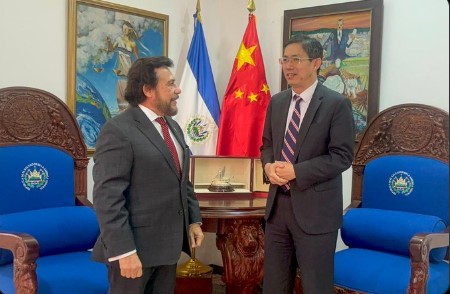 Ulloa spoke with the Chinese ambassador about the purchases of 1 BTC per day that the government of El Salvador has been making since November 2022. Source: X/VCPresidenciaSV.
Hong Kong could have a bitcoin treasure like El Salvador
The fact that the United States could have a bitcoin treasure trove following in the footsteps of El Salvador is something that has generated reactions around the world, including in Hong Kong, where Wu Jiezhuang, a member of the Legislative Council and chairman of the Web3 Virtual Asset Development Subcommittee, suggests that the region should not be left behind by the trend that is moving the world.
During an interview with Wen Wei Po newspaper, Wu Jiezhuang stressed the need for Hong Kong to study how to maintain its financial security in this new context. He therefore proposed taking advantage of the “one country, two systems” principle to include bitcoin in national reserves. “Some small countries have already taken this step, even adopting bitcoin as legal tender,” Wu commented, referring to El Salvador and highlighting the possibility of allocating up to 10% of fiscal reserves to BTC to diversify investments.
“Governments cannot turn a blind eye,” Wu said, stressing the importance of assessing how the decision to hold a bitcoin treasury could boost Hong Kong’s financial security.
In other countries, there is also talk of following El Salvador's model, such as in Brazil, for example, where Congressman Eros Biondini presented a bill to create a BTC treasury. While in Japan, Senator Satoshi Hamada urged the government to join the rush for national bitcoin reserves, highlighting its independence from national influences.
As part of the global movement, the mayor of Vancouver, Canada, proposed a motion to use the digital currency as a reserve asset; while in Venezuela, opposition leader Maria Corina Machado has discussed creating a BTC reserve as a solution to the country's economic crisis and inflation. And in Russia, MP Anton Tkachev has asked the government to create a Bitcoin treasury.