
Bitcoin ETFs have attracted $50 billion in net inflows in just 18 months since their launch in January 2024.
Yesterday, July 9, seven of the twelve spot bitcoin ETFs reported net inflows, led by BlackRock's iShares Bitcoin Trust (IBIT), which attracted $125 million. IBIT, which this week became the first bitcoin ETF to surpass 700,000 BTC , holds more than 55% of the total BTC held in these funds.
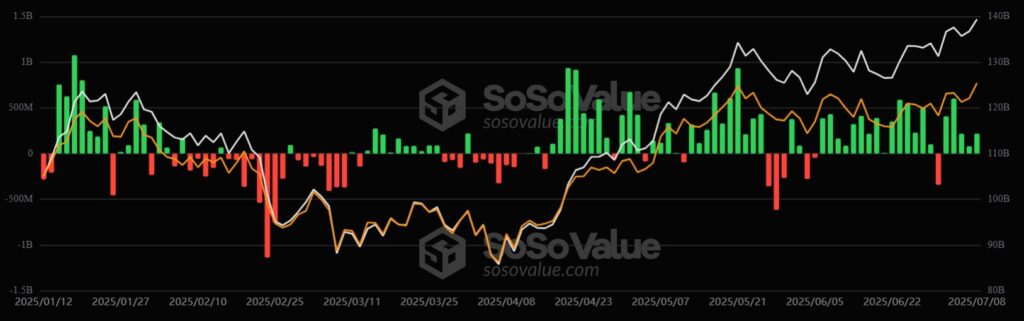 Bitcoin ETF inflows were led by IBIT. Source: Soso Value.
IBIT is the third most profitable ETF among the 1,197 funds of BlackRock, the world's largest asset manager, and is $9 billion away from becoming the firm's leader. Furthermore, IBIT generates more annual revenue for BlackRock than its flagship fund, the iShares Core S&P 500 ETF.
The ARK 21Shares Bitcoin ETF (ARKB) followed with $56 million and the Grayscale Bitcoin Mini Trust ETF (BTC) with $15 million. Other funds, including the Fidelity Wise Origin Bitcoin Fund (FBTC), the Bitwise Bitcoin ETF (BITB), and the Coinshares Valkyrie Bitcoin Fund (BRRR), also saw inflows.
This ETF performance has boosted the price of bitcoin, which reached a new all-time high of $112,000. The companies managing these funds buy and hold Bitcoin to back their shares, which has a direct impact on their stock prices. When demand for these financial products increases, the companies acquire more BTC on the market, driving up the price of the digital currency due to the dynamics of supply and demand.
Rachel Lucas, an analyst at BTC Markets, stated that the $50 billion milestone in net capital flows represents a watershed moment in the institutionalization of digital currency. “What we're seeing isn't a retail-driven frenzy, but rather a steady flow of capital from asset managers, corporate treasuries, and wealth management platforms finally entering the market,” she explained.
The analyst noted that interest in ETFs is amplified by macroeconomic factors, such as geopolitical tensions and U.S. President Donald Trump's renewed call for aggressive rate cuts, which incentivize investment in assets considered "risky." "Bitcoin, with its fixed supply and global liquidity, is in a privileged position, but it is ETFs, regulated and accessible through the traditional stock and bond infrastructure, that are driving participation," Lucas stated.






