
Demand for bitcoin (BTC) from investors who aren't selling their holdings of the digital currency has skyrocketed to unprecedented levels, according to data from on-chain explorer CryptoQuant.
This is reflected in the market metric called demand from accumulator addresses, which surpassed 260,000 this week. This level, last reached at the end of last year, was until then its all-time high.
Today, it's above 336,000, marking a new record for addresses accumulating unsold bitcoin, reflecting the current faith in the price.
"This metric tracks addresses that have only acquired BTC without selling any, giving us an idea of both demand and holding conviction," the analyst known as Darkfost recently explained.
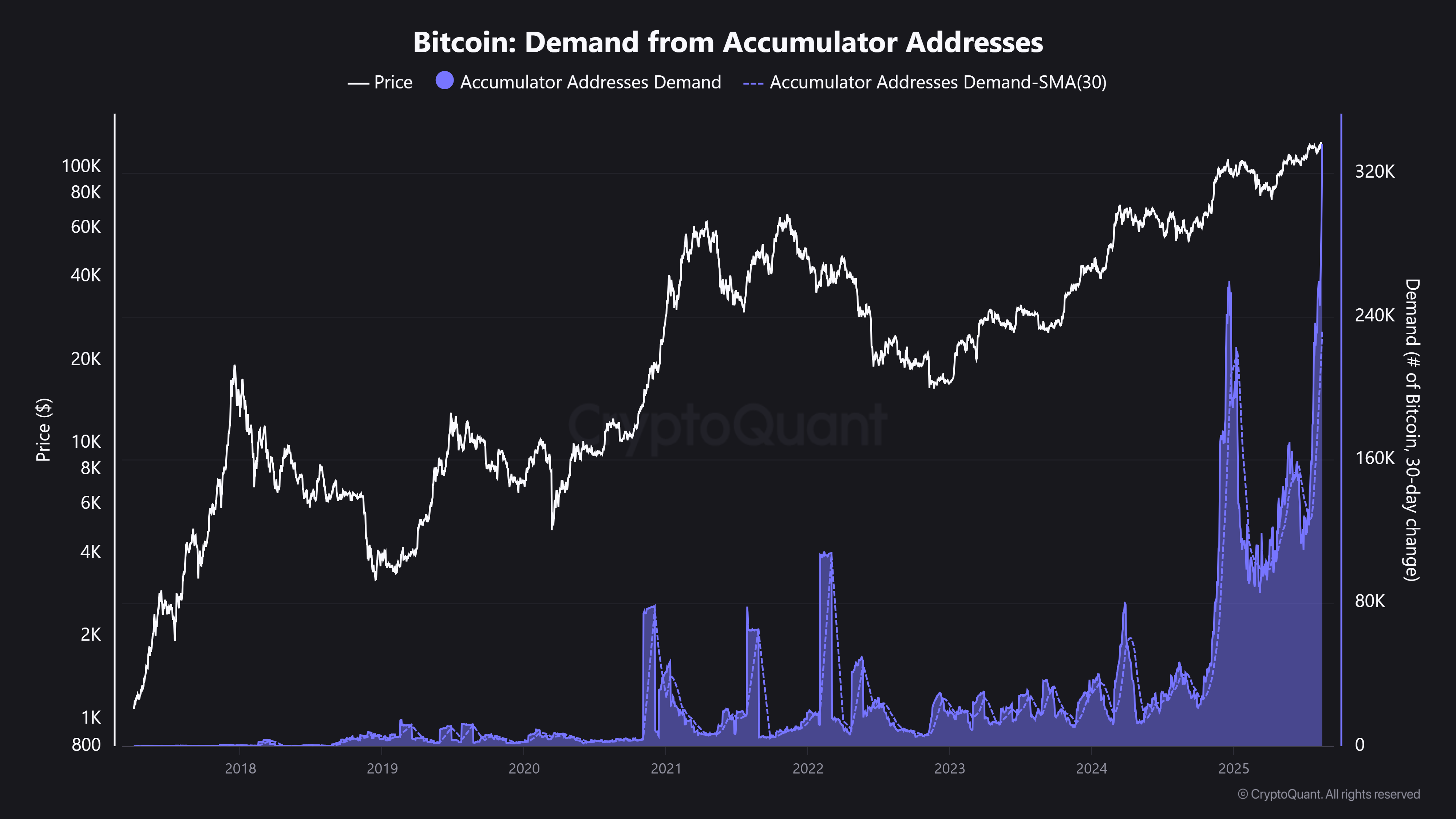 Demand for accumulator addresses. Source: CryptoQuant.
For market specialist Vivek Sen, this accumulation comes from whales, those investors with more than 1,000 BTC, considered "smart money" for tending to buy on dips and sell on rises. "They know what's coming," he maintained.
This development comes amid a significant week for the price of Bitcoin. It reached a new all-time high of nearly $124,000 on Thursday, and although it subsequently retreated slightly, it is showing strength above $117,000.
Worse-than-expected US inflation data and comments from Treasury Secretary Scott Bessent, which generated disappointment and confusion about how the government will accumulate bitcoin, led to the decline. Added to this is selling pressure from those taking advantage of the rise to take profits.
Despite the drop, Bitcoin's solvency at levels close to its all-time high, driven by strong market demand, still maintains bullish expectations among specialists like Sen. Sen noted that the global money supply is exploding, so he predicts that "bitcoin will soon follow." This is according to global M2 liquidity, a measure of money that includes cash in circulation and bank deposits.
When M2 increases, it means there is more money circulating in the economy, reflecting an expansionary monetary policy that reduces the value of money. In this context, Bitcoin, due to its fixed supply, is seen as a hedge against inflation and the loss of purchasing power of national currencies.
Unlike fiat currency, whose production is subject to the current government, Bitcoin's issuance is halved every four years through a halving process, which will occur until all 21 million units are mined. This makes it a scarce asset, which boosts demand.






