
The discussion about creating bitcoin (BTC) treasuries is gaining ground globally. The United States, which could have its own BTC reserve by 2025, is attracting great attention. In addition, companies, regions, and nations are also considering establishing their bitcoin treasuries.
Since mid-2024, the debate over strategic bitcoin reserves has intensified, especially at the state level, as President-elect Donald Trump promised to create a national BTC reserve for the United States, following the example of El Salvador, a pioneering country that created a bitcoin reserve in 2021, currently valued at more than $600 million.
Meanwhile, in the business world, interest in bitcoin reserves has grown, with dozens of companies and corporations announcing the creation of their own BTC treasuries in the last quarter.
National BTC reserves spread like wildfire
At the national level, the debate has spread widely in the United States, where enthusiasm for a strategic BTC reserve has increased under Trump's promise, made during the Bitcoin 2024 event, which could include, initially, more than 200,000 BTC under government control.
Senator Cynthia Lummis introduced a bill for the US to create a bitcoin reserve of 1 million coins, even proposing to sell gold reserves to buy BTC.
Everything indicates that this reserve could be created via express, through an executive order signed by Trump, of which there is already a draft that was released in mid-December. However, the president of the Federal Reserve, Jerome Powell, has clarified that this entity cannot hold BTC.
Despite this, in different states in the US, such as Florida, Pennsylvania, Texas and Oklahoma, steps have been taken to create their own bitcoin reserves. And it is estimated that more states will move in that direction, according to local bitcoiner organizations, such as Satoshi Act Fund.
Outside the United States, in Brazil, Congressman Eros Biondini introduced a bill to create a federal strategic reserve in BTC, and in Japan, Senator Satoshi Hamada urged the government to join the rush for national bitcoin reserves, highlighting their independence from national influences.
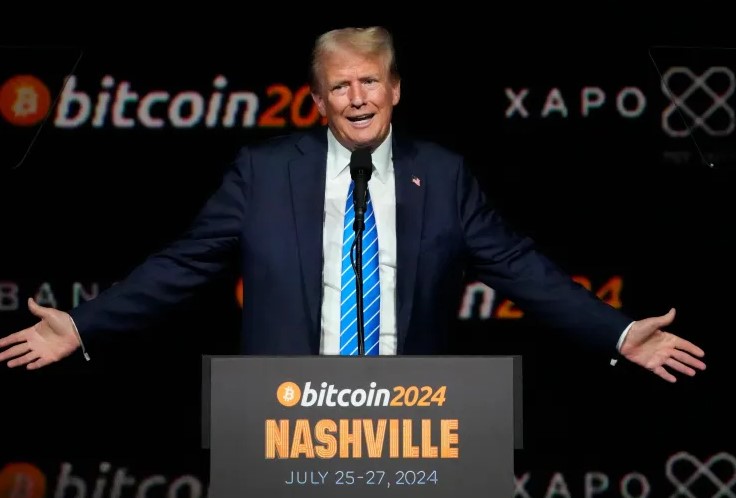 Trump announced in mid-year that he would create a bitcoin reserve. Source: Aljazeera.
In Canada, the mayor of Vancouver has introduced a motion for the use of BTC as a reserve asset. And in Venezuela, opposition leader Maria Corina Machado has spoken of creating a BTC reserve for the country, which is affected by economic crisis and inflation.
In Russia, MP Anton Tkachev has called on the government to establish a BTC treasury, similar to those of other currencies. Even Changpeng Zhao, former CEO of Binance, has recommended that China consider a strategic bitcoin reserve, noting that it is the future of money, as reported by this newspaper.
Dozens of companies are rushing into bitcoin
In the business sector, the trend has been similar. In November alone, 11 companies from different countries and dedicated to different sectors announced the creation of their own strategic bitcoin reserves.
These were the companies Boyaa, Rumble, LQR House, Remixpoint, Genius Group, Cosmos Health, Jiva Technologies, Hoth Therapeutics, Thumzup Media Corp, Acurx Pharmaceuticals and SOS, which created their own BTC treasuries last month.
In addition to these, companies that manufacture components for electric vehicle batteries, such as Solidion Technology , as well as financial companies, such as Samara Asset Group, have followed this trend. The same with the Japanese company Metaplanet, which has earned the name “Japanese MicroStrategy” due to its strategy of constantly buying bitcoin for its treasury.
During December, there were also companies that announced the creation of their own reserves, such as LEEF Brands, a company dedicated to the cannabis (marijuana) cultivation sector, which also adopted BTC as a strategic reserve asset.
This corporate move to pounce on BTC and accumulate it in a strategic treasury has been inspired by the success of MicroStrategy, the largest publicly traded company with BTC holdings. That entity has 439,000 coins in custody, making it one of the biggest whales in the bitcoin market.
What's coming in 2025?
The creation of a strategic bitcoin reserve in the United States by 2025 is the central pivot around which the ecosystem's expectations revolve. However, this perspective is not free from skepticism. Prominent investors such as Mike Novogratz, CEO of Galaxy Digital, have expressed doubts about the feasibility and real impact of such a measure.
Novogratz has warned about the inherent volatility of BTC and the lack of adequate regulatory infrastructure to handle a national reserve of such a fluctuating asset.
However, if the United States succeeds in making this reservation a reality, it is anticipated that it could trigger a global domino effect. The influence of the Donald Trump administration, with its pro-sector stance, has created a speculative fervour (FOMO) among other nations and states, which could be motivated to follow suit.
The idea of a superpower like the United States validating BTC as part of its national reserves could further legitimize and popularize the digital currency on the international stage. As Novogratz himself sees it, if the US does indeed create its reserve, it will “force all other countries to follow” that example.
Dennis Porter, director of the Satoshi Act Fund, has been vocal on this issue, predicting that by the end of 2025 “a Bitcoin Strategic Reserve will be established in a G7 member country and a BRICS member country.” This statement, shared on social media network X, suggests a growing international recognition of bitcoin’s value as a store of value, similar to gold.
In the corporate realm, the trend towards BTC adoption as a reserve asset appears to be accelerating. Inspired by the success of MicroStrategy, which has already converted a significant portion of its capital into BTC and plans to invest up to $42 billion more , many companies are watching closely. This move is not only fueled by FOMO, but also by the perception of BTC as an inflation hedge and a high-yield investment opportunity.
BTC reserves are set to be one of the most discussed and central topics in 2025. Adoption by governments and businesses could mark a turning point in how this currency is perceived and used globally.
Interest in BTC as part of national and corporate reserves could push the cryptocurrency’s price to new records. Firms like Bernstein and Standard Chartered have projected that BTC could reach as high as $250,000 by 2025, based on increased institutional demand and the perception of BTC as a safe haven asset in times of economic uncertainty.
However, these forecasts are subject to market dynamics, regulation, and global political and economic stability. Thus, the creation of strategic BTC reserves could, on the one hand, incentivize the market to increase structural demand, and could also introduce new forms of volatility if policies or markets change drastically. Regardless, 2025 promises to be a pivotal year to watch how this narrative around Bitcoin plays out.






