
On July 9, cryptocurrency investor Joe Ross shared on X that he received 100 qBTC in an anti-quantum test wallet, highlighting the ability to perform post-quantum transactions from his mobile phone.
qBTC, the native token of the eponymous sidechain developed by the Quantum Safe Bitcoin team, operates on a 1:1 backing with Bitcoin (BTC), linking each qBTC to a single BTC on the main layer. This means that the quantum-resistant test wallet received the equivalent of 100 BTC, an amount currently valued at nearly $12 million.
While the qBTC network is in the testing phase as a testnet, it allows developers and users to test transactions using qBTC Wallet, a desktop wallet that works in “all web browsers.”
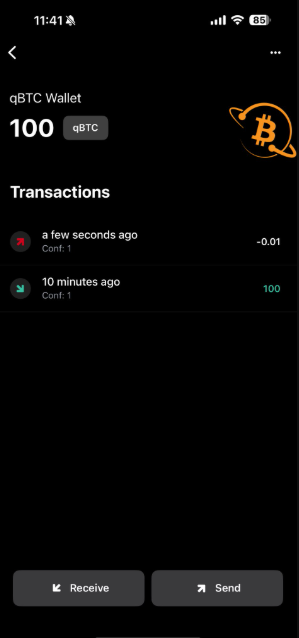 Ross received 100 qBTC coins. Source: Joe Ross/ X .
Post-quantum cryptography in qBTC
The goal of the qBTC network is to implement quantum- resistant cryptography, anticipating the potential threat of quantum-enabled computers capable of breaking algorithms like ECDSA (Elliptic Curve Digital Signature Algorithm), used in Bitcoin to sign transactions and verify private keys.
This open-source sidechain runs on its own quantum-resistant consensus mechanism based on Proof of Work. The qBTC sidechain employs lattice-based cryptography, known as ML-DSA, to protect transactions and wallet keys from the computational power of quantum computers.
Operating alongside the Bitcoin mainnet and anchored to its proof-of-work consensus, qBTC maintains the protocol's hallmark decentralization and security.
With its quantum-resistant approach, qBTC could be an alternative for Bitcoin users to transition to post-quantum solutions before such threats become viable, preserving the integrity of their assets in a sandbox environment.






