
Statements by Federal Reserve Chairman Jerome Powell regarding the project to incorporate bitcoin (BTC) into the country's reserve assets have raised a number of questions regarding the steps that the Donald Trump administration will need to take to implement the plan.
Powell referred to the limitations established by the Federal Reserve Act for making investments in digital currency.
He was referring to the fact that there are rules that “restrict the Reserve's open market investments from being subject to the obligations of the U.S. government or to instruments guaranteed by the federal government or its agencies.”
The above means that this law would have to be amended. to allow the central bank to buy bitcoins, as Powell pointed out. An action that needs to go through Congress.
This implies following the established process for making amendments or approving bills: Initiative, Discussion, Approval, Sanction, Publication, and Initiation of Validity.
 The Fed chairman offered remarks on Wednesday regarding the bitcoin reserve. Source: X.
These are stages in which not only the Chambers of Congress intervene, but also the Executive (in the first and last step). The proposals must be approved by both chambers before being considered by the president, who can veto them.
This is a process that can take months or even years, depending on the political and partisan support that a particular proposal has. Something that Trump seems to have some advantages in his next second term, having Republican majorities in both chambers and even in the Supreme Court (for at least two years).
Hence, it is said that to create the bitcoin reserve Trump would resort to an Executive Order, understood as “a rule or order issued by the president and directed to a branch of the executive branch to carry out a specific action or change a particular practice.”
The process in this case is accelerated because, to take effect, executive orders do not need the approval of Congress, having the same legal weight as laws approved in this instance.
That is true as long as they are issued in accordance with “a statutory mandate or delegation of authority by Congress,” explains the Fitzgerald Law Company law firm.
Based on this, an Executive Order can be applied if it is consistent with the law. . “It also means that the president, despite what many say, cannot create laws, he can simply prioritize their execution and specify the way in which it will be done,” the experts add.
“Executive orders are useful when action is urgently needed and can provide direction until the formal lawmaking process occurs,” they explain.
Fairly to be the idea behind Trump's team, as noted by figures such as Bitcoiner Dennis Porter and Jack Mallers.
Following this line of action, the Executive Order would allow for the acceleration of the amendment to the Federal Reserve Act, which limits the inclusion of assets such as bitcoin. The US Treasury's Foreign Exchange Stabilization Fund could then be used to buy or sell foreign currencies, including bitcoin.
Two ways to create the reserve in bitcoin
Analysts and legal experts are divided on whether Trump could actually use his executive powers to create the BTC reserve, or whether an act of Congress would be more appropriate.
Currently the most concrete bitcoin reserve proposal circulating in Washington comes from Republican Senator Cynthia Lummis.
Last July, the senator introduced a bill that would create a reserve operated by the Treasury Office. Known as the “Bitcoin Act of 2024,” the idea is to implement a “bitcoin purchase program.” More than 200,000 bitcoins would be purchased per year over a five-year period, up to one million bitcoins (5% of the total supply). The goal is to maintain it for at least 20 years.
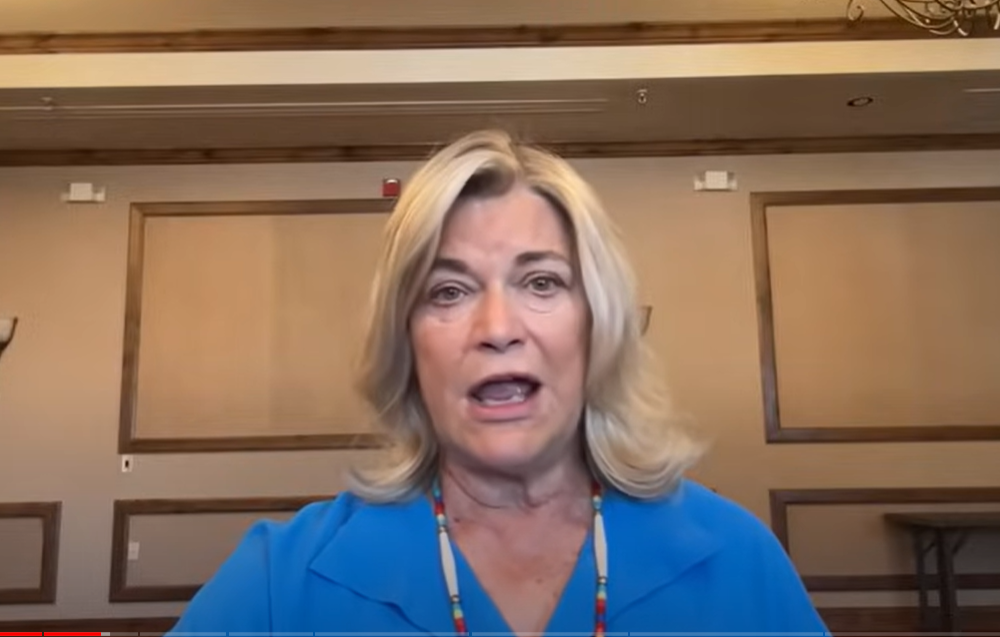 Senator Lummis defends the inclusion of bitcoin in reserves. Source: YouTube.
This plan, which would be financed, among other things, by gold from the Federal Reserve, still has a long way to go to gain momentum. Although it is expected that the steps for its approval will not be hindered, taking into account the support that the new government has in Congress.
The bill is likely to pass sooner rather than later, as the Senate is known to plan to prioritize passing the bill within the first 100 days of Trump's presidency. However, it will need some degree of bipartisan support to pass, as the Republican majority in the House of Representatives and the Senate alone is not enough. .
On the other hand, the option of the Executive Order is indicated, which has the force of law. However, executive orders have to be reviewed by the courts and can be revoked. They can even be superseded by new legislation or new executive orders. They can also be repealed by a new government, which does not occur with laws approved by Congress.
In either case, an amendment and a new law would force both the Fed and the Treasury to include digital currency, but these institutions “could view this rule as detrimental,” analysts at the Bitcoin Policy Institute (BPI) have said. An approach that takes on a different nuance if bitcoin is seen only as a way to diversify reserve assets.
It remains to be seen which path the Trump administration takes. But Powell's attitude suggests that beyond the legal restrictions (which would be resolved with new laws or amendments), because the inclusion of bitcoin in the reserves will also have to face a series of institutional conflicts.
It is important to keep in mind the traditional resistance of central banks, which are mostly skeptical of diversifying assets by adding BTC. They allege reasons that have to do with the principles that govern central banks around the world, and from which the Federal Reserve is no exception.






