
Malilkie Innovations, a patent licensing firm, is filing a lawsuit against Core Scientific and MARA Holdings. According to a patent risk management firm, the complaint is based on the mining companies' use of elliptic curve cryptography (ECC), a method that governs the generation of public keys and digital signatures in the Bitcoin protocol.
The cases filed against Core Scientific and MARA Holdings are part of a new campaign by Maliki Innovations (which has previously pursued BlackBerry patent litigation against Apollo Global Management and NRG Energy), only “this time targeting Bitcoin mining operations and related products (e.g., ASICs, computers, nodes, mining rigs, software, and wallets ),” according to the report.
Malikie Innovations, a shell company that bought thousands of BlackBerry patents, is suing Bitcoin mining companies (@MARAHoldings @Core_Scientific). They claim that Bitcoin's use of ECDSA and elliptic curve math violates patents they own. These patents are broad, vague, and based on ideas that were already in the public domain before 2005.
Dan Sanchez, creator of the campaign against Malilkie Innovations.
An infringement of U.S. patent laws
The court document refers to “patent infringement” under “the patent laws of the United States, 35 USC § 1 et seq,” and states the following:
This case focuses on pioneering innovations in elliptic curve cryptography that were discovered by some of the field’s leading technologists at Certicom Corporation and Blackberry Limited (formerly known as Research In Motion or “RIM”), which were later recognized and selected by the designers of Bitcoin, by far the world’s most valuable cryptocurrency to enable Bitcoin’s distinctive quality as a “trustless” payment system that requires no third-party intermediaries.
Malikie Innovations, plaintiff.
According to a bitcoiner familiar with the litigation who is leading a campaign called “Defend Bitcoin, Kill the Troll,” the plaintiffs allege that the following U.S. patents are owned exclusively by them and have been infringed by Core Scientific and MARA Holdings, two of the world’s largest mining companies.
- Patent No. 8,788,827
- Patent No. 10,284,370
- Patent No. 8,666,062
- Patent No. 7,372,960
- Patent No. 7,372,961
- Patent No. 8,532,286
These patents were allegedly developed by Certicom, acquired by BlackBerry, the smartphone company, and purchased by Malikie Innovations, according to the company. They cover innovations in ECC, including "accelerated verification of digital signatures, finite field calculations, and modular reduction techniques."
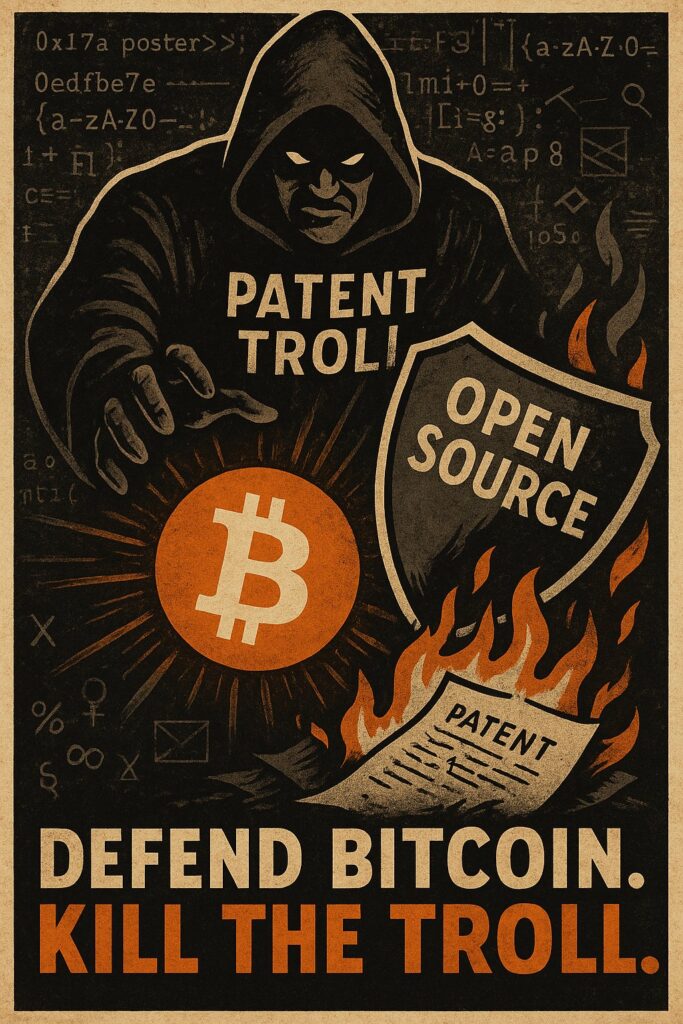 “Defend Bitcoin, Kill the Troll.” Source: Social Network X.
In short, says the campaign's driving force, Malikie believes that these mining companies are making use of a patent that belongs to them when carrying out their mining operations, operations that depend on the elliptic curve algorithm.
Malikie Innovations is seeking monetary damages for past and ongoing infringements and is asking the court to prohibit the defendants from further unauthorized use of the patented technologies. In other words, they want both cases to result in the authorized use of "their technology." This would set a dangerous precedent for any Bitcoin company, existing or not.
Dan Sanchez, creator of the Defend Bitcoin, Kill the Troll campaign.
Bitcoin now has intellectual owners…
The plaintiffs go even further, claiming that Bitcoin, in its asymmetric cryptography digital signature method called ECDSA, uses technology developed and patented by Certicom and BlackBerry. Specifically, technology created by Dan Brown, who co-authored a paper called SEC 2, and for which Certicom's research division was responsible.
Ultimately, this lawsuit against miners for using elliptic curve cryptography calls into question the idea that Bitcoin's entire technical infrastructure is free software and comes from open source transmission, complicating the protocol's historical origins.
It should be noted that the lawsuit represents an attempt to defend cryptographic patents against BTC mining companies. The lawsuit is not against Bitcoin, the protocol, so these lawsuits, if they have any impact, would only affect the economics of the crypto-asset industry, not its technical infrastructure. That said, there's no guarantee that these lawsuits will be successful. Several sources allude to the fact that the ideas that enabled Bitcoin were already in the public domain when it was created, or that several Malikie Innovations patents expired before being used in the currency's protocol.
“Defend Bitcoin, Kill the Troll”
To defend Bitcoin from this "patent troll," Sánchez suggests that the community help by identifying academic articles, technical specification documents, and open source databases published before January 18, 2005, to demonstrate the invalidity, "based on the prior art," of the plaintiff's arguments in the litigation.
A developer named PandaLife created a historical timeline of the Elliptic Curve Digital Signature Algorithm (ECDSA) used by Bitcoin. He comments as follows:
Early 2000s: ECDSA implementations appear in open source projects (e.g., OpenSSL, Bouncy Castle).
Panda Life, crypto developer.
It then concludes that “the basic mathematics and algorithm behind ECDSA were public knowledge by at least 1992” and were “standardized in public specifications well before 2005,” undermining the plaintiffs’ claim that the ECC used by Bitcoin exists only because of the efforts of Certicom and BlackBerry.
Malikie Innovations' lawsuits against Core Scientific and MARA Holdings highlight a growing tension between Bitcoin's open-source ethos and the enforcement of intellectual property rights, which have never been a primary concern of Bitcoin's ethos , even though Hal Finey, the protocol's longtime developer, reportedly celebrated the expiration of a patent years ago.
If Malikie's claims are successful, they could set a precedent in the history of Bitcoin, a protocol that has always been freely shared under the MIT License. In some possible, though unlikely, scenario, developers, miners, users, or validators would be required to pay licenses for the use of patents, which would radically change the economics of Bitcoin.
Dan Sánchez left a pessimistic comment along these lines, assuming MARA Holdings reached a financial agreement with Malilkie Innovations. However, in his opinion, Bitcoin advocates would be unable to reverse the legal initiative.
"Once they reach an agreement with Mara, it'll be over for most Bitcoin companies. They'll have to pay royalties from six years ago, in perpetuity. Prices will have to rise for everything, and we'll be contaminated by the same leeches seeking fiat rents, like the corporate world," Sánchez commented.






