
XRP seems to have come back stronger than ever after a 3-year hiatus. Wow, time has flown by!
The last time the price of the cryptocurrency issued by Ripple Labs was above $1 was in November 2021. Now, part of its community is eager to know what will happen to the price of the digital asset in the coming months.
Although making an accurate prediction in a market as volatile as that of digital currencies is complicated, it is worth noting that the recent rally allowed XRP to position itself as the sixth most valuable asset, displacing dogecoin (DOGE).
At the time of writing, the price of the digital currency is $1.50. For pessimistic investors, amidst so much expectation, we can say: yes, you are right. The price of the asset is currently 70% below its all-time high (ATH) of $3.84, reached in January 2018.
However, there are enough reasons to believe that the XRP price may enter a bullish cycle in the short term.
Below are 5 key reasons why the cryptocurrency price will continue to rise:
1. Trump's victory in the US elections
The victory of the Republican leader over Kamala Harris, candidate for the Democratic Party and current vice president of Joe Biden, generated a bullish sentiment in the digital assets market.
Throughout his campaign, Trump has expressed a pro-cryptocurrency stance and even promised to promote the creation of a Bitcoin (BTC) strategic reserve. He also assured that during his second term there will be friendly regulation for the sector, with the aim of encouraging its growth.
In this context, Brad Garlinghouse, CEO of Ripple Labs, said that he was not surprised by the market's response to Trump's victory. In an interview with Fox News, he explained the reasons and said:
“The crypto industry has embraced Trump; Trump has embraced the crypto industry. I think he’s very genuine, and I think he sees the opportunity, he sees the innovation, he sees the entrepreneurial spirit – I’m very excited about what the future holds.”
Brad Garlinghouse, CEO of Ripple Labs.
In recent days, there have also been strong rumors about a meeting between Trump and Garlinghouse to begin outlining the first measures to promote the development of cryptocurrency projects on US soil. It is worth clarifying that neither party confirmed the meeting.
However, for these initiatives to come to fruition, there must be changes in the leadership of the SEC.
2.The possible departure of Gary Gensler
The departure of current SEC head Gary Gensler could mark a change of era, providing greater clarity on how to approach issues of cryptocurrency innovation and regulation in the United States.
Although Trump had promised to fire Gensler, he does not have the authority to do so. However, there are indications that he will resign before the businessman begins his new stint in the Oval Office.
The still president of the regulatory body gave a farewell speech and stated that “it was a pleasure” to have served the federal agency.
 Gensler's departure from the SEC appears imminent, especially with the arrival of the Trump administration. Source: SEC.
During his tenure, Gensler took a persecutory stance against the sector and even promoted lawsuits against exchanges such as Binance, Kraken and Coinbase, for trading a dozen digital assets that were considered by the SEC to be unregistered securities , which prohibited their sales.
Although the rating was later removed, the reality is that the lawsuits entailed significant economic costs for those firms , in some cases, up to $400 million.
In the case of Ripple, it also had to face a lawsuit against the SEC for trading XRP through exchanges.
The US court ruled that the asset can only be considered a security in specific circumstances, such as institutional sales. Far from accepting this ruling, the SEC appealed the decision, extending the conflict between the parties. Now, with Gensler's departure, the legal dispute could have a happy ending for Ripple Labs.
Another point to note is that with an administration willing to work hand in hand with industry players, there could be more clarity on which cryptocurrencies are considered a security and which are not.
This could help launch more cryptocurrency-based investment products.
3. Applications to launch an XRP ETF
Currently, there are three companies that have filed with the SEC to list an XRP-based exchange-traded fund (ETF).
The applications are made by asset management firms 21Shares, Canary Capital and Bitwise. In their applications, it is made clear that the digital asset is not a security and is one more option to diversify the cryptocurrency investment portfolio.
So far, none of these requests have been answered by the SEC. A change in leadership could speed up the launch of these financial products to the market, which could increase liquidity and accessibility to XRP for more traditional investors.
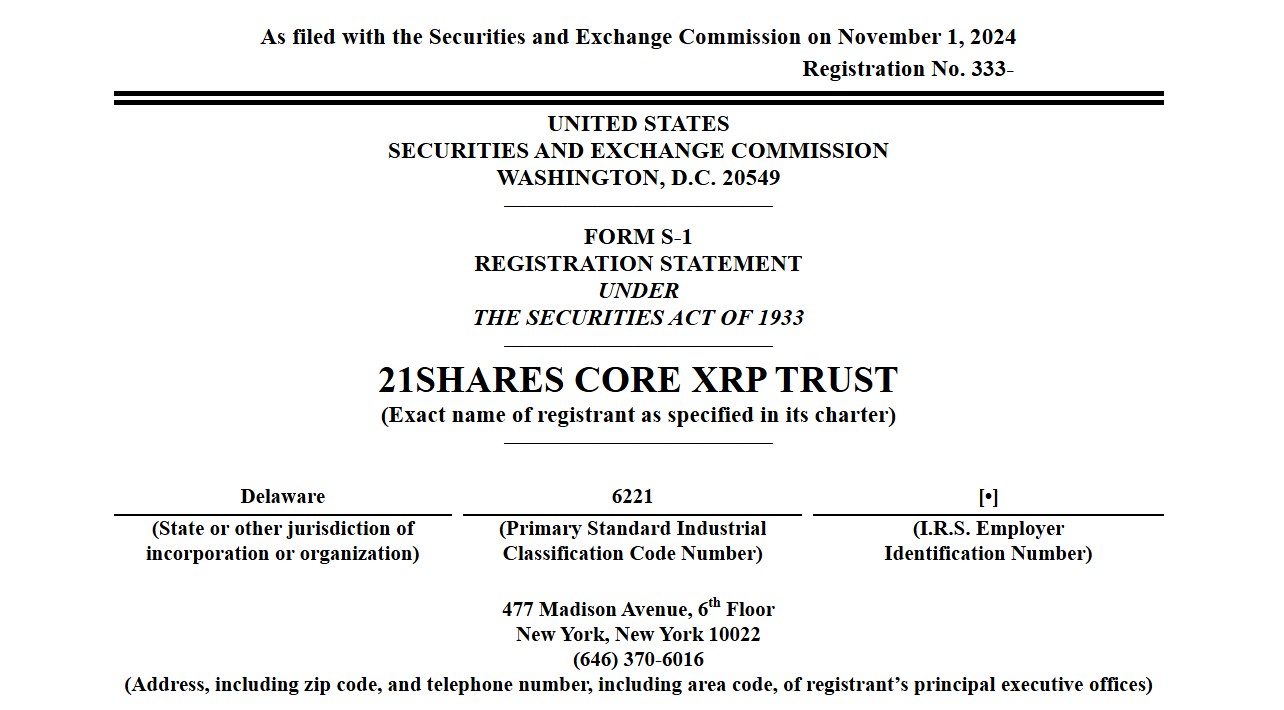 This application marks the third time a company has attempted to launch an XRP ETF. Source: SEC.
The good performance of ETFs has a direct impact on the price of the underlying asset, in this case XRP.
Because of the way they work, the companies that manage them must keep the asset in their treasuries to back their actions. Thus, by simple law of supply and demand, this causes their price to rise.
4. States sue the SEC for persecution
The attorneys general of Kentucky, Nebraska, Tennessee, Virginia, Iowa, Texas, Mississippi, Montana, Arkansas, Ohio, Kansas, Missouri, Indiana, Utah, Louisiana, South Carolina, Oklahoma and Florida joined forces to file a lawsuit against the SEC and its commissioners.
In the brief, they argue that the regulatory body overstepped its constitutional boundaries and unfairly persecuted the cryptocurrency industry.
While the potential departure of Gary Gensler would mark the end of that pursuit, the lawsuit has future relevance, as it could set significant precedents for cryptocurrency regulation in the United States.
A favorable ruling, moreover, would not only benefit companies in the sector, but would set clear limits for future regulatory actions. In other words, it serves as a protective shield for the industry, in case new actors emerge with an adverse stance towards digital assets.
In turn, it could reduce the perception of risk associated with investing in cryptocurrencies, which could attract more capital and institutional participation in the market.
5. Pro-cryptocurrency Congress
The Republican Party's big choice allows it to take control of both Houses of Congress. In this way, Trump has the legislative power necessary to carry out his plans from the White House and be able to fulfill his promises with laws to encourage the growth of financial products based on bitcoin (BTC) and the rest of the cryptocurrencies.
An example of this is the FIT21 law, which includes the definition of a series of concepts that were not clear to the industry in that country and which were the reasons for most of the aforementioned lawsuits filed by the SEC. Among them, the elements that allow a digital asset to be identified as a security or commodity stand out.
The FIT21 bill was approved in the House of Representatives, but has not yet been debated in the Senate.
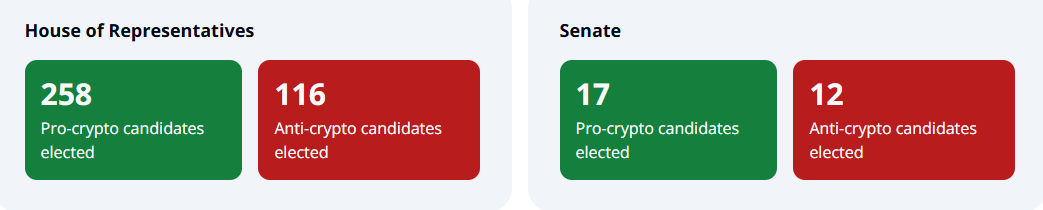 Trump will govern with a Congress that, a priori, is mostly in favor of the adoption of cryptoassets. Source: Stand with crypto.
Finally, it is worth noting that Ripple Labs continues working on the launch of the RLUSD stablecoin, which will run on the Ethereum network and on the XRP Ledger.
This novelty adds to other developments promoted by the firm such as projects for cryptocurrency education and the platform allows governments, central banks, financial institutions and other state entities to issue their digital currencies (CBDC).
After a long nap, the future looks brighter than ever for XRP. Boy, did time fly by!






