
A total of 37 companies worldwide have accumulated at least 1,000 bitcoin (BTC) in their treasuries, consolidating a growing trend of corporate adoption. By reaching this amount of BTC, they can be considered whales. Collectively, over 100 publicly traded companies own 921,388 BTC, reflecting a significant increase in these organizations' exposure to the digital asset.
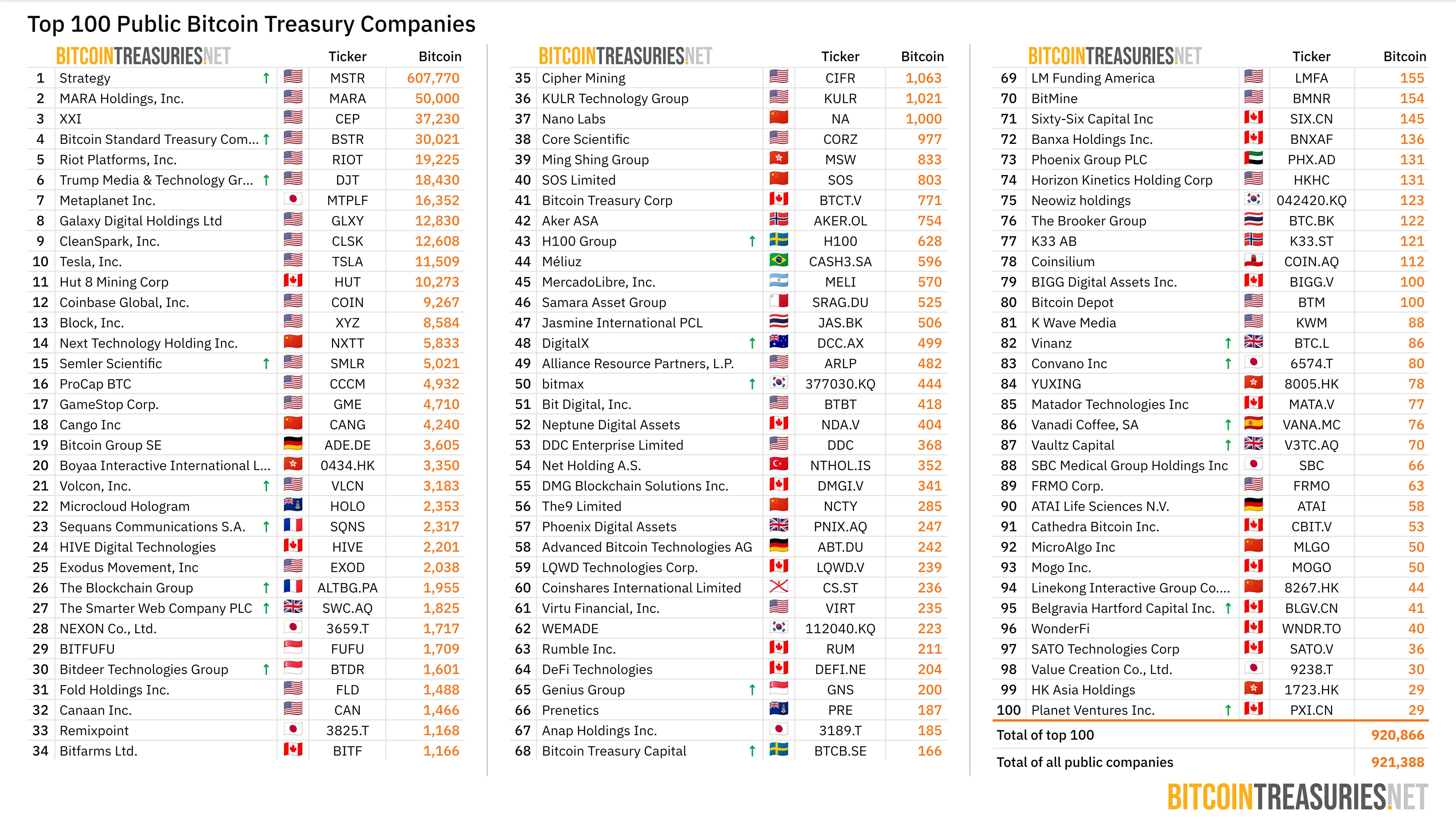 Top 100 companies with the most bitcoin in their treasuries. Source: Bitcoin Treasuries.
In this context, Strategy, led by Michael Saylor, strengthened its position on July 21 with the acquisition of 6,220 BTC, a transaction that involved an investment of $739 million at an average price of $118,940 per unit.
With this purchase, the company increased its holdings to 607,770 BTC, consolidating its position as the third largest holder of bitcoin worldwide, only behind BlackRock's iShares Bitcoin Trust (IBIT) ETF, with 736,943 BTC, and the currency's creator, Satoshi Nakamoto, with 1,123,500 BTC.
To finance these acquisitions, Strategy has resorted to issuing 0% interest-bearing debt bonds with extended maturities. This approach allows investors to bet on the appreciation of the company's stock, as the bonds are convertible into shares at a premium price, a strategy that has inspired other companies to follow a similar path.
For his part, Chris Kuiper, vice president of research at Fidelity, highlighted the diversification of bitcoin purchases. “What I find most interesting is that, from the first to the second quarter, bitcoin purchases were more widely distributed among public companies rather than concentrated among a few large buyers,” he noted.
The growing interest in Bitcoin responds to a challenging economic environment characterized by inflation, the devaluation of fiat currencies, and global uncertainty.
With a limited supply of 21 million BTC, its scarcity positions it as a safe haven against the unlimited issuance of money by central banks. Furthermore, companies see this asset as an opportunity to diversify their portfolios, protect against volatility, and project an image of innovation that attracts new investors in highly competitive markets.






