
Blockchain’s Strongest Treasury Model Ensures Project Longevity
Lack of funding can be the death knell for the brightest ideas and aspirations. In and out of the crypto space, projects with insufficient revenue models fall by the wayside.
Now, there are plenty of other means by which organizations go under. While there are endless “why businesses fail” articles on the Internet, inadequate cashflow tends to float towards the top of everyone’s list.
Funding often leads projects of all sizes to a crossroads. No matter if initial funding came from an IEO, ICO, or personal funds, no money leads to layoffs. Worse still, there may come a time when the startup goes belly up altogether, as some are wont to do.
In the land of crypto, projects with actual products and revenue models are hard to find. Many are stuck in the whitepaper phase.
And many more have no intention of ever doing anything with investor funds other than throwing lavish parties for the core team.
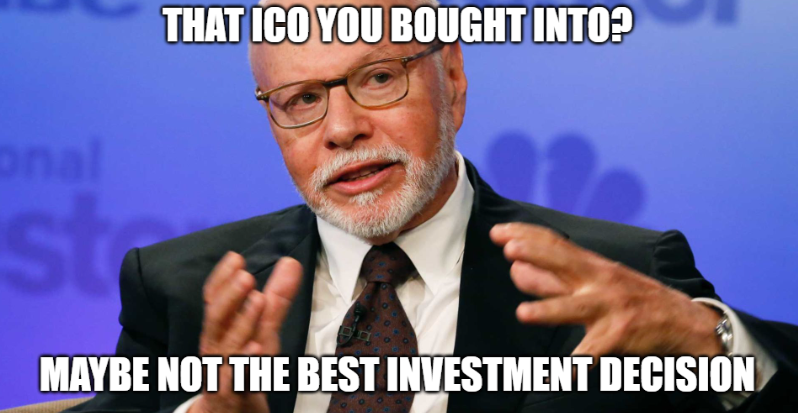
After a year or two rolls by and ICO funds are lost to fancy booze and jet setting, it’s game over. But the not-so-funny thing is how fickle crypto investors are.
If you’re playing by the rules and not investing more than you can afford to lose, you take the hit, forget about it, and move on. The space’s bad actors count on investors to turn and walk away.
Remember that BTC you traded for MadoffCoin? Sorry, bud, you got Bernie’d.
Scams aside, some projects are hellbent on saving the world, but if they don’t build fast enough and get revenue streaming in, the world lives up to its rep as a cruel place.
On the other side of the token are the functional projects that have a legitimate form of income. Without it, development is tough, to say the least.
The project I’m about to share with you has the luxury of launching after Bitcoin and Ethereum brought unique protocols to the blockchain space.
Bitcoin intends to be a payment method and a store of value. But Ethereum, at least until the near-future launch of v2.0, focuses more on self-executing smart contracts.
Modern blockchain iterations examine what works — and what doesn’t — for other chains, then refines and enhances.
Let’s go back a few years, and I’ll give you a brief history of Energi — from the project’s genesis block in 2018, to today’s massive crypto reserves.
But before we dive too deep, check out this quick project synopsis video:
v1.0: Proven to Work
Proof of Work (PoW) and Proof of Stake (PoS) are two of blockchain’s most widespread consensus mechanisms. And the difference is quite simple.
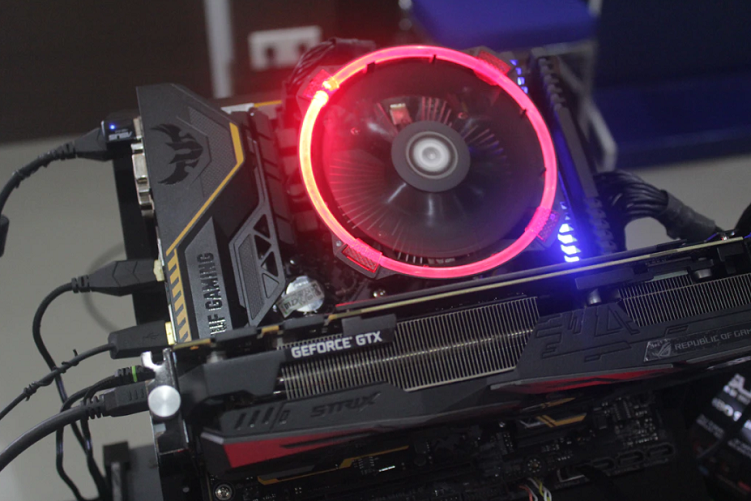
Image courtesy of Reina Kousaka via Unsplash
On PoW chains, node operators use pricey, power-hungry mining hardware fine-tuned to solve complex mathematical problems. The first machine to solve a block’s puzzle gains rewards in the chain’s native currency.
PoS, on the other hand, rewards participants who have a “stake” in the network by holding its coin. The simple act of holding PoS coins in the proper wallet provides staking rewards — paid as a percentage of coins in storage.
Energi began life as a PoW chain
Rather than raise funds by way of ICO (because IEOs weren’t even a thing in 2018), Energi issued coins by allowing miners to harvest its v1.0 PoW chain.
By spreading funds throughout the crypto community, Energi laid the groundwork for the next phase.
v2.0: The Fork
Once sufficient NRG coins were in circulation, the chain hardforked over to Proof of Stake. Hardforking involves a radical network change requiring all nodes and wallet operators to upgrade their software.
Now, NRG is not only a PoS coin, but the cryptoasset offers some of blockchain’s best HODLers rewards. At 23%, NRG vastly outperforms most of today’s staking coins.
While some projects offer much higher rewards, they tend to coincide with the inability to trade. In other words, NRG offers the highest liquid staking returns in all of crypto.
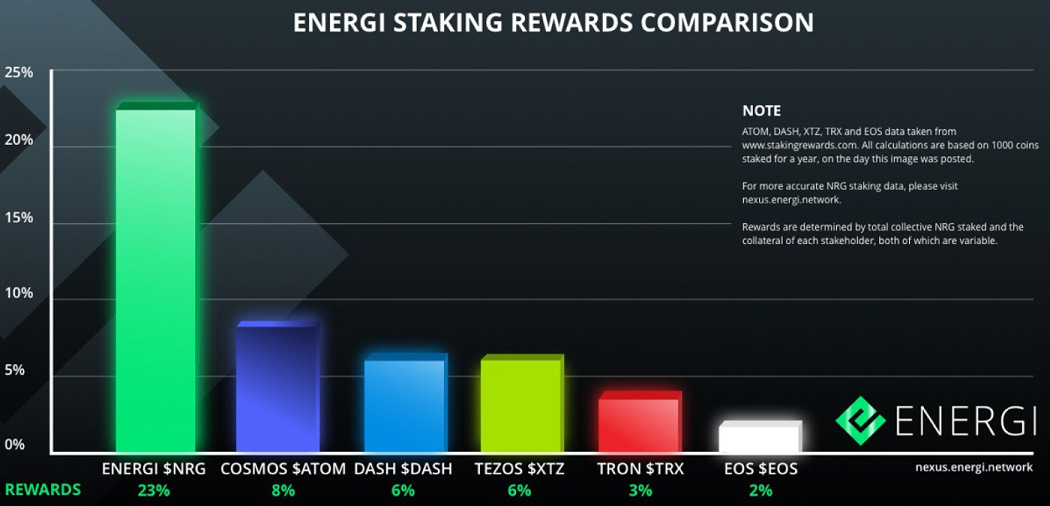
Have you ever seen anything that high from a central bank? No, you haven’t. And you never will. Unless your bank offers staking as a service, which, at the moment, only occurs in the DeFi space.
Masternodes
For those with the technical prowess and enough NRG, masternodes offer the chance to earn even greater rewards than staking. Masternode rewards on the Energi network currently sit at 33% — almost double the nearest competitor.
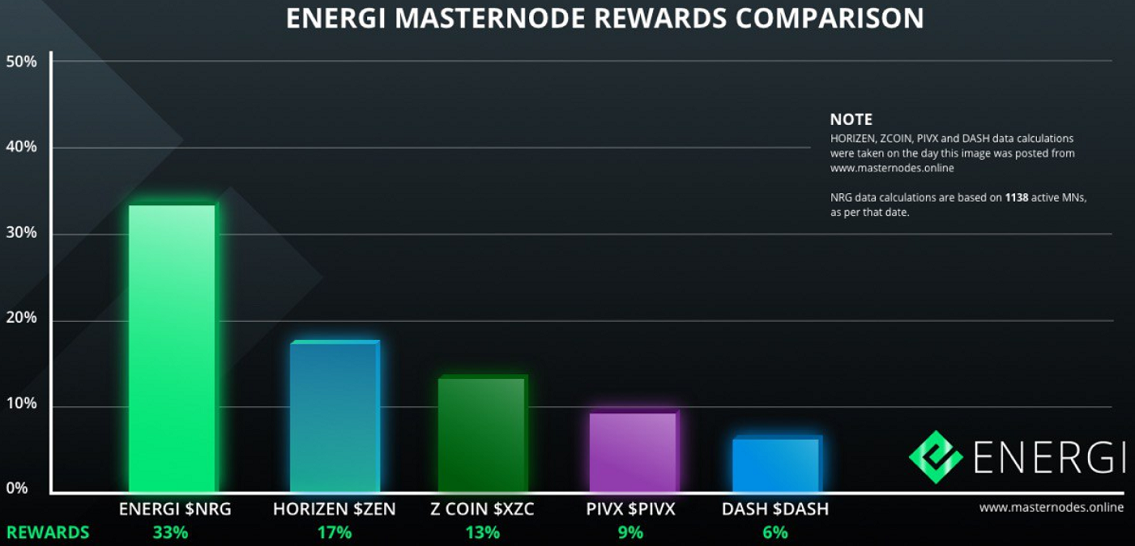
The combination of staking and masternodes means there are rewards to be available for technophiles and passive investors alike.
The Earndrop
Airdrops are a common method for growing a crypto community. Well, in theory, anyhow. Dropping a few illiquid coins into a wallet is easily forgettable.
But when the coin is from a top-100 project trading on multiple exchanges, participants tend to pay attention. Throughout several rounds, dependent upon geographic location, the Energi team gave thousands of participants 100 NRG coins apiece.
Since NRG is a volatile asset, the price continually fluctuates. However, after all was said and done, the Earndrop program gave away roughly U.S. $6M in coins at the time of distribution.
If you were an Earndrop participant and still have those coins, their value is over $250 at the time of writing.
Not a bad deal in exchange for completing a few tasks on social media! Plus, in the process of giving away all that value, the project also realized a jump in new community members.
v3.0: The Migration
March 2020 saw Energi transition to a smart contracts platform similar to Ethereum. The new framework runs in Solidity — the same programming language used by Ethereum developers.
A familiar codeset opens the door for devs to build decentralized applications on the Energi platform. Anything that can run on Ethereum can run on Energi v3.0.
But it’s not all about the devs — the new Energi platform is built for users, too. Here are a few notable upgrades:
-
Decentralized Governance
Anyone can propose an upgrade to Energi’s network, and if the proposal has merit, the community votes. Stakeholders can vote on what receives funding to push the platform forward.
-
Improved Wallets
The move to an ETH-based protocol gives Energi the ability to integrate with existing ETH wallets like Trust and MetaMask. Coming soon to the Energi network are crypto wallets that don’t force users to sync with the entire blockchain.
Everything you just read is fairly common for projects launching in 2018 and beyond. But there’s one item that no other project has. Something that sets Energi apart and gives the project an enormous edge over the competition: a self-funding mechanism.
Crypto’s Deepest Treasury
Every month, the Energi chain’s block rewards release 1M new NRG coins. Of those, 400k go straight to the treasury.
Since the USD value depends on conversion rates, the figures fluctuate from month to month. But from January through May 2020, Energi’s treasury deposits soared past $4M.
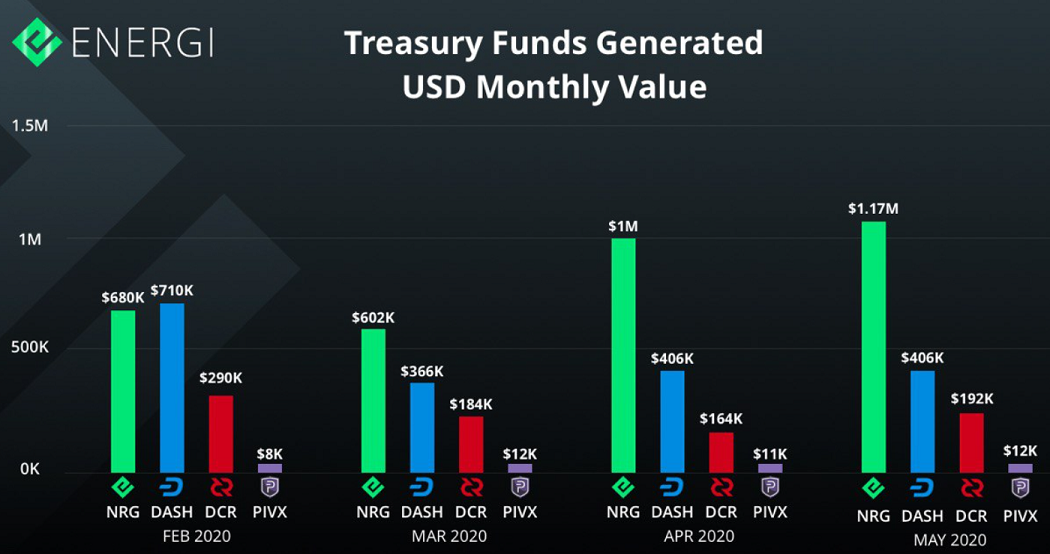
Last month alone, the treasury added $1.17M to its reserves! Energi reinvests treasury funds into the ecosystem to further project development and maintain current initiatives. How do you think your favorite project would fare with the same cash infusions?
Click here to see where Energi’s spends its treasury funds.
Do you see the self-perpetuating growth cycle at play here? Every month presents a new injection of capital. Continual reinvestment makes Energi stronger and more durable over time. There’s a strong AI-empowered machine-learning vibe here.
Unlike projects that barely scrape by and hope to get a single listing on a major exchange, Energi set itself up with exchange funding from the project’s onset. And today, NRG trades on seven different exchanges, including DigiFinex and HitBTC.
And if you’d rather not deal with a staking wallet that requires syncing with the Energi blockchain, KuCoin offers a soft staking service paying passively. But since the service is with a centralized entity holding your private keys — unlike official Energi wallets.
Conclusion
We didn’t even touch upon a couple of Energi’s divisions, Defense and Impact, each of which warrants another article. Yes, the treasury funds their activities as well.
Near-future plans include Energi X, the project’s fee-less, staking-friendly crypto exchange. We may even see NRG-based stablecoins and stable assets upon the exchange’s launch.
Having cash on hand to pay for coding, cybersecurity, marketing — and even charity — bodes very well for Energi’s scalability and sustainability.
Energi’s growing treasury accelerates the project’s goal of mass adoption. And with $2M+ flowing into the ecosystem over the past two months alone, the project’s brilliant construction is poised to turn that dream into reality.





