
Back in 2017 and 2018, the crypto industry looked nothing like it does today.
Names like EOS, NEM, Lisk, Qtum, and Wanchain were considered among the future leaders of blockchain. Several reached the Top 20 by market capitalization, raised hundreds of millions of dollars, and were expected to compete with Ethereum.
Fast forward to 2026.
Most have faded from the spotlight.
Meanwhile, projects like XDC Network, XRP, Hedera, Quant, Ethereum, and Chainlink continue to remain relevant as enterprise adoption becomes the next chapter of crypto.
The obvious question is...
What changed?
The ICO Boom Created Giants Overnight
The 2017 ICO cycle rewarded ambitious whitepapers more than working products.
Investors poured billions into blockchain startups hoping to discover the next Ethereum.
Some of the biggest winners included:
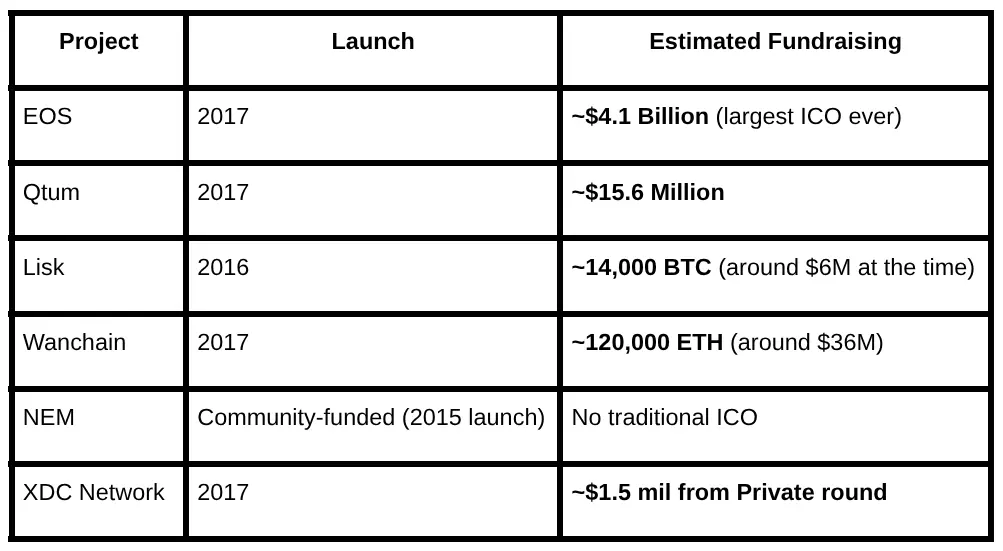
Ironically, raising the most money didn't guarantee long-term success.
Where Things Started Going Wrong
EOS — The $4 Billion Blockchain That Lost Momentum
EOS created buzz with the largest ICO in crypto history.
It promised fast transactions, zero fees, and an Ethereum alternative capable of mass adoption.
Yet a number of challenges slowed its growth:
-
Governance disputes
-
Declining developer activity
-
Limited DeFi ecosystem
-
Increasing competition from newer Layer-1 networks
Today, EOS has undergone rebranding and ecosystem restructuring, but it never fulfilled the expectations created during its record-breaking ICO.
Lisk — JavaScript Wasn't Enough
Lisk attracted developers by allowing blockchain applications to be built in JavaScript.
It sounded revolutionary.
The problem?
Developer adoption never reached critical mass.
While Ethereum expanded into DeFi, NFTs, and Layer-2 ecosystems, Lisk struggled to attract builders at scale.
NEM — Early Innovation, Limited Evolution
NEM introduced several innovative concepts years before many competitors.
However, innovation alone wasn't enough.
The ecosystem expanded slowly, enterprise adoption remained limited, and newer smart contract platforms eventually captured developer attention.
Wanchain — Ahead of Its Time
Long before interoperability became one of crypto's hottest narratives, Wanchain was already building blockchain bridges.
Unfortunately, timing matters.
The infrastructure, liquidity, and institutional demand simply weren't mature enough.
Today, interoperability is thriving—but newer ecosystems dominate the conversation.
Qtum — Solid Technology, Weak Narrative
Qtum combined Bitcoin's security model with Ethereum's smart contracts.
Technically, it was a respectable project.
Commercially, it struggled.
Without strong ecosystem growth or major enterprise adoption, Qtum slowly lost visibility as newer Layer-1 blockchains captured developer attention.
Why XDC Took a Different Path
Unlike many projects chasing retail hype, XDC Network focused on enterprise adoption from the beginning.
Instead of competing for meme coin attention or speculative narratives, XDC invested in areas that traditional finance increasingly cares about:
-
Trade Finance
-
Real-World Asset (RWA) Tokenization
-
Cross-border Payments
-
ISO 20022 compatibility
-
Enterprise blockchain infrastructure
-
Low-cost, high-throughput transactions
-
EVM compatibility
Interestingly, many of these sectors weren't popular during the ICO boom.
They became major narratives years later as institutions began exploring blockchain technology.
Rather than pivoting every market cycle, XDC largely stayed aligned with its original vision.
The Market Is Rewarding Builders Again
Crypto in 2026 looks very different from crypto in 2017.
The conversation has shifted from:
-
"Which coin will 100x?"
to
-
"Which blockchain is actually being used?"
Institutional investors now pay closer attention to:
-
Developer activity
-
Enterprise partnerships
-
Tokenization
-
Stablecoin infrastructure
-
Regulatory readiness
-
Real-world adoption
Projects that continued shipping products—even during bear markets—are generally in a stronger position than those driven primarily by marketing.
The Bigger Lesson
History shows that capital alone doesn't create longevity.
EOS raised over $4 billion.
Many competitors raised hundreds of millions.
Yet years later, several have lost much of the influence they once held.
The projects still shaping today's market tend to share a different characteristic:
They kept building after the headlines disappeared.
Whether it's XDC in trade finance, XRP in payments, Hedera in enterprise DLT, Quant in interoperability, or Ethereum in smart contracts, the common thread isn't hype.
It's persistence.
Perhaps that's the real lesson from crypto's last decade.
The biggest ICO isn't always the biggest winner. The longest builders often are.
Disclaimer
This article is for informational and educational purposes only and should not be considered financial or investment advice. Fundraising figures are based on publicly reported historical data and may vary slightly across sources. The projects discussed are referenced to examine long-term industry trends and do not constitute endorsements or investment recommendations. Readers should conduct their own research before making financial decisions.






