Wall Street is attempting to stabilize after a volatile week marked by renewed inflationary pressures, a steep decline in the semiconductor sector, and increasingly rigorous scrutiny over how the Artificial Intelligence boom is being financed. With Brent crude firmly above $105 per barrel and military tensions escalating around the Strait of Hormuz, the market points to one undeniable conclusion: the primary problem is no longer just inflation, but the actual capacity of corporations, households, and governments to endure persistently elevated capital costs.
1. United States: Energy-Driven Inflation and Labor Softening
Markets are grappling with a challenging macroeconomic triad:
* Upstream Cost Pressures: CPI held at 3.7%, while the Producer Price Index (PPI) surged 1.3% MoM (seasonally adjusted) and 6.3% YoY (unadjusted). Final demand goods jumped 2.6% on the month, driven by a 10.8% surge in the energy component—which accounted for over 80% of the increase in goods prices.
* Fed Policy Tightening: Following September's rate hike to the 3.75%–4.00% target range, markets price in a 72% probability of a pause in October, but a decisive 92% probability of another 25 bps hike in December.
* Labor Market Fatigue: September Nonfarm Payrolls added just 29,000 jobs as the unemployment rate ticked up to 4.2%.
2. The Hidden Signal in the Treasury Market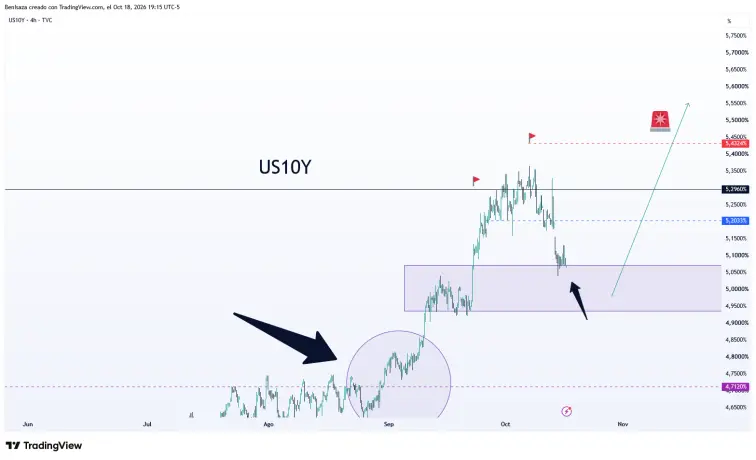
Under normal conditions, hotter inflation data would drive bond yields higher across the curve. Instead, after touching 5.33% on Wednesday, the 10-year US Treasury yield reversed sharply lower, consolidating between 5.08% and 5.10%. This anomaly signals that fixed-income investors are discounting a far deeper risk: the threat that further monetary tightening will fracture the AI capital expenditure (CapEx) cycle and trigger a corporate credit stress event.
3. From Tech Valuations to Credit Stress: The Case of CoreWeave
While headline index gains mask underlying fragility—with the Philadelphia Semiconductor Index (SOX) posting its eighth consecutive losing session and the VIX spiking over 27%—institutional attention has shifted to balance-sheet leverage:
* Industry-Wide Warning: Gartner cautioned against up to $3.5 trillion in potential accounting write-downs across neocloud and AI projects.
* Credit Alarm Bells: CoreWeave (CRWV) shares slid sharply while yields on its unsecured bonds crossed above 15% in the secondary market. Despite strong revenue growth, its total debt tripled over the past year (reaching approximately 6.8x revenue and 134% of market cap, compared to an S&P 500 average of 20.2%), accompanied by a negative free cash flow of -$13.66 billion and an RSI compressed to 18.85.
4. Geopolitics and Safe-Haven Capital Rotation
With the Strait of Hormuz conflict anchoring Brent above $105, geopolitical friction has filtered directly into corporate operating margins. While European equities show relative resilience and Japan digests historical intraday swings, institutional capital is actively rotating into sovereign debt, defensive sectors, and gold.