
The "Bitcoin Ponzi Scheme" narrative is a common criticism that paints Bitcoin as a fraudulent investment scam that relies on attracting new participants to sustain its value, rather than having intrinsic worth. It has been made as an example of the "The Greater Fool Theory", in which those who invest late pay the money to those who invested earlier.
The "Bitcoin Ponzi Scheme" Narrative
The argument is that Bitcoin's value is solely based on speculation and the influx of new buyers. It is the early adopters who profit by selling their Bitcoin to later entrants, creating a pyramid-like structure.
They often point to Bitcoin's price volatility as evidence of its speculative nature.They may also highlight the lack of traditional "intrinsic value" like that of a company's earnings or a commodity's utility.
The narrative suggests that Bitcoin is destined to collapse once the flow of new buyers dries up, leaving latecomers with significant losses. This will bring the realized value of BTC (Bitcoin's native currency) to 0, which will be a collapse similar to the "Tulip Bubble" of the 17th century.
Debunking The Narrative
The narrative can be debunked with the following rebuttal:
Bitcoin is not a Ponzi Scheme because it provides full transparency of funds with no future obligations of returns. It is a decentralized payment network that has no organized structure that controls the currency issuance, and it is an open distributed system that can be checked for verification.
The following 4 reasons further explains the rebuttal statement:
- Transparency: Bitcoin uses a blockchain, which is a public ledger database. It allows anyone to verify all transactions and the total supply of the currency or funds. True Ponzi schemes are opaque and secretive, using deceptive means to manipulate information.
- Decentralization: Bitcoin has no central organizer or promoter guaranteeing returns. Ponzi schemes rely on a central figure promising unrealistic profits. Bitcoin does not have a ring leader promoting a service or soliciting money, it is all voluntary based on ideological principles about money.
- No Promised Returns: Bitcoin's price is determined by market forces, and there are no guaranteed returns. Ponzi schemes promise fixed or exceptionally high returns. Bitcoin has no promise of future gains, other than the belief in Bitcoin as a form of money that offers an alternative to the traditional financial system.
- Open-Source and Verifiable: Bitcoin's code is open-source, which can be viewed by the public. Ponzi schemes operate in secrecy with the intent to commit fraud. They offer false promises to their investors, who in turn believe and trust in those who are promoting the scheme. None of the sources of a Ponzi scheme are truly verifiable. Investors trust it until someone digs deeper to discover red flags.
What Bitcoin Is
Proponents can argue that Bitcoin has actual utility with a value proposition. Ponzi schemes are great at pushing ideas with social media marketing and paid promotions. It has a leadership structure that gets orders from the top. Bitcoin has no such organization where orders are dictated.
Bitcoin has evolved from the white paper in 2008, which many people had begun to interpret based on the principles of Austrian economics, free trade, and the Libertarian philosophy of less government control of money. It continues to take ideas from its new proponents, that contribute to its strength and growing adoption.
The decentralized network of Bitcoin further proves that it is not being coordinated by one or a few entities, but by a whole community based on a consensus mechanism. No one is above anyone else on the Bitcoin network, they are all peers that make decisions together. Therefore, a scammer cannot rug pull the money since there are checks and balances in the system that prevent this.
The Bitcoin network is a peer-to-peer payment system that does not require intermediaries for processing transactions. A Ponzi scheme does not offer any utility other than taking money and not creating value that will sustain the system. Bitcoin creates money through an incentive structure from utilization of its network in validating and securing transactions.
How A Ponzi Works
There is no universally accepted formula for a Ponzi scheme, but here is a simple example:
x = Payouts to Early Investors
y = Funds from New Investors
x = y
This requires an ever-increasing influx of new participants (y) to sustain the scheme, which pays the early investors (x). As x accumulates in value, you will notice that is due to funds coming in from new investors and no other sources.
There is a geometric progression in the growth of investors in a Ponzi.
- Let 'N(t)' be the number of investors at time 't'.
- Let 'r' be the rate at which new investors are recruited (a factor greater than 1).
- Then, N(t) = N(0) * r^t
This formula shows that the number of investors grows exponentially over time, which is a hallmark of a Ponzi scheme. It is exponential because the interest and popularity has increased, and more people are joining the network.

The payouts to early Investors can be modeled by the following statements:
- Let 'P(t)' be the total amount paid out to early investors at time 't'.
- Let 'I(t)' be the total amount invested by new investors at time 't'.
- In a Ponzi scheme, P(t) is directly related to I(t), not to any actual profits.
The problem arises when the growth of new investors (r) cannot be sustained. Eventually, the amount needed to pay existing investors exceeds the amount coming in from new investors.
This can be represented as:
- When I(t) < P(t), the scheme collapses

Going back to our earlier example, the scheme begins to collapse over time when y < x. This is when the formerly new investors become the new early investors, and this time they expect their payout. When the system collapses it is the new early investors who suffer, as soon there is no more money coming in from the newest investors.
Do Bitcoin Charts Resemble A Ponzi?
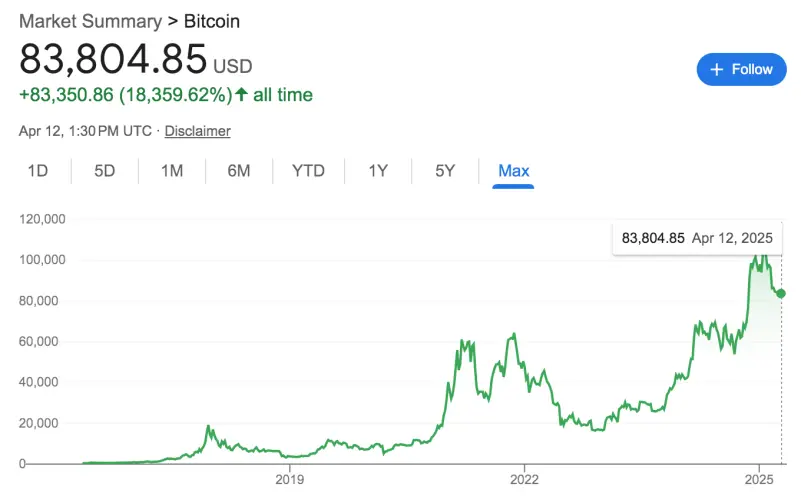
The Bitcoin charts show cycles in which there are dips and peaks, but it does not follow the traditional Ponzi pattern. It may resemble a sudden exponential spike, but there is a recovery. Bitcoin price discovery leads to higher highs over time.
If Bitcoin does go to zero in the future, does that prove it's a Ponzi?
That is not any proof of a Ponzi since any type of system that requires a constant flow of liquidity and utility can also fail and go to zero. What is absent from a Bitcoin network compared to a Ponzi network, in mathematical terms, is that it does not require giving money to a recruiter who directly pockets the money. Bitcoin has a total marketcap that is traded on a spot market.
The resemblance to a Ponzi scheme pattern can be explained based on basic money flows. Both systems gain value from new investors, but a Ponzi does not distribute the value to the network. Ponzi pays those at the top of the pyramid in their hierarchy. Bitcoin distributes the value to all investors, so no matter how small an amount of BTC you own, you gain when BTC is bought on the spot market.
Bitcoin vs. Ponzi
In a Ponzi scheme there is no real value proposition or genuine idea. If Bitcoin were a scam there would be no network creating value and providing resources to maintain its operation and security.
As for the statement that Bitcoin is a Ponzi that will collapse, it has already crashed many times but made dramatic recoveries to achieve even higher highs in price value. The life of Bitcoin is full of cycles of accumulation, consolidation, buying, and selling that occurs due to certain events that influence human behavior.
In contrast, when a Ponzi collapses, it never returns. It either loses all value or is shut down by law enforcement. That has not happened to Bitcoin even during its worst crashes.
A Ponzi is usually an organized system that includes solicitors who try to convince people of ridiculous money making pyramid networks (e.g. Bitconnect). Bitcoin is driven by an open market where anyone can be a promoter, but does not require payment from any of the people they convince to buy BTC. If they are soliciting fees, that is wrong and more likely opportunistic, but the Bitcoin network does not work that way.
It is valid to say that Bitcoin will lose value if no more users are buying in, which will also happen to any financial system if there are no longer any users. The point here is that the purpose of Bitcoin is not putting money to pay other users who came before you, it is about the utility that the network brings to its users.
Adoption of Bitcoin as a payment system and the belief of its properties as a form of money is what keeps Bitcoin alive. Bitcoin will continue to exist as long as the network effect continues its utilization.
Realized And Unrealized Value
BTC is finite, and capped to a fixed total supply that cannot be changed since it is written into the software protocol code on the network. When you buy BTC it is personally yours for life as verified on a blockchain. You don't give money for Bitcoin to give to another person, you are transferring value for a digital asset.
The value is what you are willing to pay based on market price. Once you have BTC, that is an asset that is yours to keep.
We can end the comparison there that Bitcoin involves the purchase of a digital asset, while Ponzi is about giving money to a scam investment. The next thing we need to discuss is that Bitcoin is also a form of currency, that has both a realized and unrealized value while in Ponzi schemes, it is only a realized value.
In Bitcoin the new investors can be less than early investors, and vice versa. In the end, if you have 5 BTC, it is 5 BTC as recorded on a blockchain. This means it does not require any new investors to put in more money by buying BTC as long as there are existing BTC users.
In a Ponzi, you can lose your all your money when a rug pull occurs. With Bitcoin there is no way a rug pull can be performed since your 5 BTC belongs exclusively to you and cannot be taken by anyone else, provided the BTC is in your personal wallet.
When people think in terms of fiat currency, it is much different and this is where some people get the impression of a Ponzi scheme. When you invest in fiat $5,000 to buy 1 BTC, then your 1 BTC = $5,000.
If BTC value goes down, you have not lost any Bitcoin since you will still have 1 BTC. However, the fiat value has gone down to $3,500 and is a loss of $1,500. That is an unrealized loss, and it can recover to an unrealized gain once the market liquidity returns to an uptrend. Losses only become realized in Bitcoin when you sell your BTC.
In a Ponzi, losses can immediately be realized the moment you give your money. The difference is that with Bitcoin you can recover losses because they are unrealized. An unrealized loss can be recovered once the market improves and become a realized gain when BTC is cashed out. A Ponzi is an immediate realized loss that has no path to recovery other than with the help of law enforcement to catch those who were involved in the scheme.
Synopsis
There is no proven evidence or claim that Bitcoin is a true scam, specifically a Ponzi scheme. There are more favorable arguments to counter the narrative that Bitcoin is a financial crime. The properties of transparency, decentralization, utility, and market-driven economy, are the arguments that effectively counter the Ponzi scheme narrative.
Bitcoin distributes the value to its network. A Ponzi scheme concentrates wealth creation to those at the top of their organization's pyramid, which is highly centralized. Even a decentralized Ponzi scheme is not what Bitcoin is because the Bitcoin network functions on a consensus mechanism with rules for an incentivized system to participants.
Bitcoin has existed for over a decade and has survived numerous market cycles. This longevity challenges the notion of a short-lived Ponzi scheme. A Ponzi usually falls apart when its centralized organization begins to dump money on its investors.
The ownership of BTC is not heavily concentrated to one person that can influence the value of the asset. Preventing large holders or whales from dominating control was the reason for having a decentralized model.
The "Bitcoin Ponzi Scheme" narrative often relies on mischaracterizations and a lack of understanding of Bitcoin's technology and economics. While Bitcoin is a speculative asset, it possesses unique characteristics and potential utility that distinguish it from fraudulent Ponzi schemes.
Whether or not Bitcoin will be exposed as a Ponzi scheme is not known. For now there are strong counterpoints for the harshest critic to consider.
***************
For more about Bitcoin and Ponzis, read my article "Bitcoin vs. Ponzi Scheme" on The Data Driven Investor
For more about Bitcoin and other financial crimes, read my article "Bitcoin And Financial Crimes" on the The Bitcoinist
Disclaimer: This is not financial advice. This article makes strong counterpoints to Bitcoin being a Ponzi scheme. If it is a Ponzi scheme there must be evidence to conclusively prove this. The information provided is for reference and educational purposes only. Investing in cryptocurrency like Bitcoin involves risk. Please DYOR to learn and understand more about cryptocurrency.






